Get Full Government Meeting Transcripts, Videos, & Alerts Forever!
Get email alerts on the Strategic Plan topic
No spam. Unsubscribe anytime.
Dubuque schools outline five strategic‑plan priorities focused on graduation tracking, instruction and staffing
Summary
District leaders presented five strategic priorities—graduation tracking and family conferences; instructional practices and standards‑based grading; behavior and attendance supports; facilities planning; and staff recruitment—along with action steps, timelines and community events. The board approved the meeting agenda and no formal policy was changed.
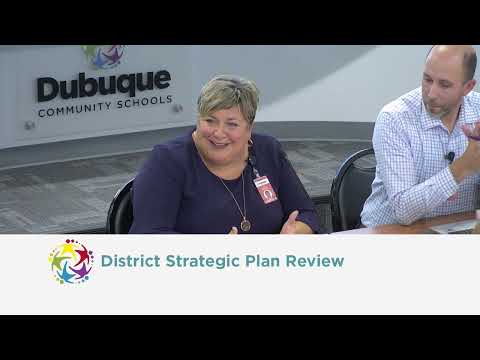
Superintendent Hawkins presented a new format for the district’s strategic‑plan updates and walked the board through five priority initiatives for 2024–25, saying the district will report progress in October, February and May and set new priorities each August.
The first priority aims to “strengthen and systematize how the district tracks, monitors, and shares student progress toward graduation,” Hawkins said, introducing two initiatives: rethinking parent‑teacher conferences to add a focus on graduation progress and post‑graduation plans, and expanding post‑secondary planning and ICAP work to reach more students.
Mark Burns, co‑facilitator of the conferences and post‑secondary teams, told the board a committee of roughly 30 members—including school staff and community partners—has met twice and is organizing action planning around three areas: content (what a highly engaged conference looks like), structure (virtual vs. in‑person timing) and communication to families. Burns said the committee will hold follow‑up meetings and that recommendations are scheduled to come forward in March for implementation in the 2025–26 school year.
On instruction, the district said it will study standards‑based grading at the middle‑school level. Burns described standards‑based grading as focusing on mastery of standards instead of averaging letter grades and noted the district is examining local research and conducting a gap analysis of teacher knowledge and needs before any shift is implemented.
District leaders also reviewed professional learning tied to diagnostic data. Presenters said the district is in its third year of using the i‑Ready diagnostic for K–8 and has provided professional development so teachers and building leadership teams can interpret growth data, plan interventions, and find resources within the platform. The district is sending a small leadership team to an I‑Ready Leadership Academy and will follow up with building‑level work and additional i‑Ready sessions in February.
Priority 3 focuses on minimizing barriers to learning, including behavior solutions and attendance. A district presenter described a Behavior Solutions rollout and an MTSS framework for behavioral supports; the district plans a support‑staff symposium (transportation, food service and paraprofessionals) featuring Dr. Jacob Priest from the Scanlon Center as a keynote speaker.
On attendance, the district said it will align local practices with recent state guidance while emphasizing family‑centered approaches and positive incentives. An example at Lincoln Elementary awards a token for present and on‑time attendance, with prizes or additional recess as rewards. The district will issue guidance to families and hold a multicultural family engagement night on Dec. 5 to highlight attendance and career‑readiness topics.
Leaders also announced a small district advisory group to study student cell‑phone use and its impact on learning and mental health. The advisory group includes administrators, teachers, two high‑school students and three parents; it met Oct. 2 and has five meetings scheduled between December and April. The group will survey students, staff and families and track state legislative activity before recommending district policy changes. "This is really a brain health, mental health issue as well too," a staff presenter said of the cell‑phone discussion.
Priority 4 calls for updating the district’s 10‑year capital facility plan with the architect firm Envisions to examine enrollment, finances and possible options including a bond referendum. Priority 5 focuses on staff recruitment, onboarding and a leadership pipeline; the district plans its first district career fair in January to attract candidates.
Board members thanked staff for the new format and the depth of the work. The board approved the meeting agenda at the start of the session; no additional votes on policy were recorded. The meeting concluded with an acknowledgement of Kevin Kelleher’s final strategic‑planning meeting with the district and a discussion about voucher research cited by a board member.