Get Full Government Meeting Transcripts, Videos, & Alerts Forever!
Get email alerts on the Residential Tax Exemption topic
No spam. Unsubscribe anytime.
Concord working group: survey shows residential tax exemption helps homeowners but funnels dollars to higher-value properties
Summary
A working-group review of a town survey found Concord's residential tax exemption (RTE) is effective at reaching homeowners (including many lower-income owners) but inefficient because a large share of benefit dollars go to homes valued above $1 million; members directed follow-up (landlord interviews, assessor data, cohort cuts).
John, chair of the Concord RTE Working Group, told members the residential tax exemption is “very effective” at reaching homeowners but that the program is not efficient because many recipients are higher-value properties.
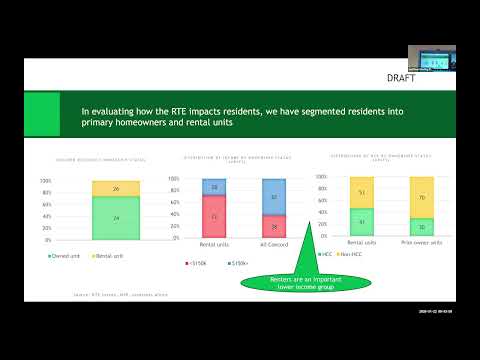
The group reviewed draft slide analysis of a resident survey and comparable housing-production data that found roughly 74% of responding units were owner-occupied and 26% rental. Presenter Flora said 95% of lower-income homeowners who live in their homes benefit from the RTE on a unit basis, but on a dollar basis about 61% of the program's value flows to properties worth more than $1 million — a distribution that concentrates benefits away from the program's intended targets.
“This is not particularly efficient,” Flora said, adding that survey results and assessor valuations indicate non-qualifying parcels account for the vast majority of RTE funding in the draft analysis. “We're giving a lot of money to people who we're not trying to target,” she said.
Why it matters: The working group is producing a report for the Select Board that must weigh two separate questions: whether the RTE achieves its statutory goal for homeowners (the program appears to do so) and whether the outcome aligns with broader town priorities for economic diversity and renter protections (the analysis raises concerns).
Key evidence and planned follow-ups
- Representation and methods: Flora cautioned the slides are a draft based on survey responses and not yet merged with assessor records; the survey skewed toward lower-income respondents but yielded enough renter responses (about 43) to draw preliminary observations. The group agreed to perform sensitivity tests on income cut points (the draft used $150,000 as a breakpoint) and to add residual-income measures where useful.
- Distribution of benefits: On a unit basis the RTE reaches many lower-income homeowners, but on a dollar basis the majority of the benefit accrues to homes above $1 million. Flora's slide set estimated roughly 61% of program dollars go to those high-value homes and that RTE-qualifying homes above the program's breakeven fund about 11% of the exemption while non-qualifying parcels fund roughly 80% (survey-based figures that the group will refine using assessor data).
- Who pays and landlord pass-through: The presenters flagged a draft estimate that landlords account for a meaningful portion of non-qualifying funding (a directional range of about $800,000 to $1 million in transfer value). The group agreed to interview large property owners and management companies confidentially to better assess whether tax increases are passed through to tenants and, if so, by how much.
- Impact on renters: Flora cited literature and local reporting showing tax increases can correlate with higher rents; she warned that if landlords pass through tax changes, renters could be harmed even though the RTE statute targets homeowners.
- Policy alternatives and equity considerations: Members discussed other tools (clause 41C and a half, circuit-breaker tax credits, senior means-tested exemptions) and noted many of those options target seniors/homeowners and would not directly help younger renters. The group debated whether to frame the evaluation strictly around the RTE statute (homeowners) or more broadly around resident affordability (including renters).
- Data and next steps: The working group asked staff to provide assessor flags and address lists (to identify LLCs and nonresidential billing addresses), asked Meredith to pull counts and missing numbers, and assigned Ellen and John to refine landlord-dollar estimates. Members also requested targeted cuts by age and tenure, and planned to extract verbatim interview excerpts that illustrate seniors' experiences.
Quotes
"95% isn't just that is wildly effective," John said of the baseline homeowner reach; "but half of the people benefiting are not low income, so it's not efficient."
"We're giving a lot of money to people who we're not trying to target," Flora said, urging further analysis of dollar flows and household cohorts.
"If taxes go up, real-world evidence says rents go up," Flora added when discussing the potential pass-through effect and the need to interview landlords.
Next steps and procedural note
The group set the next meeting for Feb. 5 and directed staff to pull assessor data and to identify the subset of eligible residents who did not apply. The transcript records a motion to adjourn at 09:50, but the meeting record in the transcript does not include a recorded vote on that motion.
Ending
Working-group members said the draft analysis gives the Select Board a clear bottom line to consider: the RTE performs well at reaching owner-occupants the statute targets, but the town must decide whether the program's outcomes — and potential downstream effects on renters and small businesses — are acceptable or require policy changes and additional protections.