
District staff recommend transferring aging district fiber network to WANRAC, citing $4.9M life-cycle savings
Get AI-powered insights, summaries, and transcripts
Subscribe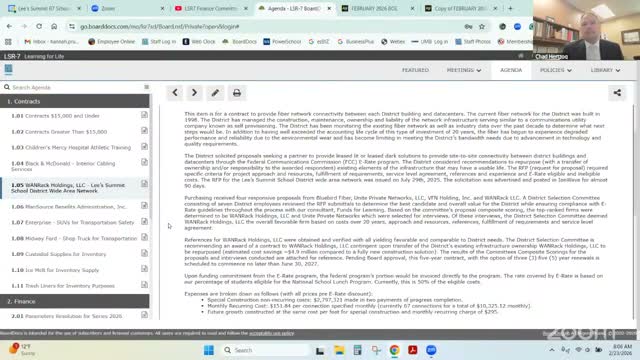
Summary
District staff told the finance committee they recommend transferring ownership of the district’s aging fiber infrastructure to WANRAC after an RFP and E-rate evaluation, saying the move would save roughly $4.9 million over a greenfield rebuild while shifting long-term maintenance responsibility to a specialist vendor.
District staff recommended at the finance committee that the district move forward with a long-term fiber-network plan that transfers ownership of usable existing infrastructure to WANRAC following a competitive evaluation.
The presenter said the recommendation followed an RFP and a seven-member district evaluation committee that examined 20-year cost, service levels and references. "This recommendation is contingent upon transferring ownership of our usable existing infrastructure to WANRAC," the presenter said, adding the selection followed E-rate guidelines and an evaluation of 4 proposals.
Staff told the committee the transaction would use E-rate funds (covering a 50% match) alongside district capital-project funds (Fund 4) and that billing would likely occur in FY28. Staff also outlined required logistics: negotiating an asset-purchase agreement, transferring certain pull-attachment agreements with Evergy, and conveying railroad and city right-of-way items.
Board members asked whether ceding ownership would leave the district vulnerable to a single vendor. One committee member asked whether a vendor monopoly could create risk; the presenter replied transferring ownership actually reduces the district’s exposure to large, unpredictable repair bills, citing prior examples in other districts where cable damage caused six-figure replacement costs. "Doing this is more cost certainty over the course of its life instead of having the constant potential of a big ticket dollar to fix it," the presenter said.
The presenter also described the proposed contract structure and protections: staff said the recommendation was based on a life-cycle view and that the contract envisions a 20-year investment horizon, with an initial term proposed as five years and three renewal options; language is being reviewed with legal and purchasing to protect the district on renewals and E-rate compliance.
Staff estimated roughly $4,900,000 in savings compared with a greenfield build, and said they have additional logistics to work through before any final approval. The committee did not take a formal vote in this meeting; staff said further contract negotiation and documentation (asset-purchase agreement and right-of-way transfers) remain to be completed before a decision is finalized.