Get Full Government Meeting Transcripts, Videos, & Alerts Forever!
Get email alerts on the School Construction Referendum topic
No spam. Unsubscribe anytime.
Architects and former superintendent brief OAKES 41 committee on school-repair options and referendum strategy
Summary
At an OAKES 41 facilities meeting, ICON representatives and former superintendent Travis Jordan outlined steps to convert a failed referendum into feasible projects: validate the facility assessment, run independent surveys, obtain engineering estimates, and prioritize tangible fixes (HVAC, windows, ADA) to rebuild public trust before a vote.
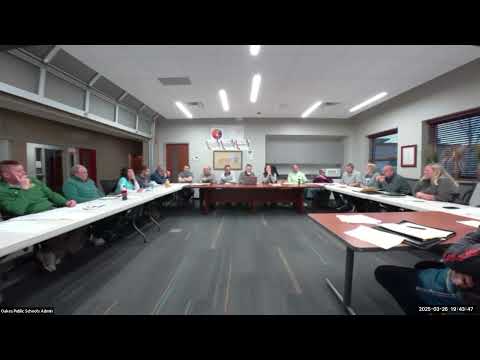
At a meeting of the OAKES 41 facilities committee, representatives from ICON and former Buhl superintendent Travis Jordan advised the citizen advisory group on how to turn a long list of deferred maintenance into a viable funding plan and referendum. ICON urged the district to validate its assessment, use independent surveys to measure public support and obtain engineering cost estimates before placing a new proposition before voters.
Why it matters: the committee faces about $29 million in deferred maintenance and a building fund that collects roughly $460,000 a year. Members said the district’s earlier referendum failed in part because voters questioned line‑item costs and the absence of competitive bids. The group focused on near-term priorities — HVAC, windows and ADA restrooms — as projects that voters can see and understand.
ICON explained procurement limits under state law: contractors can provide informal quotes, but aggregate projects above roughly $50,000 typically require public bidding, and construction projects generally trigger an architect/engineer design threshold (discussed in the meeting as about $200,000) because of life‑safety and liability requirements. An ICON representative said those limits make it difficult to present hard contractor bids before a referendum unless the district pays engineering and design costs up front.
On surveys and community outreach, ICON recommended an independent, mailed survey (not conducted by architects or contractors) that asks residents to weigh specific scope-and-price options. ICON and Jordan described Valley City and Dickinson as examples where multi‑meeting community processes, independent surveys and scope adjustments turned failed votes into successful referenda.
Committee members raised specific cost concerns from the failed ballot: one member cited an $1.8 million estimate for a kitchen remodel from the earlier consultant and asked whether that number was defensible without competitive bids. An ICON representative responded that some items (for example, commercial kitchen hoods and ranges) are nationally standardized and less variable, while other costs (site work, code compliance, sealed bids for public projects) can drive up prices; ICON recommended getting a second engineer’s review to test the figures.
Members explored lower‑cost alternatives. One committee member reported finding a used air‑handler on a marketplace and suggested buying equipment to qualify as repair rather than a larger construction project; others warned that piecemeal repairs could void system design assumptions and create insurance or liability exposures. ICON recommended bringing engineers for a site walk so they could say which repair options were technically feasible and which would carry unacceptable risk.
Finance and timing also shaped the discussion. Participants noted that referendum debt would typically be amortized over 15–20 years and that spending a large portion of the district’s allotment on a single project could limit capacity for other repairs. Several members argued for targeting a single, tangible problem first, proving success, and then returning to voters for subsequent work.
Next steps agreed by the committee: ICON will provide references and contact engineers (including a suggested Prairie Engineering firm) to review the district assessment and, if feasible, join a site visit. The committee also agreed to evaluate an independent survey and to reconvene after engineering feedback and additional cost validation.
The meeting ended with scheduling agreed for a follow‑up meeting next week; members said they want concrete engineering guidance before making budget or referendum decisions.