Get Full Government Meeting Transcripts, Videos, & Alerts Forever!
Get email alerts on the Budget topic
No spam. Unsubscribe anytime.
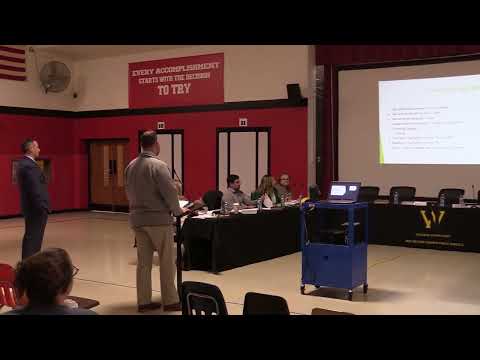
West Milford district warns $9 million-plus state-aid shortfall, outlines program and staffing responses
Summary
District presenters told the board that cumulative state-aid reductions exceed $9 million, described new course offerings and K–12 training, warned that one-time state aid and fund balance have been used to balance budgets, and flagged rising energy and transportation costs.
District officials told the West Milford Township Public School District board that multi-year state-aid reductions and rising operating costs are creating fiscal strain and prompting program and staffing adjustments.
At the meeting, a staff member said the district is entering the sixth year of a seven-year phase of budget cuts and that "the cumulative reduction this year went over 9,000,000." The presenter outlined new high-school offerings — including aviation, EMT and SAT-prep courses — and said the EMT courses were implemented in a cost‑efficient manner.
The district emphasized training and technology as part of its response. A presenter described a K–12 initiative to align instruction to the New Jersey student-learning standards for mathematics, technology upgrades for algebra and geometry teachers, continued robotics certification and plans to move the intervention and referral services process from paper folders into a real‑time student-information system expected to begin after spring break.
Why it matters: board members were told that one-time state aid and the district’s fund balance have been used to smooth prior shortfalls, but those sources are not sustainable for recurring costs. A staff member cited recent extraordinary and stabilization aid statewide — describing a prior $40,000,000 infusion and a later $30,000,000 competitive allocation — and warned that those were one‑time revenues that do not cover ongoing salary and benefit costs.
Officials also flagged operational pressures. A staff member said transportation and energy costs have risen significantly, noting oil use at two buildings (UGL and Oshawa) is especially high and that the district hopes an SCA grant will fund window replacement at UGL to reduce heating demand.
Enrollment and staffing pressures were raised for English-language learners. The presenter said the district has posted a 0.5 position to address increased ELL needs and reported ELL counts rising from roughly 15 three years ago to the mid‑40s now, with a possibility of low‑50s by week’s end.
Board members were reminded that some capital projects are funded from capital reserves rather than the tax levy, and staff urged the public and board to consider the limits of relying on fund balance. The presentation closed with committee work on five new programs, honors‑program adjustments, and continued rollout of literacy initiatives described as a "science of reading" program previously introduced in K–5 classrooms.
Quotes and attribution: The article uses direct quotes and attributions to the meeting speakers as recorded in the transcript. For example, one staff member said, "the cumulative reduction this year went over 9,000,000." Another presenter described the planned move to a real‑time student information system "when we return from spring break."
What’s next: presenters said the budget number discussed at the meeting was not final and that additional sessions will be held to refine the levy and budget prior to adoption.