Get Full Government Meeting Transcripts, Videos, & Alerts Forever!
Get email alerts on the Class Size Policy topic
No spam. Unsubscribe anytime.
West Milford board adopts new class-size policy after heated debate; one trustee abstains
Summary
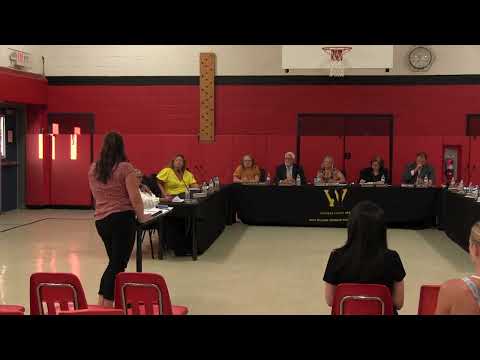
At its Aug. 22 meeting the West Milford Board of Education approved a revised class-size policy after trustees and public commenters urged smaller caps for early grades. The policy passed by roll call with one abstention; the superintendent said no elementary class currently meets the policy's maximum threshold.
The West Milford Board of Education on Aug. 22 adopted a revised class-size policy that sets guideline and maximum student counts for elementary grades after a prolonged discussion by trustees and public commenters.
Courtney Stevenson, co-leader of the Highlander Funding Committee, told the board she and other parents were alarmed by the draft policy's numbers. "According to the revised policy, the number desired for the K'1 range is 20 to 23 students with a max of 25. This is too many children in our primary grades," she said, urging trustees to reconsider the limits and to collaborate with community fundraisers to avoid cuts that increase class sizes.
Several trustees echoed that concern during discussion. "We truly do want smaller class sizes," said Trustee Seidewitz, describing the proposal as an "unfortunate and uncomfortable reality" tied to fiscal pressures. Trustee Dwyer said she would abstain from the final vote because she wants the policy revisited soon.
Superintendent Dr. Furnari responded to those concerns by describing the policy as a guideline for the district and noting present enrollment data: "So I can tell you right now, though, based on the numbers in our enrollment, currently, as of today, there are no classes that reach 28 students at any grade in the elementary level." She characterized the policy as a tool to give the administration flexibility amid space and staffing constraints.
After debate, the board adopted the policy by roll call. The roll call responses recorded in the meeting were: Mister Seidlitz ' yes; Mister Lippy ' yes; Missus Reccano ' yes; Missus Van Dyke ' yes; Missus Dwyer ' abstain; Missus Lockwood ' yes; Missus Romeo ' yes. The motion carried.
The board and speakers emphasized that the policy establishes "desired" classroom sizes and that the board may overrule guidelines on a case-by-case basis. Trustees said they intend to review the policy if data or enrollment shifts warrant change. The policy adoption was followed by normal business and an executive session scheduled for personnel, litigation, special-education matters and negotiations.
What happens next: the superintendent and administration will implement the policy as a guideline, monitor class rosters and report back to trustees if the district approaches any caps that would require specific board action or mitigation measures.