Lifetime Citizen Portal Access — AI Briefings, Alerts & Unlimited Follows
Appeals court hears dispute over victim medical records and prior-strangulation evidence in State v. Thompson
Loading...
Summary
At oral argument in State v. Thompson, defense counsel urged an in-camera review and subpoenas for the victim's medical records to support a natural-death theory; the state countered that the records are private and that prior-strangulation evidence was admissible to show motive and context.
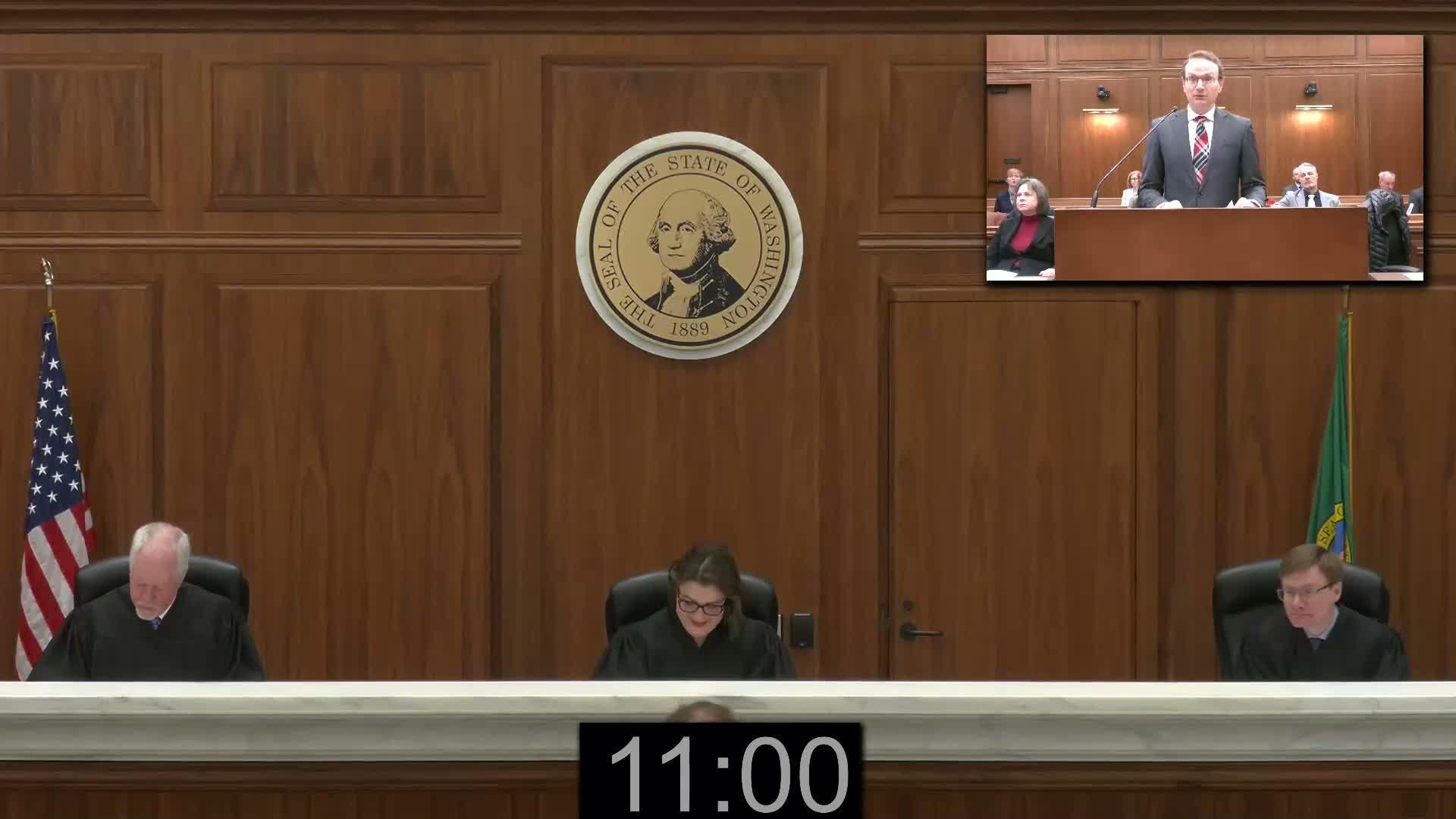
The Washington Court of Appeals heard arguments in State v. Thompson over whether the defendant, Lester Thompson, is entitled to subpoenas or an in-camera review of Destiny Gates Jackson’s confidential medical records and whether evidence of a prior 2013 strangulation was admissible under ER 404(b).
Christopher Petrone, appearing "with the Washington Appellate Project" for Thompson, asked the court to "remand for review in camera of Miss Gates Jackson's medical records," saying his expert had made a "plausible showing" that the records could contain evidence of a natural death. Petrone told the panel the defense had identified at least six facts, including that "doctor Wigren found microscopic blood clots in Miss Gates Jackson's lungs," and that an independent Arizona expert confirmed those findings.
The judges pressed the defense on the materiality and specificity of that showing. One judge asked, "What's what's he gonna look at in the records that's gonna allow him to say there was a a natural death here unrelated to strangulation?" Petrone responded that the Gregory standard does not require the defense to specify an exact causal pathway in advance and that the medical findings were "far more specific than the facts in Gregory" that previously justified in-camera review.
State counsel Anne Summers defended the trial court's rulings. Summers said the court had "identified two proper purposes" for admitting prior-act evidence and relied on the limiting instruction agreed by the parties. She argued the medical examiner's testimony supported that the victim was strangled and that motive and surrounding circumstances were highly probative in a circumstantial homicide case, noting a recorded conversation the prosecutor presented as evidence of motive.
A second appellee counsel, Elizabeth Flavin, argued the victim's records are "confidential and private" and that the defense had not shown a "particularized materiality" that would justify invading medical privacy. Flavin noted that the Arizona expert received slides of lung tissue but not the autopsy report, and she disputed that learning the label "Graves' disease" would have altered the expert's opinion without other supporting autopsy findings.
Much of the panel's questioning focused on two linked issues: (1) whether the defense's proffered expert evidence and factual claims create a reasonable probability that the records would affect the trial outcome, and (2) whether the probative value of the prior 2013 strangulation outweighs the risk of unfair prejudice under ER 404(b). The judges expressed skepticism about the sufficiency of an outlier case report tying Graves' disease to fatal clotting but also acknowledged that motive evidence can be highly probative when direct eyewitness testimony is lacking.
Petrone asked the court to at least order in-camera review or limited subpoenas targeted to specific institutions (he described a second request narrowed to two hospitals and the university endocrinology department). He told the panel the narrower request "absolutely" narrowed the prior wide net and increased the likelihood of materially relevant records; the defense argued the trial court abused its discretion by refusing those subpoenas.
Summers and Flavin urged deference to the trial court's protective order and evidentiary rulings, emphasizing victim privacy and arguing the record did not show that medical records would likely change the trial outcome.
The panel recessed briefly to transition to the next argument; no ruling was announced at the hearing.