Get Full Government Meeting Transcripts, Videos, & Alerts Forever!
Get email alerts on the Indigent Defense Caseloads topic
No spam. Unsubscribe anytime.
Washington Supreme Court hears wide-ranging testimony for and against proposed indigent defense caseload standards
Summary
At a Nov. 13 hearing, dozens of public defenders, county and city officials, judges and advocates urged opposing outcomes on proposed statewide caseload standards: supporters said reduced caseloads are needed to protect constitutional rights and racial equity; opponents warned of large unfunded local costs and urged more Washington-specific data.
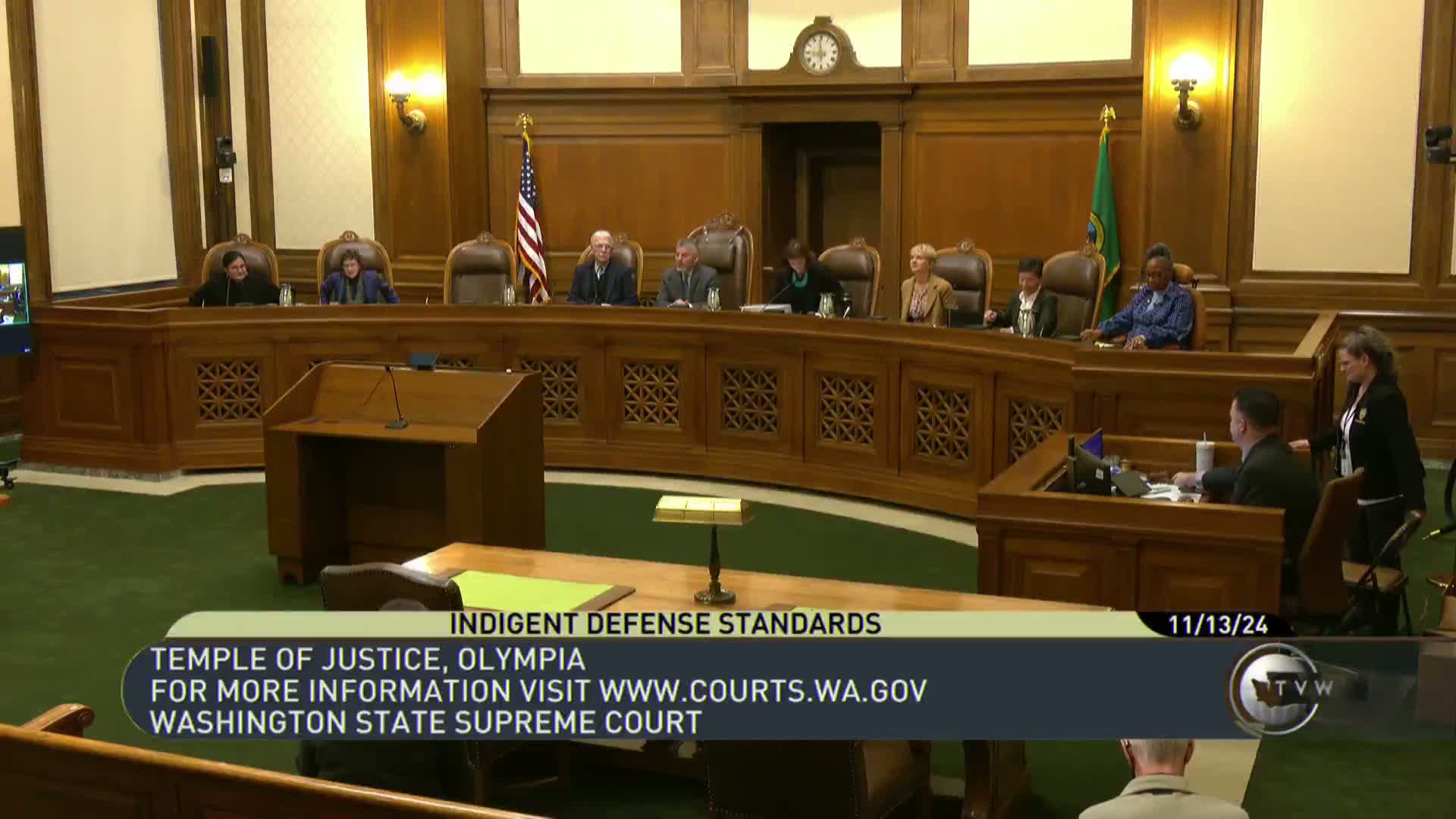
Chief Justice Gonzales opened the Washington Supreme Court’s Nov. 13 hearing on proposed indigent defense caseload standards, noting Justice Owens was recused and explaining the order for in-person and remote testimony. Dozens of speakers — including public defenders, county executives, mayors, prosecutors, judges and community advocates — presented sharply divided views on the Washington State Bar Association’s recommended rules.
Supporters told the court the current caseloads are causing constitutional harms and undermine fair representation. Matthew Sanders, interim director of the King County Department of Public Defense, said the system is in crisis and that delaying changes would prolong harm to people who are disproportionately poor and people of color. "We know, as a fact, that there is a crisis in public defense," Sanders said, urging the court to adopt the standards and order immediate implementation. Nikita Parekh, misdemeanor supervisor at the Snohomish County Public Defender Association, warned that a 400-case misdemeanor caseload "does not allow even the most organized attorney to consistently do an effective job" and cited Wilbur v. City of Mount Vernon as a precedent showing the risks of excessive loads. Several public defenders and labor groups framed adoption as both a workforce and racial-justice measure and said modern caseloads include time-consuming digital evidence review that did not exist when older standards were set.
Opponents — including city and county officials and some prosecutors — warned the proposed statewide standards rely on national studies that were not Washington-specific and would impose large, unfunded obligations on local governments. Deanna Dawson, CEO of the Association of Washington Cities, said the record suggests many jurisdictions have attorney shortages and recommended a Washington-specific study and a task force. "Adopting this rule statewide would have devastating consequences," Dawson said. Ryan Mello, chair of the Pierce County Council, said Pierce County’s modeling shows an initial need for 28 additional full-time staff at an estimated first-year cost of about $9.8–$11.6 million and as many as 184 additional staff by 2028 at an annual cost the county estimated at $34.6–$42.6 million; he urged state funding and a realistic phased implementation plan.
Several local officials and county associations urged the court to delay action and to work with the Office of Public Defense and the Legislature on funding and structure. Derek Young, interim executive director of the Washington State Association of Counties, said counties — typically politically diverse — were nearly unanimous in opposing immediate adoption because of fiscal strain. Likewise, city attorneys and prosecutors from multiple jurisdictions said local experience does not uniformly show ineffective representation under current standards and that wholesale changes risk cutting other essential services.
The Office of Public Defense signaled conditional support for the proposed standards while urging flexibility on timelines for jurisdictions that cannot meet a strict three-year implementation. Sofia Byrd McSherry of OPD recommended limited extensions (for example, four or five years for some counties) in exchange for transparent planning and progress reporting. The Superior Court Judges Association recommended adopting phase 1 while delaying phases 2 and 3 to gather county-specific data.
Community members and advocates described the human cost of delayed representation: Dominic Davis, a community advocate, said people sitting in jail for months or years are traumatized while waiting for their cases to be resolved. Several speakers — including public defenders and defenders’ organizations — proposed complementary approaches such as expanding investigators, social workers and diversion programs (for example, LEAD) to reduce downstream burdens.
No formal vote or rule adoption occurred at the hearing. Chief Justice Gonzales said the court will meet en banc on Dec. 4, 2024, and that the justices will announce next steps and any further process at a later date. The hearing produced extensive written and oral records that the court can consider in its forthcoming deliberations.