Get Full Government Meeting Transcripts, Videos, & Alerts Forever!
Get email alerts on the Labor Wages topic
No spam. Unsubscribe anytime.
Justices hear arguments over whether L&I may sue employers without prior administrative order
Summary
At oral argument, the Department of Labor and Industries told the Supreme Court it may petition superior court to collect unpaid wages without first issuing a formal administrative order; Cannabis Green countered the statute requires a prior administrative determination or notice and that the department had not followed the required process in this case.
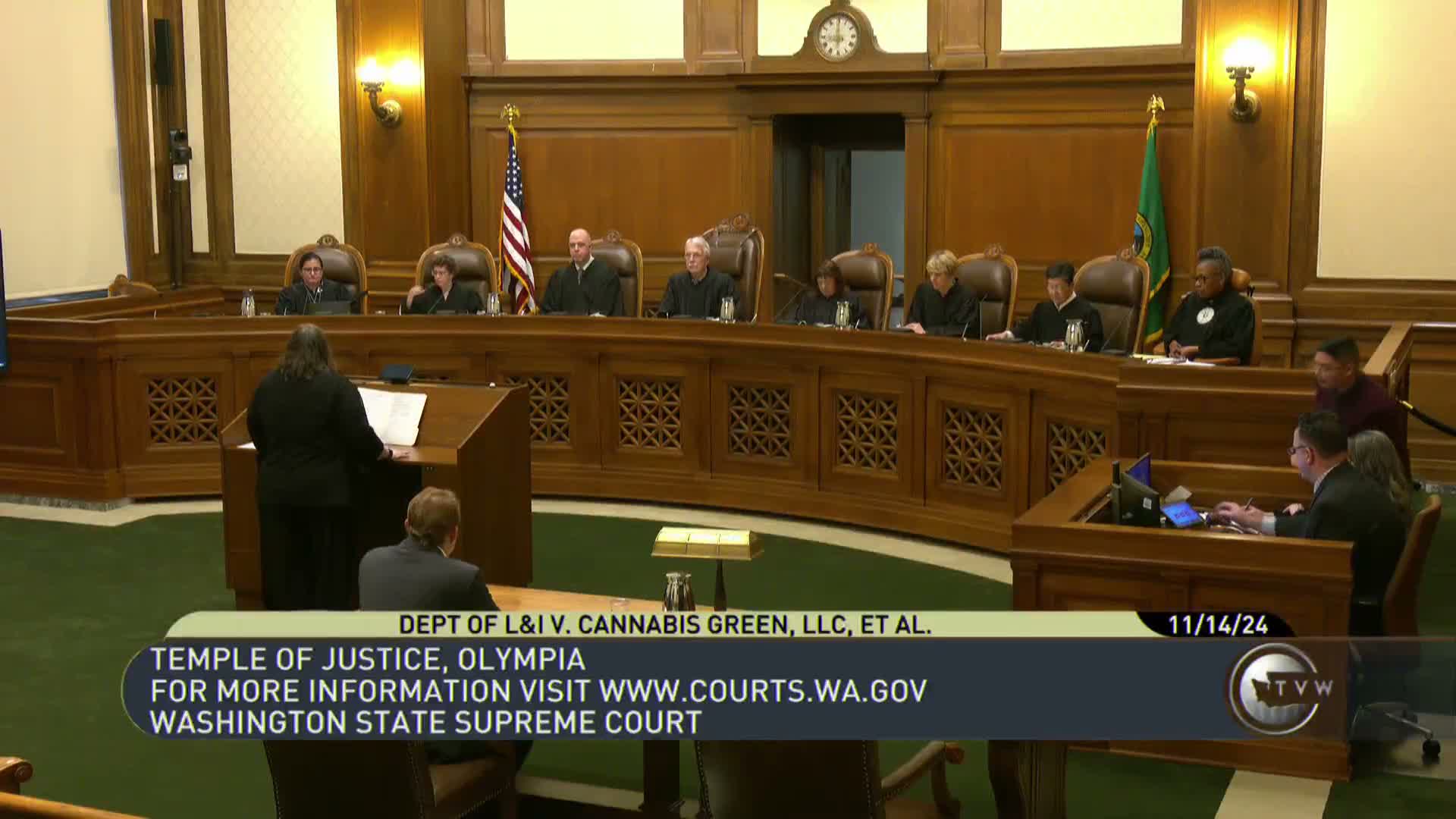
An oral argument at the Supreme Court on November 14 considered whether the Washington Department of Labor and Industries (L&I) may bring a superior-court collection action for unpaid wages without first issuing a formal administrative order or satisfying notice provisions the respondents say are statutory prerequisites.
Anastasia Sandstrom, assistant attorney general representing L&I, told the court the department is authorized under RCW 49.48.040 to "order the payment of all wages owed" or to "institute actions necessary for the collection of sums determined owed," and argued the conjunctive "and" can be read distributively so L&I may pursue either path immediately. "Those workers work those hours, they work that overtime, that amount is owed," Sandstrom said, urging the Court to interpret the remedial statute in a manner that benefits vulnerable workers who face retaliation and may not file individual claims.
The respondent, through attorney Sam Filo of Evans, Craven & Lackey, told the Court that in the absence of an individual worker's WPA complaint the statutory scheme requires L&I to make an administrative determination or otherwise follow RCW 49.48.040's process before filing a judicial collection action. Filo argued that L&I "filed their action without any order, without Cannabis Green being given the opportunity to identify inaccuracies" and that the department's conduct—issuing a press release, pursuing litigation after subpoenas were resisted, and negotiating a compliance agreement—created uncertainty for employees and employers about who was captured by the claims.
Justices pressed both sides on statutory text and context, repeatedly asking whether the penalties provision (discussed as RCW 49.46.0604 in argument) that includes a 30-day notice for penalties should be read to apply to wage collection as well. Sandstrom responded that the notice requirement applies to penalties and cure opportunities but not to wage payments themselves, and that superior-court collection can be more beneficial to workers because it permits double damages, attorney fees, interest and fuller remedies.
Filo countered that permitting L&I to proceed to court without a clear administrative determination would create a "catch-all" lawsuit that may extinguish workers' rights and leave employers unable to correct asserted errors through the administrative record. He noted the amended complaint sought $318,000 while a compliance negotiation referenced $25,000 (which counsel characterized as attorney fees), and argued the department did not "substantially comply" with the statutory sequence the respondents read into RCW 49.48.040.
The argument ranged across statutory construction principles and legislative history. Counsel debated whether later bill reports (cited by respondents) can be used to confirm intent for language drafted decades earlier; the justices questioned the contemporaneity and weight of such materials. Several justices also pursued the practical consequences of adopting either rule—whether a requirement of preliminary administrative steps would delay relief to low-wage workers or whether permitting immediate court actions would undermine procedural safeguards and transparency.
No decision was announced from the bench. After extended questioning of counsel for both sides, the Court thanked counsel and submitted the case for decision. The justices recessed for 10 minutes at the close of argument.
Citation and authorities discussed in argument were statutes cited orally: RCW 49.48.040 (department authority to order wages and institute collection actions) and related statutory provisions addressing penalties and notice. The Court heard competing readings of those provisions and extensive questioning about whether the statutory text, case precedents (including cases counsel cited as Mount Spokane, Hodgins, and related pre-WPA decisions), and legislative history support reading the statute to require or to permit prior administrative steps before suit.