Get Full Government Meeting Transcripts, Videos, & Alerts Forever!
Get email alerts on the Statute Of Limitations Rcw 4.16.340 topic
No spam. Unsubscribe anytime.
Washington Supreme Court hears argument on whether childhood-abuse time limit can cover abuse continuing after 18
Summary
At oral argument Nov. 19, 2024, the Washington Supreme Court considered whether RCW 4.16.340the state's childhood-sexual-abuse statute of limitationsapplies to continuing abuse that occurred after a survivor turned 18, with Petitioner arguing it can and Respondent saying the statute is limited to acts committed while a victim was a child.
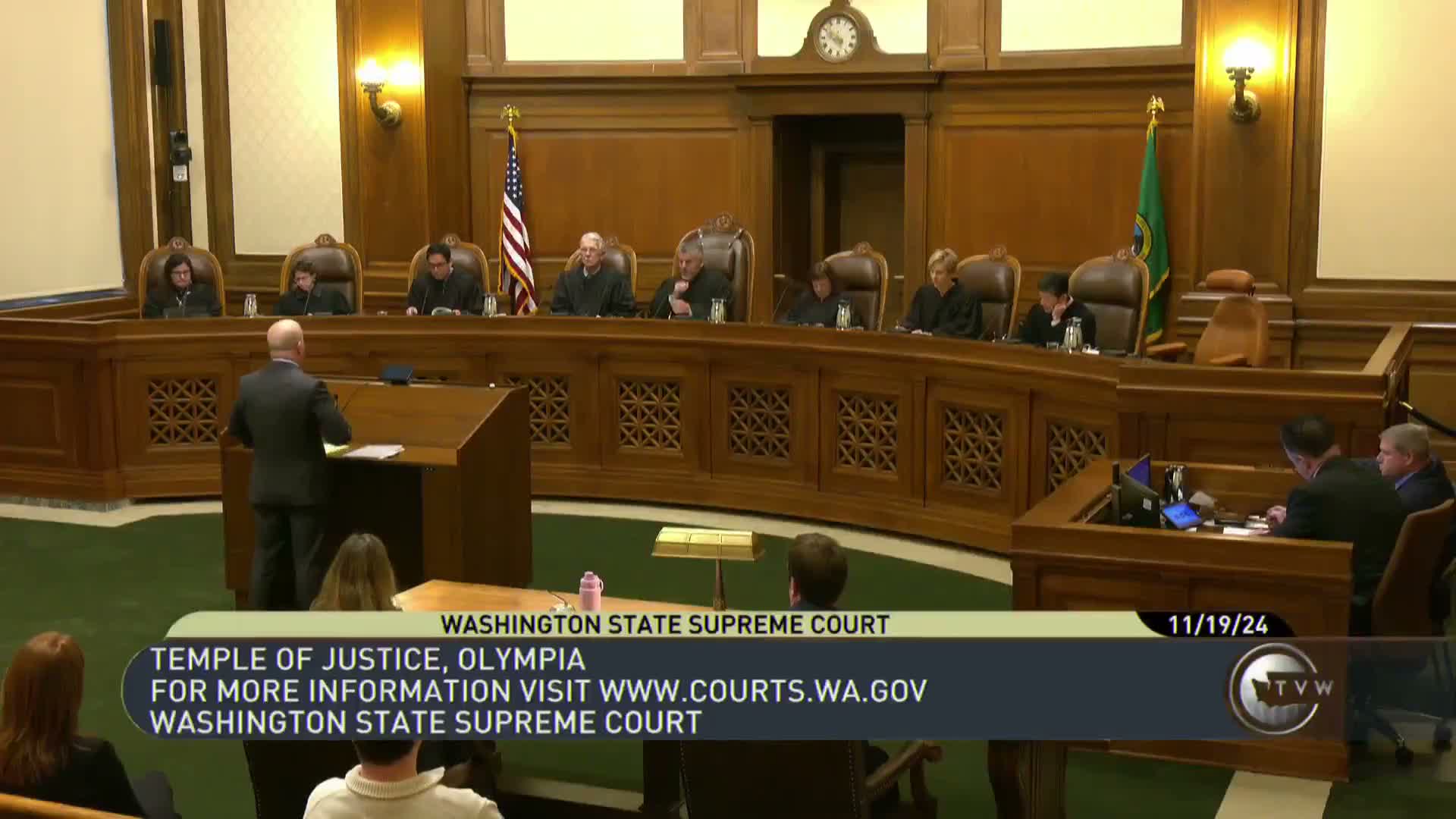
The Washington Supreme Court heard argument on Nov. 19, 2024, in MR v. State over whether RCW 4.16.340the state's special statute of limitations for childhood sexual abusepermits recovery for abuse that continued after a victim reached age 18.
Christopher Lipp, counsel for petitioner MR, told the court the statute was enacted to "provide a broad and generous application of the discovery rule to civil actions for injuries caused by childhood sexual abuse," and urged the justices that the question of whether continuing abuse after 18 falls within that statute is "answered with a resounding yes" when the statute's plain language and purpose are read together. Lipp said the statute focuses on discovery of a connection between wrongful conduct and injury and that, when grooming and its long-term effects produce later abusive acts, the continuing conduct can be a single claim if supported by the specific facts of the case.
Julie Turley, arguing for the State of Washington and other respondents, told the court that RCW 4.16.340 "applies to childhood sexual abuse, not acts of abuse that occur during adulthood." Turley argued the statute's text, particularly subsection 5which defines childhood sexual abuse by reference to acts against a person under 18 that meet specified criminal-code citationsand its tolling provisions, supports a reading limited to abuses committed while the victim was a child. "MR essentially asked this court to legislate from the bench by transforming abuse that occurs when a person is a child into adult abuse," Turley said.
Throughout argument the justices probed the boundary between legal questions for the court and factual questions for a jury. Several justices pressed counsel on whether the statute's phrases such as "injury suffered as a result of childhood sexual abuse" and "as a result of" require a causal showing that must be resolved by a factfinder. Lipp acknowledged factual disputes may arise but said the court must decide whether, as a matter of law, the statute can apply to a continuing course of abuse given appropriate facts; he identified proximate causation and whether the abuse constitutes a continuing course as issues that could go to a jury.
The bench also questioned how subsection 5 operates in practice. Justice Madsen asked whether subsection 5 requires predicate criminal acts during minority; Lipp answered that at least one predicate act meeting the criminal-code definition is required to invoke the childhood-abuse statute for a continuing-course claim. Turley countered that subsequent adult acts—even if related to earlier childhood abuse—are independent torts subject to their own discovery rules and limitations unless each act itself fits subsection 5 during minority.
Counsel debated CJC and other cases the parties cited to show how negligence and statutory definitions have been treated in prior decisions, and they discussed doctrinal issues such as tolling for incapacity, grooming as conditioning a victim, and the practical consequences of requiring claim-by-claim litigation for acts that span childhood and adulthood. Lipp emphasized the statute's remedial purpose and the legislature's focus on long-lasting harms from childhood abuse; Turley emphasized the statutory text's age-based limits and urged deferring policy changes to the legislature.
In rebuttal, Lipp asked the court to reverse the Court of Appeals and hold that RCW 4.16.340 permits recovery for continuing abuse after the age of 18 when the record supports the necessary factual findings (for example, proximate causation and a showing of a continuous course of abuse tied to the childhood acts). The chief justice then submitted the morning's cases and recessed the court until 1:30 p.m.
What happens next: The court took no immediate vote on the bench. The argument is submitted; the Supreme Court will issue its opinion in due course.
Quotes in context: All quoted material and attributions are taken from the court's oral argument transcript and are attributed to the speaking counsel or to the presiding justice when used in questions.