Get Full Government Meeting Transcripts, Videos, & Alerts Forever!
Get email alerts on the Criminal Justice Privacy topic
No spam. Unsubscribe anytime.
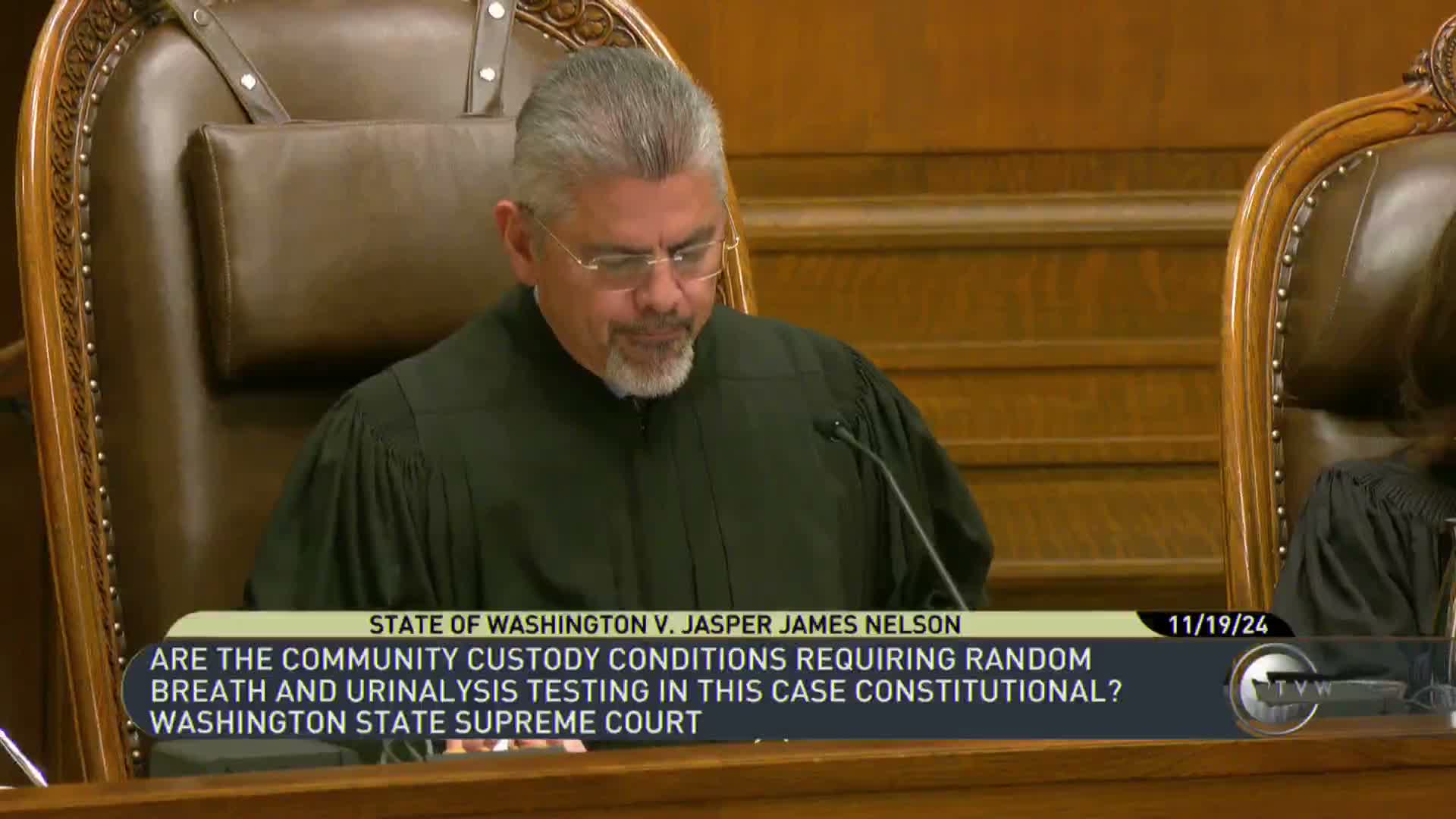
Washington Supreme Court hears challenge to suspicionless drug, alcohol testing in community custody
Summary
In oral argument the court considered whether suspicionless urinalysis and breath testing imposed as part of community-custody monitoring violate the privacy guarantee in Article I, Section 7 of the Washington Constitution. Petitioner’s counsel urged strict scrutiny; the state defended testing as narrowly tailored enforcement of valid prohibitions.
Mary Swift, counsel for petitioner Jasper James Nelson, told the Washington Supreme Court on Nov. 19 that “individuals on community custody do not forfeit all expectations of privacy” and that monitoring conditions that intrude on private affairs must be narrowly tailored to a compelling government interest.
Swift said Mr. Nelson challenges the constitutionality of suspicionless urinalysis (UA) and breath analysis (BA) that he contends are unrelated to his underlying offense and that a person with no history of substance use would face the indignity of “essentially urinat[ing] in front of his community corrections officer.” She told the court she limited her petition to constitutional grounds and did not pursue statutory interpretation in this appeal.
Will Ferguson, representing the State of Washington, told the court division-of-court-of-appeals precedent is split but that the Court of Appeals here upheld the conditions as constitutional. Ferguson said the testing procedures support enforcement of otherwise valid prohibitions on alcohol and drug use and argued the statutes and prior cases permit targeted UA and BA as means to ensure compliance.
Much of argument focused on two legal questions: (1) is this case a proper vehicle now, or must a challenge wait until enforcement or a different collateral remedy; and (2) whether the state’s asserted authority and the means of testing satisfy the narrow-tailoring requirement under Article I, Section 7. Justices pressed both sides on ripeness and on whether acceptance of conditions in a Sosa plea or their presence in the judgment and sentence forecloses a later constitutional attack after revocation.
Counsel for Nelson emphasized the Court of Appeals reached the merits and highlighted that the contested testing conditions appear in the judgment and sentence paperwork. The state noted statutory subsections cited in briefing (referred to in argument as “703” and “704”) and contended that testing narrowly serves the purpose of enforcing the no-drug/no-alcohol prohibitions; the state also acknowledged reported and unreported appellate decisions have taken different approaches.
Justices raised hypotheticals to probe limits: would a valid prohibition justify ever-more pervasive monitoring such as continuous video? The state and justices agreed limits must exist, and several questions centered on the meaning of “authority of law” and whether a statute alone can satisfy constitutional safeguards or whether additional, case-specific constraints are required.
Both sides also touched on practical consequences. Counsel for Nelson flagged the practical hardship of suspicionless testing and noted Mr. Nelson had counsel at prior violation proceedings but that protections at purely administrative DOC hearings are not automatic. The state said counsel could be required in some Sosa-related sanction proceedings and offered to provide supplemental briefing on the right-to-counsel question if the court desired.
In rebuttal Swift pointed to the clerk’s papers and the judgment and sentence to show the conditions are expressly imposed upon revocation and reiterated the request that the court hold suspicionless UAs and BAs unconstitutional when not tied by reasonable suspicion or narrow tailoring to an offense-related purpose.
The justices thanked counsel, submitted the case, and adjourned. No decision was announced from the bench.
The case: State of Washington v. Jasper James Nelson; argument date Nov. 19, 2024. Next steps: the court will issue a written opinion at a later date.