Get Full Government Meeting Transcripts, Videos, & Alerts Forever!
Get email alerts on the Reunification Harm Review topic
No spam. Unsubscribe anytime.
Petitioner asks Washington Supreme Court to review whether harm of removing a child from foster care may block reunification; state urges denial
Summary
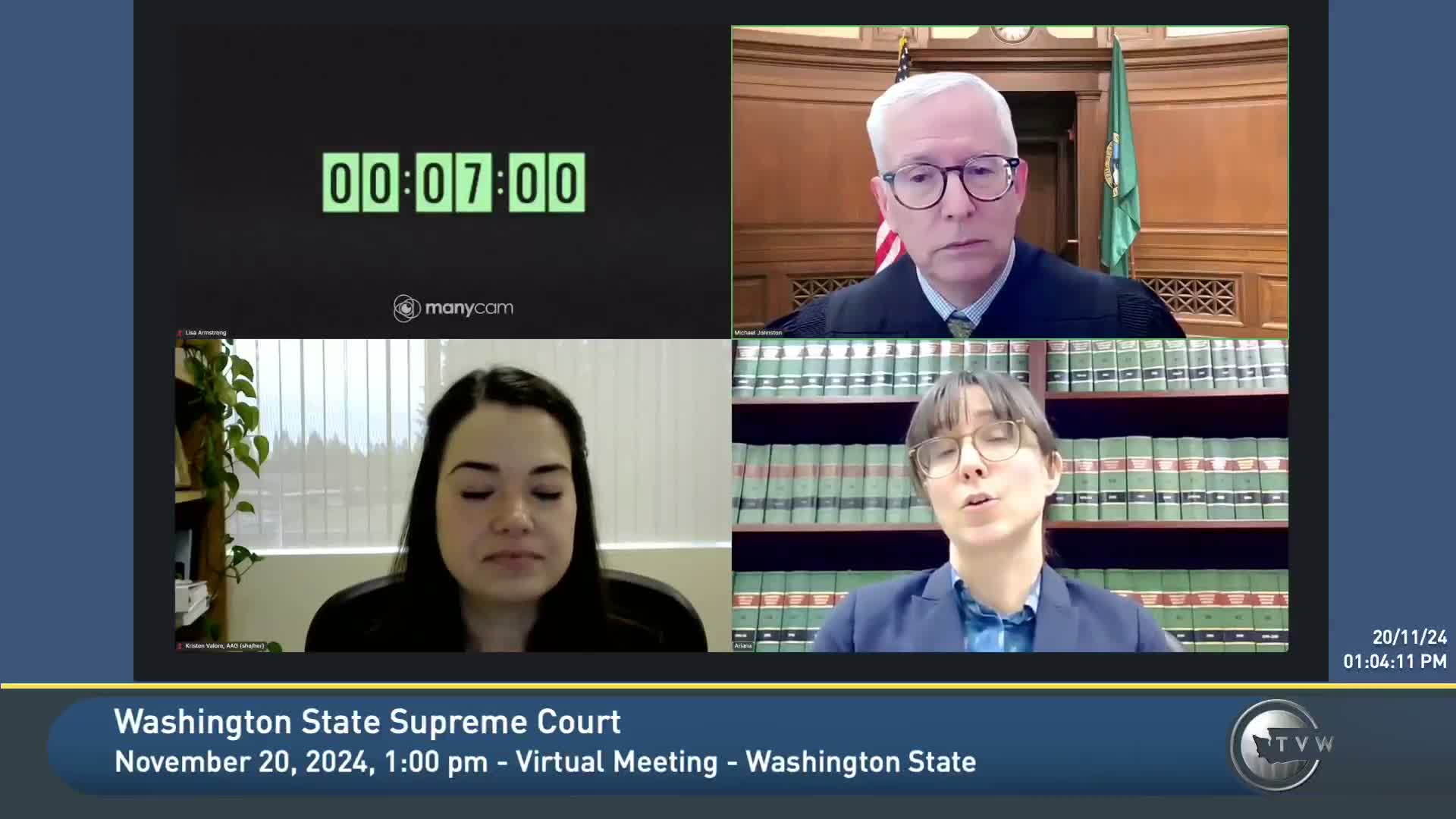
At a commissioner's hearing, petitioner counsel argued the court should review whether juvenile courts may treat harm from removing a child from a foster family as a basis to deny reunification; the Department of Children, Youth, and Families urged denial on mootness and procedural grounds, saying the issue does not present a continuing, substantial public interest.
Miss Valore, counsel for the petitioner, urged the Washington Supreme Court at a commissioner's hearing to take up a dependency dispute that the parties agree is technically moot. Miss Valore argued juvenile courts sometimes consider the possible harm of removing a child from a foster family when deciding reunification and that recognizing such harm as a basis to deny reunification “undermines the purposes of the dependency statute” and could create artificial barriers to reunification. “There are several thousand children right now who are living with foster families throughout the state of Washington,” she said, arguing the court’s guidance is needed so juvenile courts do not apply an improper standard.
Kristen Bellori, who argued on behalf of the Department of Children, Youth, and Families, told the court it should deny discretionary review. Bellori said the responding party (RP) did not challenge the underlying order in the juvenile court, that RP’s earlier position below supported increased visitation and successful return, and that the Court of Appeals properly denied review based on mootness. “We have a moot case,” she told the Commissioner, saying the juvenile court’s isolated error does not present an issue of continuing and substantial public interest that would warrant Supreme Court review.
The petitioner asked the court to apply RAP 13.5(b)(3) (interlocutory/accelerated review) or to overlook briefing-form errors that had cited RAP 13.4; Miss Valore argued those procedural mistakes should not preclude consideration of the merits. She also invoked a statutory provision the transcript records as “RCW thirteen-thirty four-twenty,” arguing that when the parent’s and child’s rights do not conflict, courts should not substitute a best-interest analysis for reunification and that applying best-interest standards in such cases risks race- or class-based considerations entering the decision.
Bellori countered that recent Washington Supreme Court dependency decisions (identified in argument as dependency of KW and JBS) already provide guidance on placement and best-interest factors, including children’s bonds with foster parents, and that House Bill 1227 amended certain ShelterCare statutes but did not alter the dependency-review statute at issue. The department argued the record shows the juvenile court applied an applicable statute and that the Court of Appeals’ denial of review aligned with accepted practice.
The Commissioner noted the parties’ agreement that the case is moot and reminded counsel that the court recently experienced a systems outage that has delayed processing; the Commissioner said a written disposition might take longer than usual and outlined possible procedural outcomes (deny review, grant review, or refer the matter for a petition for review). The hearing concluded with the parties exchanging brief courtesies.
The hearing transcript reflects argument on whether this court should create guidance for juvenile courts about weighing the harm of removing a child from foster care when deciding reunification, and whether procedural obstacles (mootness, briefing form, and standing) prevent review. The Commissioner did not announce a decision at the hearing.