Get Full Government Meeting Transcripts, Videos, & Alerts Forever!
Get email alerts on the Evictions Policy topic
No spam. Unsubscribe anytime.
Justices weigh whether CARES Act 30‑day notice applies to all evictions or only nonpayment cases
Summary
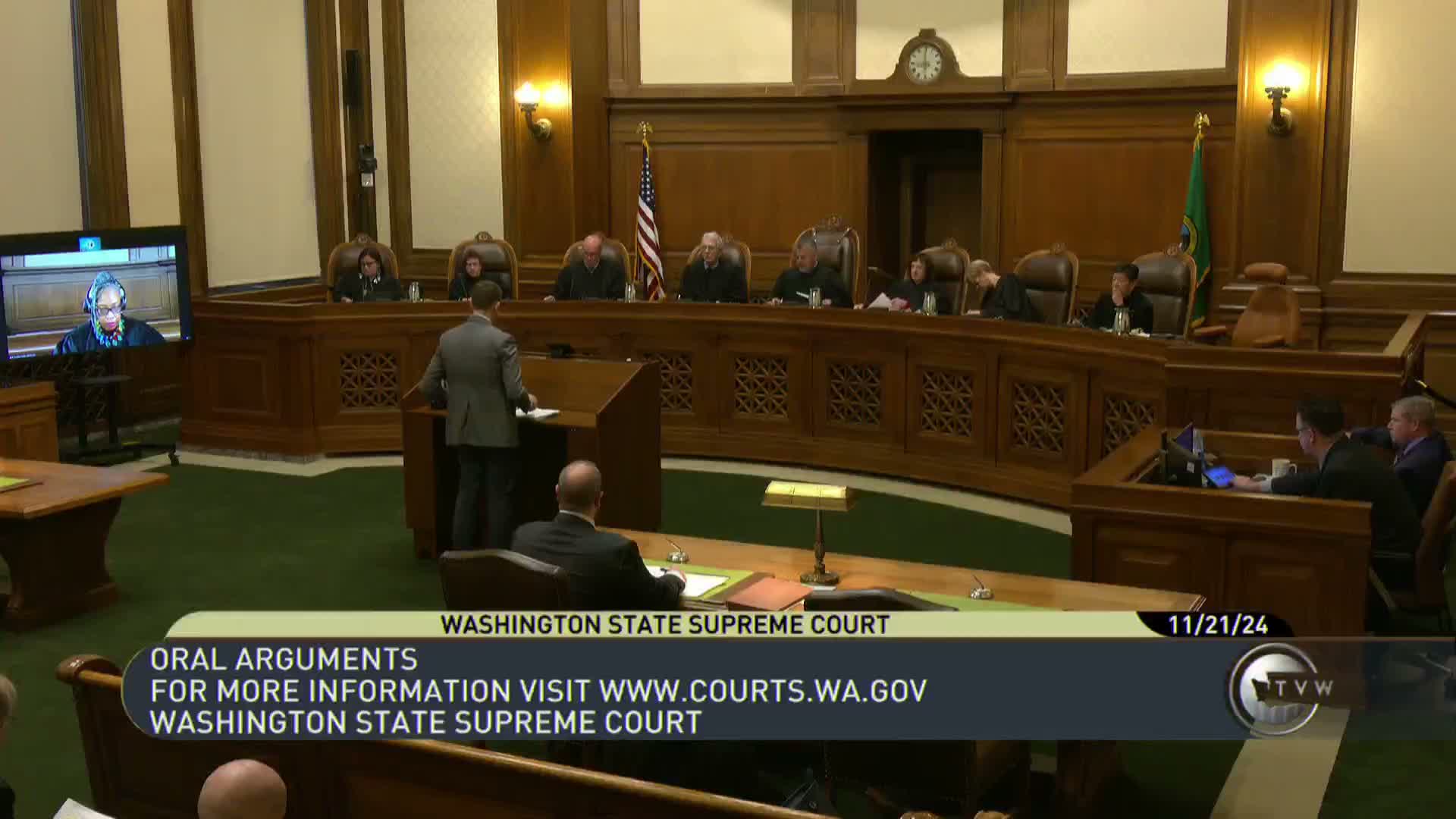
At oral argument on Nov. 21, 2024, counsel for petitioner Andre Knight argued the CARES Act—24 notice-to-vacate provision applies broadly to any eviction notice, while counsel for the King County Housing Authority urged a narrower reading tied to nonpayment moratoria; the court took the case under submission.
The Supreme Court heard arguments on Nov. 21, 2024, over whether a provision of the CARES Act requires landlords of covered properties to give a 30-day notice to vacate for all eviction types or only for evictions based on nonpayment of rent. The case was argued for the petitioner by Evan Wood and for the respondent by Christopher Reed of Montgomery Purdue, which represents the King County Housing Authority.
Wood, identifying himself as counsel for petitioner Andre Knight, told the court that subsection C(1) of the statute "says that a lessor of a covered dwelling unit may not demand that the tenant vacate" without a 30-day notice and that the text contains no limitation to nonpayment. "There's nothing in here that would indicate to the reader that that is only limited to non payment," Wood said, urging the court to adopt a plain‑text reading and to reverse the lower court.
Christopher Reed, counsel for the King County Housing Authority, asked the court to affirm the Division I Court of Appeals. Reed said the statute and its context — "passed to address economic insecurity" during the COVID-19 pandemic — support a narrower construction that applies the 30-day notice only to nonpayment cases. "We believe section 4,024(subsection C) specifically does not require a 30 day notice for criminal activity such as this case," Reed said, adding that applying a 30‑day rule to all eviction types could conflict with other federal and state notice provisions and could disadvantage residents subject to criminal‑activity evictions.
Multiple justices pressed both sides on how to read subsection B (the 120‑day moratorium on nonpayment filings) together with subsection C. Some asked whether C merely borrows B—24 time frame or instead imports B—24 nonpayment limitation. Wood responded that C refers to B for its time period but otherwise is written broadly; Reed said the sections should be read together and that C(2)—24 language tying issuance of notices to the moratorium supports a narrower interpretation.
Both lawyers discussed related authorities and policy context. Wood invoked other federal housing statutes (including the Protecting Tenants of Foreclosure Act) to show Congress sometimes prescribes broad notice periods; Reed relied on federalism principles and the clear‑statement canon, arguing that Congress did not plainly displace state landlord‑tenant authority for nonpayment and criminal‑activity evictions.
Counsel also debated whether the question is legally "live" given that the tenant in the underlying case has moved out and whether any part of the CARES Act notice provision has expired; both sides told the court they view the issue as likely to recur and therefore suitable for resolution.
After rebuttal from petitioner Evan Wood, the court took the case under submission and recessed. No decision was announced from the bench.
The petition concerns statutory interpretation of a federal emergency housing provision and how it interacts with traditional state regulation of eviction procedure; the court's ruling will resolve a split in the courts of appeals on whether the CARES Act's 30‑day notice applies only to nonpayment evictions or to all eviction notices for covered properties.