Get Full Government Meeting Transcripts, Videos, & Alerts Forever!
Get email alerts on the Occupational Health And Safety topic
No spam. Unsubscribe anytime.
Washington Supreme Court hears arguments over whether asbestos victims may sue outside workers’ comp
Summary
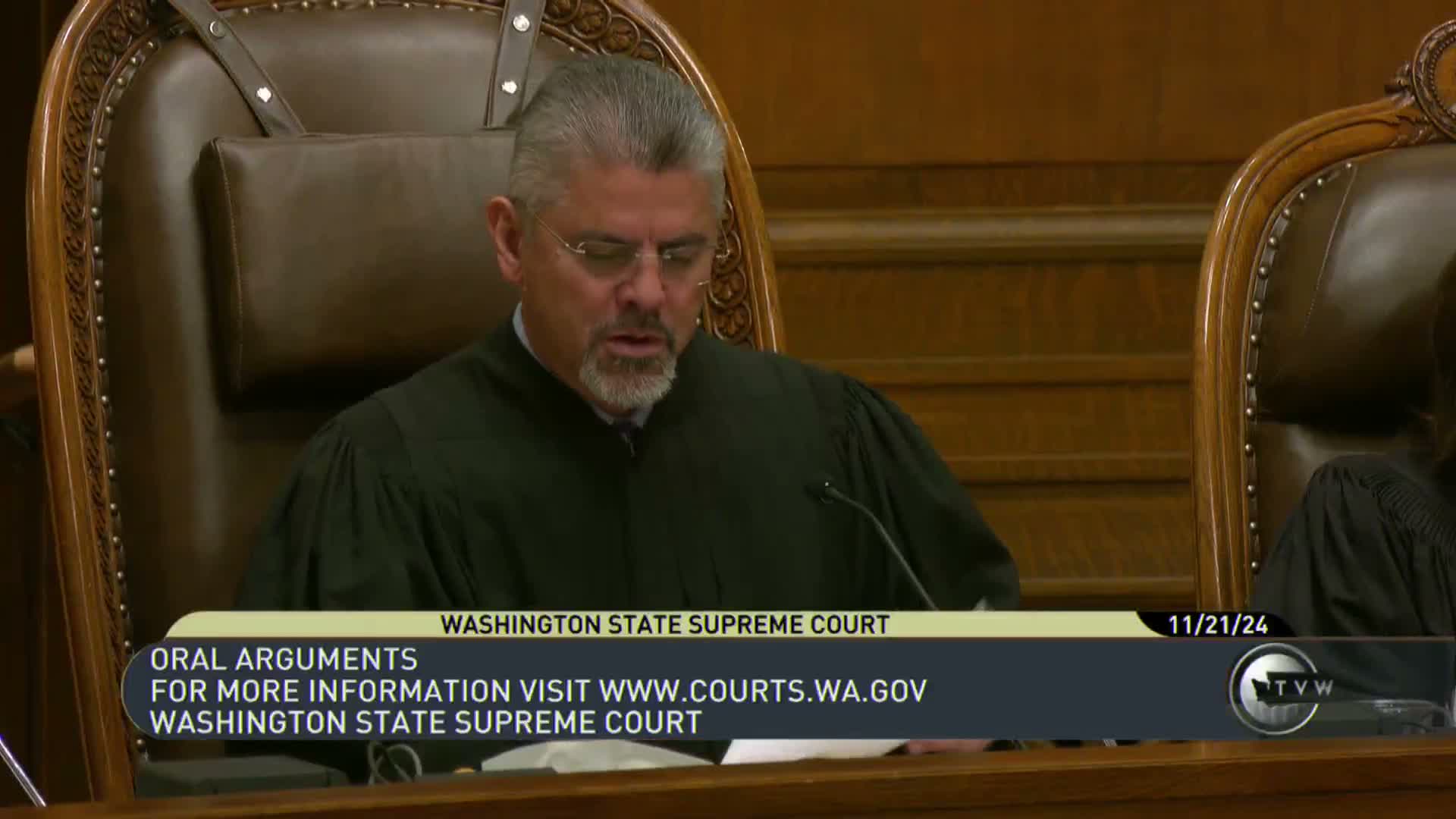
On Nov. 21, 2024 the Washington Supreme Court heard oral argument in Jeffrey L. Cochran v. C. H. Murphy, Clark, Ullman, Inc., et al., on whether an employer that knowingly exposed workers to asbestos can be sued in tort under the deliberate-injury exception to the Industrial Insurance Act or is limited to workers’ compensation remedies.
The Washington Supreme Court on Nov. 21, 2024 heard competing arguments about whether a worker exposed long-term to asbestos may sue an employer in tort under the Industrial Insurance Act’s deliberate-injury exception, or whether that remedy is foreclosed by the court’s prior decisions and the workers’ compensation framework.
Matthew Bergman, counsel for the petitioner Jeffrey L. Cochran, told the court that Cochrane’s employers (identified in the briefs as Alcoa) knowingly exposed him to asbestos over a roughly 30‑year period and observed similarly exposed coworkers develop compensable disease. "Geoffrey Cochrane was exposed to asbestos knowingly and deliberately over a 30 year period at Alcoa," Bergman said, arguing that when an employer observes coworkers becoming ill from the same toxin the deliberate‑injury exception should allow a jury to decide tort liability rather than forcing claimants into workers’ compensation alone.
Bergman urged the court to focus on employer conduct and contemporaneous knowledge rather than require mathematical proof that an individual plaintiff was "100% certain" to develop disease. He described a fact‑issue approach tied to employer observation of disease in similarly situated employees and said the court could clarify language in prior opinions without fully overruling them.
Anastasia Sandstrom, assistant attorney general for the Department of Labor and Industries (amicus), urged a somewhat different formulation: she asked the court to adopt a "substantial certainty" standard drawn from the Restatement of Torts and argued occupational disease should be treated comparably to acute industrial injuries. "The level of certainty should be substantial certainty," Sandstrom said, and she warned that allowing broad tort liability without a clear standard could unsettle the "grand bargain" that underpins the workers’ compensation system unless courts and the legislature carefully define the rule.
Counsel for the respondents, Michael King for Halmet Aerospace (historically the Aluminum Company of America, "Alcoa"), urged deference to the court’s prior statutory interpretations in Berkeley and Walston and argued the issue is one of statutory construction best left to the legislature. King emphasized a separation‑of‑powers and legislative‑acquiescence argument, telling the court: "This is a statutory interpretation question…you don't go back and say, well, now we've got a new situation, so we're gonna undo our interpretation."
Throughout the argument the justices pressed counsel on how to measure the required certainty: several asked whether a numerical probability test, a "one‑bite" observation rule, or a substantial‑certainty standard would apply across different substances and factual records. Counsel and an amicus debated whether the relevant inquiry should focus on the individual plaintiff’s certainty of injury, the employer’s knowledge of similar worker injuries, or evolving scientific evidence showing causation in exposed populations.
Bergman returned in rebuttal to stress that the record here included employer monitoring records and physician evaluations showing progressive occupational disease among coworkers and that denying tort remedies where the employer had actual knowledge would permit some employers to evade civil liability despite prolonged exposure. The court took the case as submitted and recessed; no decision was announced. The justices will issue an opinion at a later date.
The immediate practical effect of a ruling for the petitioner would be to open some occupational‑disease claims to tort litigation where the record shows employer knowledge of similar worker illness; a ruling for the respondent would largely preserve the current limited pathway for such claims and maintain the established division between tort and the workers’ compensation system. The court did not set a schedule for issuing a decision at argument.