Get Full Government Meeting Transcripts, Videos, & Alerts Forever!
Get email alerts on the Judiciary topic
No spam. Unsubscribe anytime.
Supreme Court hears challenge to juvenile court rule limiting bench warrants
Summary
At oral argument on Nov. 21, 2024, petitioners told the Washington Supreme Court that juvenile bench warrants are procedural and therefore subject to court rulemaking; the State said Juvenile Rule 7.16 effectively rewrites the Juvenile Justice Act and asked the Court to affirm the Court of Appeals. The case was submitted for decision.
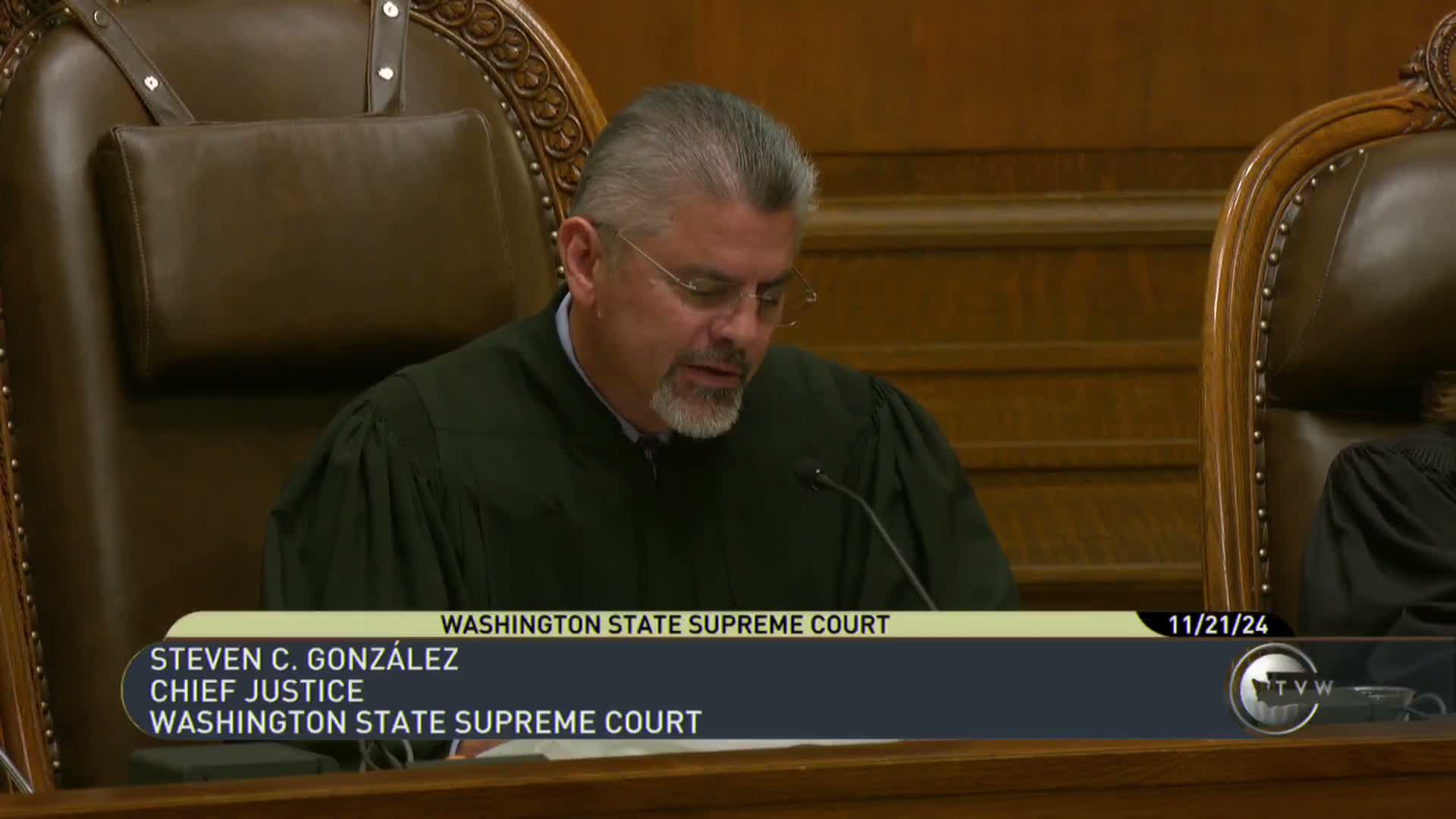
The Washington Supreme Court heard arguments on Nov. 21, 2024, in State of Washington v. JMH and AMW over whether Juvenile Court Rule 7.16 — which limits bench warrants to juvenile violations that "pose a serious threat to public safety" — is a procedural court rule or a substantive change to legislative policy.
Kevin March, counsel for petitioners AMW and JMH, told the Court that "warrants are a form of legal process" and argued that rules governing such process fall within the Court's rulemaking authority. March said the analysis should focus on the nature of the rule rather than downstream effects and identified three core points: warrants are procedural; characterization depends on the rule's nature, not consequences; and the legislature has established mechanisms to respond to court rules if it objects.
"When a warrant issues from a neutral and detached magistrate, that is criminal procedure 101," March said, arguing that arrest warrants compel appearance and therefore are part of court procedure. He urged reversal of the Court of Appeals and reinstatement of Rule 7.16 as controlling law.
Alexis Lundgren, representing the State, countered that the Juvenile Justice Act reflects a legislative decision to make the Act apply broadly to juveniles adjudicated guilty and that Rule 7.16 "supplants this policy determination" by narrowing enforcement to juveniles whose noncompliance poses a serious public-safety threat. Lundgren said that, under the rule's plain language, the juveniles in the two consolidated cases conceded not to pose such a threat.
The State relied on separation-of-powers principles and asked the Court to affirm the Court of Appeals, saying that while prior Washington decisions treat some court rules as procedural even when affecting constitutional protections, the Court must examine whether Rule 7.16 functionally prevents the Legislature's chosen policy from operating.
Justices pressed both sides on practical questions. Several asked whether trial courts could harmonize the statute and Rule 7.16, whether summonses could be used before issuing a warrant, and whether bench-warrant issuance necessarily leads to detention. Lundgren acknowledged that summonses are common and that detention follows a separate statutory hearing after a warrant is served, but she said that if a juvenile refuses a summons the court may lack any way to compel presence absent a warrant. March acknowledged that trial courts have discretion but argued that where a court rule governs procedure it becomes the controlling law and an otherwise nonconforming warrant is unlawful.
The Court also discussed case-specific issues. The State conceded that in JMH the trial judge who issued the warrant should have recused himself from the appellate panel that addressed the appeal, and counsel identified timing and filing complications on appeal.
Counsel summarized the relief requested: March asked the Court to reverse the Court of Appeals and reinstate the juvenile court rule; Lundgren asked the Court to affirm the Court of Appeals and find that the rule is substantive and violates separation of powers. After final questions the case was submitted.
The Court took the matter under advisement and adjourned.