Get Full Government Meeting Transcripts, Videos, & Alerts Forever!
Get email alerts on the Military Leave topic
No spam. Unsubscribe anytime.
Washington Supreme Court hears case on whether public employers must keep paying annual 21‑day military leave during extended active duty
Summary
The Supreme Court heard arguments in Travis Bearden v. City of Ocean Shores over whether Washington’s paid‑military‑leave law requires a public employer to pay a service member 21 days of leave each year even while the employee remains on extended active orders, and whether a reemployment requirement limits that entitlement.
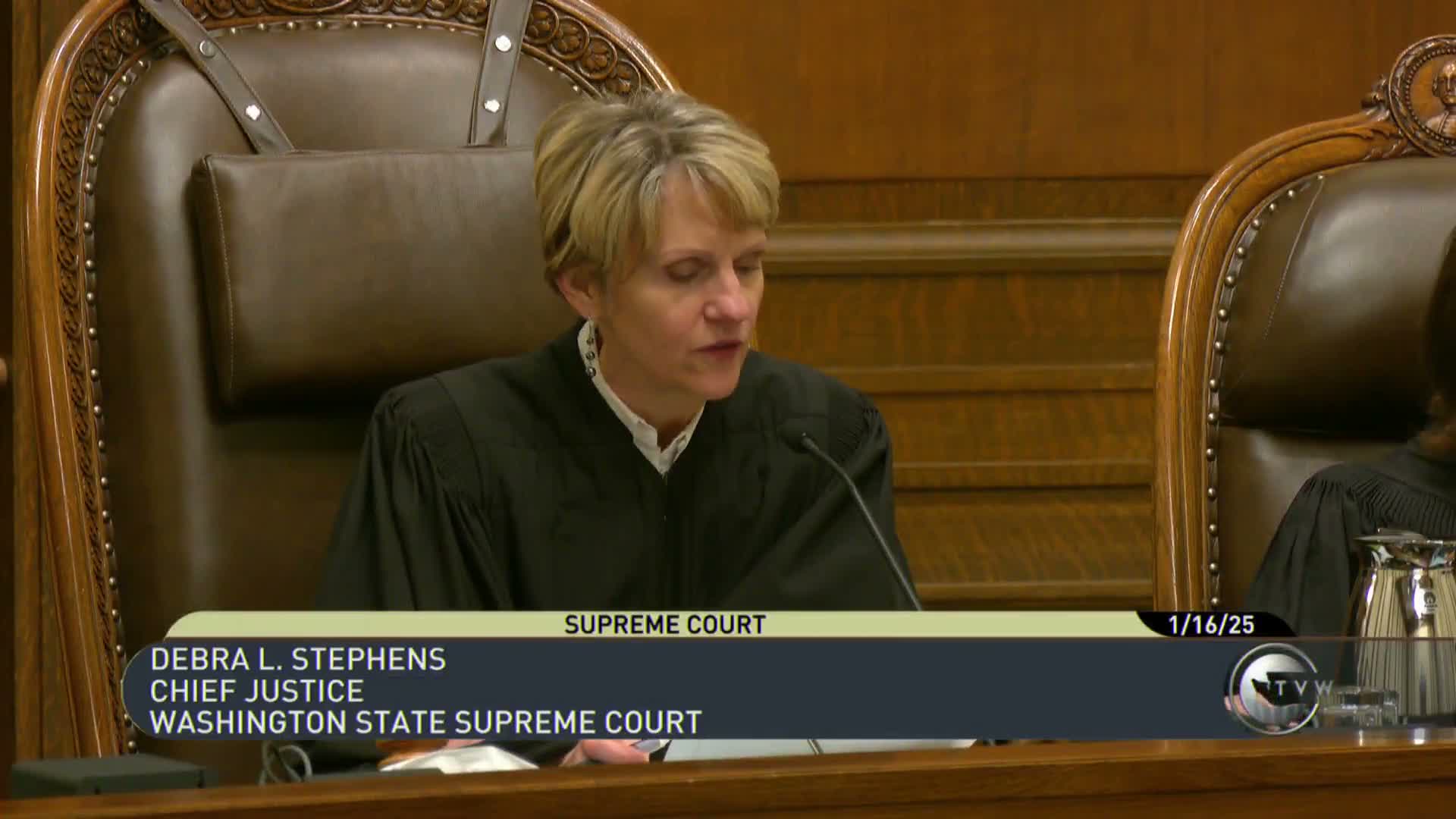
The Washington State Supreme Court heard oral argument Jan. 16 in Travis Bearden v. City of Ocean Shores, a dispute over whether public employers must pay a 21‑day block of paid military leave each year to employees who remain on extended active orders and whether state law contains a separate reemployment requirement.
Thomas Girard, counsel for firefighter and appellant Travis Bearden, told the court the issue is “Ocean Shore's manipulation of the Washington Paid Leave statute for military service.” Girard argued the statute’s plain language requires employers to pay service members for days they were regularly scheduled to work during military leave and contains no limit on the type or length of military duty or any intervening reemployment requirement.
“Scheduled to work, within the context of the statute, is very clear,” Girard said, urging the justices to treat nontraditional schedules—such as 24‑ or 36‑hour firefighter shifts—as regular schedules for counting paid military leave. He told the court Bearden took short military leave in October 2019, had 21 days of military leave on the books, later provided continuation orders under Title 32 and that Ocean Shores charged his paid leave during that extended period before ultimately telling him his paid leave had expired.
Elizabeth McIntyre, counsel for the City of Ocean Shores, said the city’s interpretation is consistent with the statute and with federal reemployment law. McIntyre told the court that under USERRA an employee on military leave is deemed on a leave or furlough and may use accrued leave available before their absence; once an employee is on an unpaid leave of absence they stop accruing paid leave and are not "scheduled to work," which she described as the practical cutoff for the 21‑day benefit. "Mr. Bearden's interpretation of this law would require the payment of military leave annually, year after year after year," McIntyre said, and she argued that result would exceed what the legislature set out.
Justices pressed both sides on mechanics: how an employer determines when a variable‑hour or shift worker is ‘‘scheduled’’ to work, whether a service member’s orders must be reactivated to continue an entitlement, and how long an employer’s reemployment obligation lasts. Counsel discussed statutory history and precedent, and McIntyre pointed to USERRA provisions and Washington’s so‑called mini‑USERRA (a four‑year limit referenced in argument) and to federal rules that provide reemployment windows (including references during argument to 180‑day and five‑year benchmarks for certain reemployment rights).
Counsel also flagged factual points for the court: Girard said Bearden has provided continued orders after 2021 and that the city excluded him from schedules because of extended leave; McIntyre pointed to a 2021 amended complaint alleging constructive discharge as evidence that the record includes conflicting statements about whether Bearden intended to return.
The case was presented to the court as a certified question from the Ninth Circuit; neither side asked the court to issue an immediate ruling from the bench. After rebuttal, the court recessed for 10 minutes without announcing a decision.
Why it matters: the court’s interpretation will affect public employers and servicemembers across Washington by clarifying whether the annual 21‑day paid military leave renews or continues during long‑term activations, how to count leave for nontraditional schedules, and whether federal reemployment rules or state law create timing limits on an employer’s obligation.
What’s next: the court did not issue a ruling at argument. Any decision will be issued in a written opinion and could resolve the certified question about the interplay between Washington’s paid‑leave statute and reemployment principles under USERRA.