Get Full Government Meeting Transcripts, Videos, & Alerts Forever!
Get email alerts on the Confrontation Clause topic
No spam. Unsubscribe anytime.
High court hears case on whether toxicology supervisors may testify without the bench tester
Summary
At oral argument in State of Washington v. Samantha Hall Haught, defense counsel said admitting a toxicology report and allowing a supervisor to testify violated the Confrontation Clause; the State replied the supervisor reviewed raw instrument data, controls and calibrators and had sufficient personal knowledge. The court asked probing hypotheticals but issued no decision.
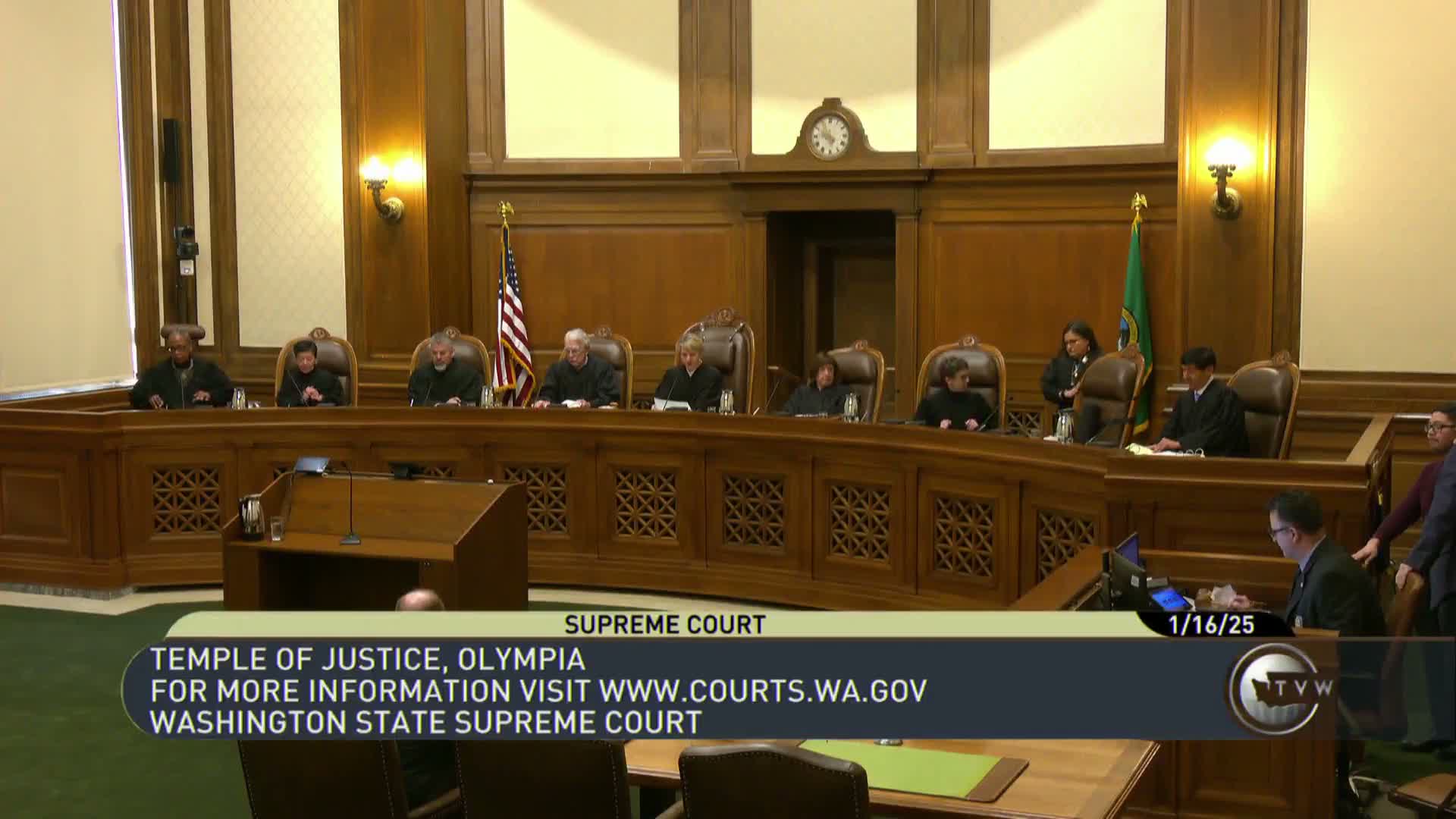
The Supreme Court heard argument in State of Washington v. Samantha Hall Haught over whether a toxicology supervisor who reviewed lab files but did not perform the testing may lawfully testify about test results.
Petitioner counsel Jared Steed told the court the Confrontation Clause requires the person who "lays the hands on the evidence that is inculpatory" to testify and said the case falls squarely under Melendez-Diaz and Bullcoming. He argued the certified toxicology report here — which attributed the presence of THC to testing done by a laboratory analyst who did not testify — was inculpatory and thus its author should have been produced for cross-examination. "The person who lays the hands on the evidence that is inculpatory is the person who has to testify," Steed said, urging reversal.
Justices pressed Steed on practical consequences. One asked whether body-camera video of testing would suffice and how far the chain of required witnesses extends (from the hospital phlebotomist to the bench analyst). Steed said best practices would be to produce anyone who handled or observed inculpatory evidence or to retest so an available analyst performed the testing at trial; he emphasized that merely reviewing notes and signing a report does not substitute for original testimony.
Respondent counsel David Carmen asked the court to affirm the conviction. Carmen said the testifying supervisor, Katie Harris, did more than read a two-page report: she reviewed the full case file, including raw instrument printouts, batch calibrators and controls, and the safeguards that demonstrate whether standard operating procedures were followed. "Katie Harris looked at the exact same raw data that the bench tester would have looked at in order to come to the same conclusion," Carmen said, adding that those controls and calibrators are part of the laboratory's safeguards.
Several Justices emphasized U.S. Supreme Court precedent that focuses on the Confrontation Clause's demands rather than a reliability inquiry. One cautioned that strong reliability or thorough review does not automatically satisfy confrontation rights, citing Crawford and related decisions that reversed courts relying principally on reliability arguments.
The bench explored a series of hypotheticals: whether a supervisor who observed testing in person could testify; whether machine-generated data could be treated as non-hearsay; and which factual foundation questions (for example, whether the vial tested was the defendant's) go to admissibility versus the weight of the evidence. Counsel for both sides acknowledged some foundational questions were not asked at trial, leaving uncertainty about what the supervisor would have said on certain chain-of-custody points.
No opinion was announced. Petitioner reserved rebuttal time and reiterated that, in his view, the factual posture of this case presented the same confrontation problems resolved in Bullcoming and similar precedents. The court thanked counsel and adjourned.
The case presents a potentially significant ruling on how lower courts may handle forensic reports and supervisory testimony when the analyst who performed testing is unavailable; the court did not indicate the timing of any opinion.