Get Full Government Meeting Transcripts, Videos, & Alerts Forever!
Get email alerts on the State Of The Judiciary topic
No spam. Unsubscribe anytime.
Chief Justice Deborah L. Stevens outlines 'courts of the future,' cites Blake relief and a jury-pay pilot in State of the Judiciary address
Summary
At a joint session, Chief Justice Deborah L. Stevens urged continued investment in court technology, cybersecurity, language access, and therapeutic programs; she reported Blake‑decision relief figures (over $4 million issued; 55,000 convictions vacated) and highlighted a Pierce County jury-pay pilot that raised juror compensation 900%.
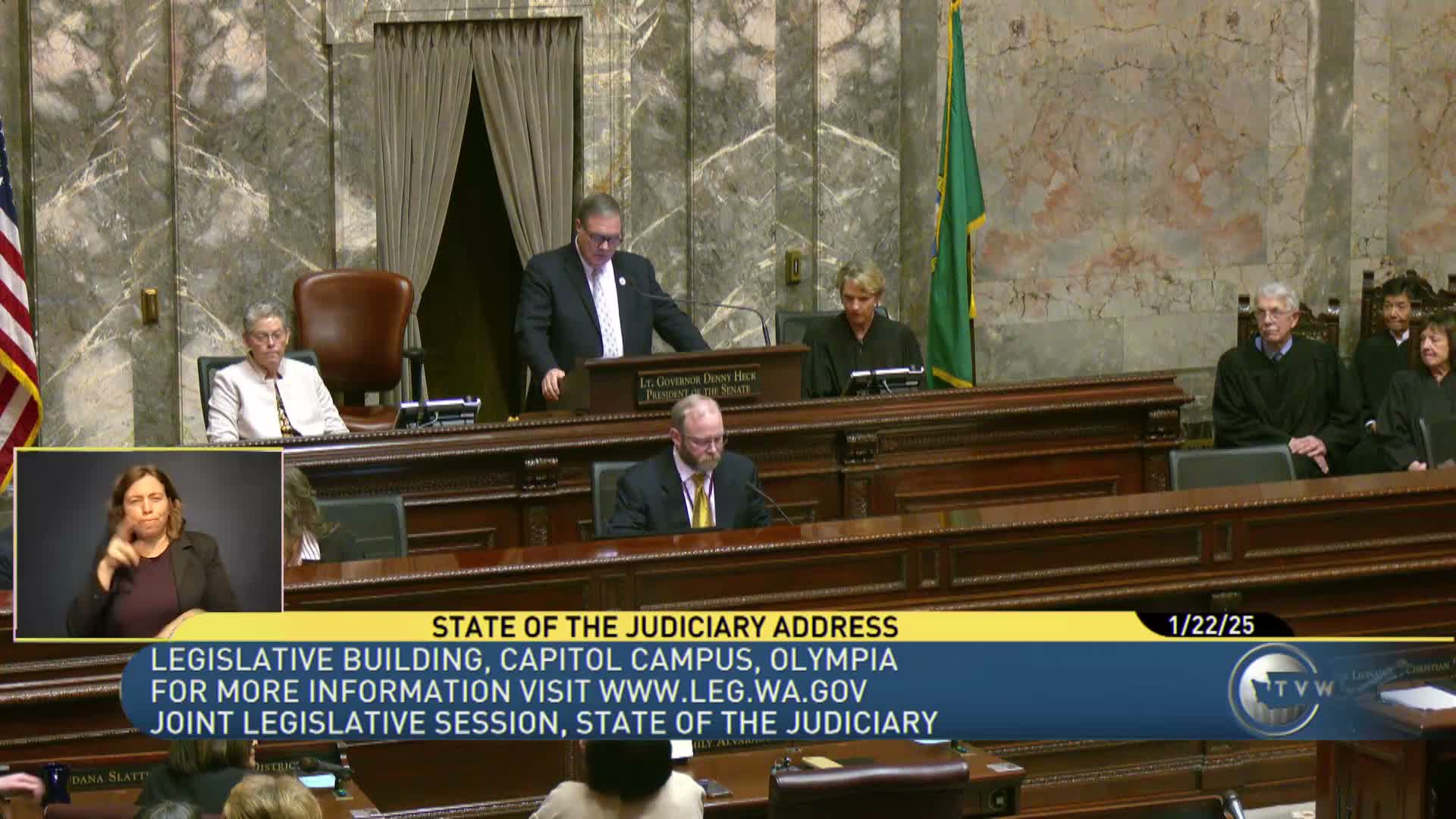
Chief Justice Deborah L. Stevens delivered the State of the Judiciary to a joint session of the Washington State Legislature, calling for sustained investment in court modernization, cybersecurity, and programs that increase access to justice.
Stevens framed the judiciary's priorities around building “courts of the future” that are innovative, responsive and inclusive. She said the courts continue to offer remote proceedings and alternative dispute-resolution options that improved access while systems recover from pandemic disruptions. “We are the many judges and other court professionals who serve the public in the judicial branch of our government,” Stevens said in her opening remarks.
Why it matters: Stevens asked lawmakers to maintain funding for the Administrative Office of the Courts (AOC) to support statewide IT infrastructure, case-management modernization, and programs that reduce barriers to justice. She stressed that technology projects require ongoing state backing to be effective in local courts.
Major initiatives and numbers - Therapeutic courts: Stevens said innovative therapeutic court programs have nearly doubled statewide, providing alternatives focusing on rehabilitation for people with mental-health and substance-use disorders. - Language access and self-help services: The judiciary has expanded interpreter services and launched an equity and access web page; Stevens also highlighted courthouse clinics and self-help centers that assist unrepresented litigants. - Blake decision implementation: Stevens reported that the Blake Refund Bureau has issued more than $4,000,000 in refunds for approximately 3,300 qualifying cases; an additional $21,000,000 is pending for nearly 63,000 submitted cases across about 127 courts. She added that roughly 55,000 Blake convictions have been vacated, benefiting more than 37,000 individuals in Department of Corrections custody. These relief and outreach efforts, she said, will continue through 2025.
On jury service, Stevens spotlighted a Pierce County pilot that increased juror compensation by 900 percent, noting the large percentage reflects a low starting rate (juror pay previously was $10 per day). Stevens said higher pay addresses economic barriers and promotes jury diversity.
Technology, cybersecurity and AI Stevens described a Court of Limited Jurisdiction Case Management System (CLJ CMS) pilot as a major modernization effort for lower courts and said continued state support is essential to implementation. She reported that a recent cyberattack on the courts’ network was resolved and major systems restored within 18 days thanks to AOC response efforts and urged investment in advanced cybersecurity protocols to protect sensitive data. Stevens also cautioned about the promise and perils of artificial intelligence, saying that “judicial decisions will always be made by judges” and that the judiciary will work with the Washington State Bar Association AI Task Force and partners to evaluate AI tools.
Support and recognition Stevens thanked the legislature for recent funding that stabilized statewide IT infrastructure and supported rural courts and therapeutic programs. She recognized judges and court staff who led local innovations and emphasized that continued funding is necessary to maintain services, training and programs statewide.
Closing and next steps Stevens closed by quoting Cornel West: “Justice is what love looks like in public,” and urged collaboration across branches of government and the community. After the address, Senator Roccelli moved to dissolve the joint session; members voted in favor and the president declared the joint session dissolved.