Get Full Government Meeting Transcripts, Videos, & Alerts Forever!
Get email alerts on the Jury Selection topic
No spam. Unsubscribe anytime.
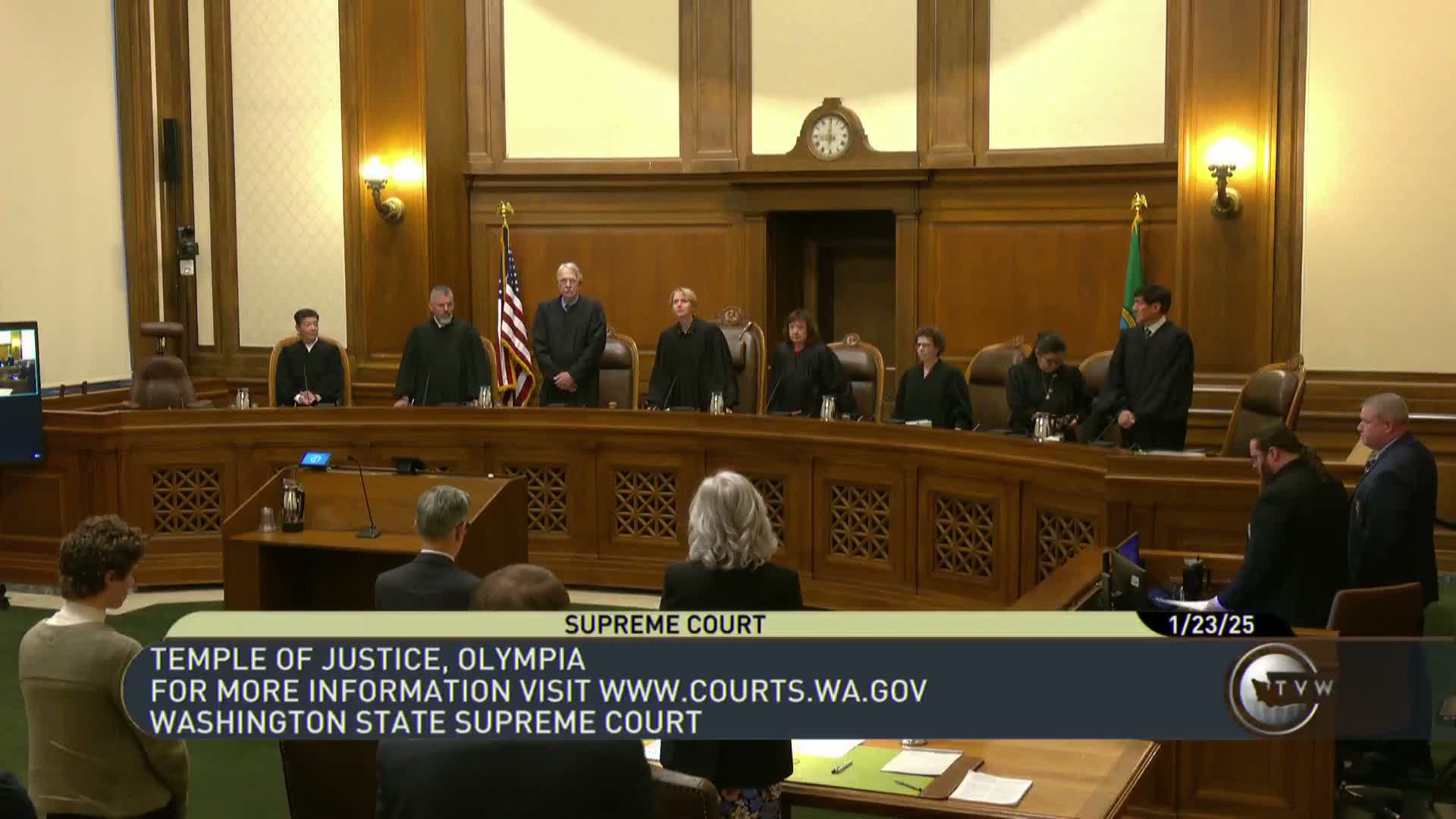
Washington Supreme Court hears challenge to juror strike and GR 37 notice rule
Summary
The Washington State Supreme Court heard argument in State v. Sean Lamar Bell over whether a peremptory strike based on a prospective juror's comment that he "wasn't paying attention" required the State to give prior notice under GR 37 and whether an objective-observer, de novo review applies. Counsel clashed over timing of notice, the meaning of the juror's words, and deference to trial-court observations; the Court recessed to consider the issue.
The Washington State Supreme Court heard arguments Thursday in State v. Sean Lamar Bell about whether the State properly used a peremptory strike after a prospective juror said "I wasn't paying attention," and whether the strike should have been subject to GR 37's notice and corroboration procedures.
Petitioner counsel Britta Halverson told the Court the Court of Appeals reversed Mr. Bell's convictions because the State did not give formal notice of its intent to strike that juror, but argued GR 37(I)'s notice and corroboration requirements do not apply when a juror expressly admits inattention. "The best evidence of a juror's inattention is the jurors' own admission of their inattention," Halverson said, urging the justices to treat the juror's words as the operative fact and to reverse the Court of Appeals.
Respondent counsel Monique Mystery urged the justices to read GR 37 as a safeguard against the disproportionate removal of jurors of color and to apply an objective-observer test without deference to the trial court's subjective impressions. "We start with an objective observer who is not only aware of the history of discrimination in jury selection, but also who understands implicit bias," Mystery said, arguing that the record showed similarly situated white jurors who asked for questions to be repeated were left on the panel while juror 39, a person of color, was singled out.
The justices pressed both sides on practical and doctrinal points. They asked Halverson to explain the voir dire logistics — COVID-era masking, the length of individual questioning (about 2.5 days), and that roughly 50 of 81 potential jurors had individual questioning — and whether juror 39 had actually been individually questioned. Halverson replied the juror's statement came during the final round of general voir dire and that the juror's own words and the trial judge's contemporaneous observations supported the strike.
Several justices questioned Mystery about whether an allegation of inattention can be a pretext for discrimination and about when a party must give "reasonable notice" that it intends to use a peremptory challenge based on inattention. Mystery said the rule requires that a party who may rely on such a justification give notice so the court and opposing counsel can verify and, if appropriate, further question the juror or panel before accepting the strike.
The Court also discussed standards of appellate review. Mystery argued GR 37 displaces the usual deference accorded trial-court demeanor findings by imposing an objective-observer, de novo standard; Halverson countered that factual findings about a juror's demeanor traditionally receive deference and that the juror's own admission warranted a different treatment.
Counsel for both sides reiterated that the record contained competing evidence: Halverson emphasized the contemporaneous judge's observation that juror 39 appeared disengaged, while Mystery pointed to the broader pattern in the voir dire (other jurors asking for repeats, and several jurors not asked questions at all) and the State's failure to give pre-exercise notice about using peremptories for inattention. "We're asking you to uphold the court of appeals decision and remand Mr. Bell's case for a new trial," Mystery told the Court.
After argument and questioning, the Chief Justice recessed the Court for 10 minutes. The justices did not announce a timetable for a decision from the bench at the hearing's close.
The case centers on competing interpretations of GR 37: whether a juror's own admission that he was not paying attention is a self-sufficient basis for a peremptory strike without prior notice and corroboration, or whether the rule's notice requirement and objective-observer framework must apply to guard against potential discriminatory use of inattention as pretext.