Get Full Government Meeting Transcripts, Videos, & Alerts Forever!
Get email alerts on the Vested Rights Firearm Restoration topic
No spam. Unsubscribe anytime.
Petitioner urges Supreme Court to apply vested-rights rule to firearm-restoration statute
Summary
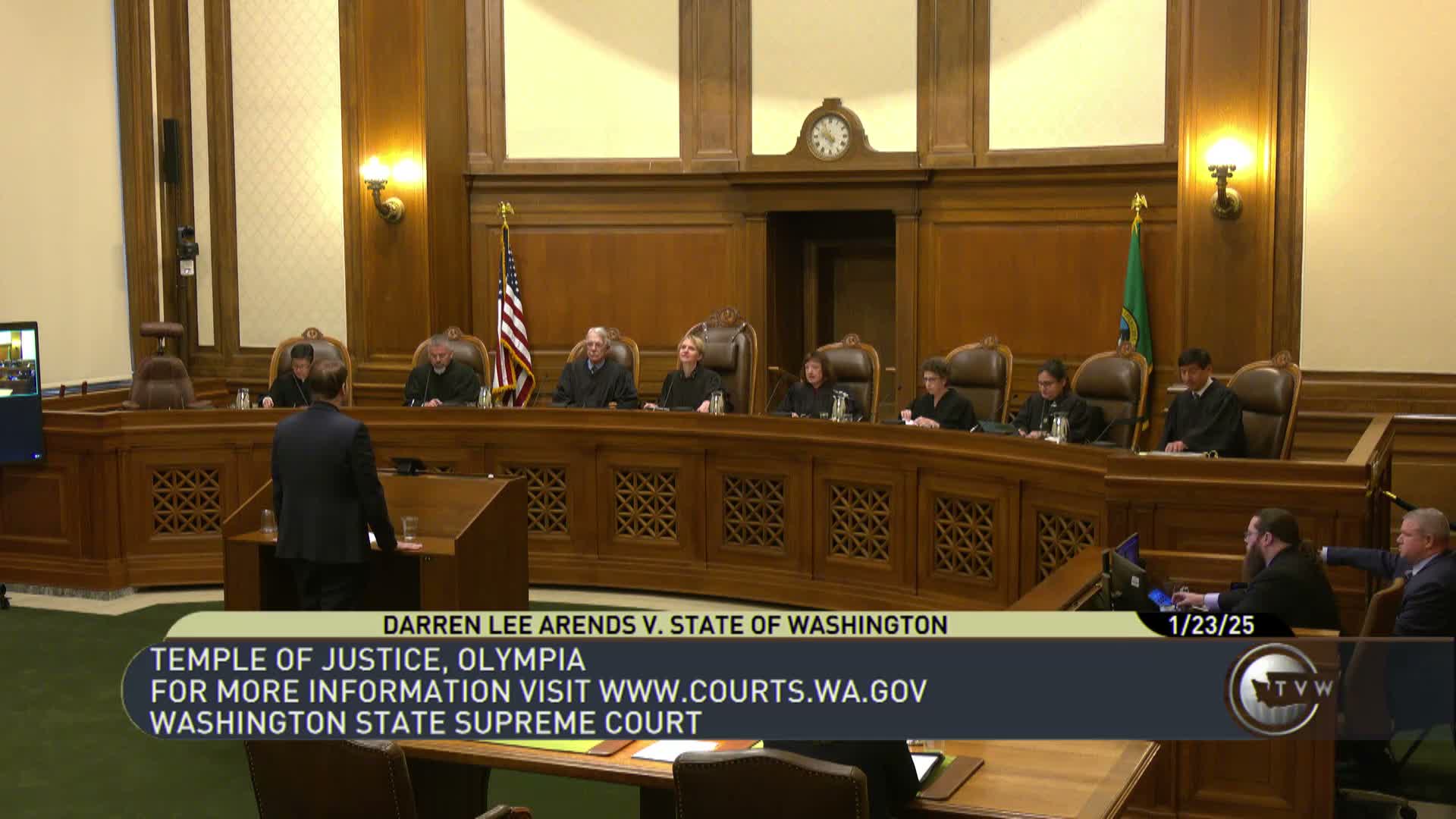
At oral arguments in Ahrens v. State of Washington, petitioner’s counsel argued that previously vested rights — including an earlier venue provision — should prevent application of a 2023 amendment to Washington’s firearm-restoration statute; the state countered that the amendment prioritizes victim participation and public safety.
At oral argument before the Supreme Court, counsel for petitioner Darren Lee Ahrens argued that the Court of Appeals erred by applying legislative-intent analysis instead of the established vested-rights framework and that the petitioner’s rights vested under the earlier statute, including the venue provision.
"A vested-rights analysis asks, does the statute operate prospectively or retrospectively?" said Vitali Kerchin, counsel for the petitioner, arguing the entire prior subsection — venue and substantive prerequisites alike — vested before the 2023 amendment took effect.
Kerchin told the court the record lacks a formal factual finding below that the petitioner met the former statute’s requirements but said the state did not contest merits in the lower proceedings and urged that the case be remanded so a superior court could resolve any factual questions.
The state’s deputy prosecutor, Nathan Sugg of the Snohomish County Prosecutor’s Office, said the legislative update (referred to in argument as House Bill 1562) reshaped the restoration process to reflect modern research and to prioritize victim participation and safety. "The legislature opted to prioritize victim safety with a victim-informed, evidentiary procedure in this case," Sugg said, emphasizing prosecutorial duties to identify and notify victims so they may provide information about ongoing risk.
Justices pressed both sides on whether the prior decision known as TK controls and on the practical consequences of a ruling for vested petitioners. Kerchin said TK’s precipitating-event and subject-matter analysis supports applying vested-rights here; Sugg argued TK addressed juvenile sealing and rehabilitation and that firearm-restoration statutes regulate different subject matter tied directly to public safety.
Sugg warned that accepting a broad vested-rights rule for restoration petitions could allow petitioners vested under older statutory regimes to bypass substantive safeguards introduced in 2023 — for example, law-enforcement background checks and new disqualifying-offense rules — and would impose substantial administrative burdens on lower courts asked to evaluate multiple historical statute versions. He noted that Mr. Ahrens’s original conviction dates to 1988, creating potential uncertainty about which vintage statute might apply.
Throughout argument, the bench questioned whether a venue requirement could be treated differently from substantive eligibility criteria and whether the lack of an alternative venue would require the court to construe the new statute to preserve a petitioner’s ability to be heard. Kerchin acknowledged some record gaps but maintained that the vesting question should govern the case’s resolution rather than unbriefed venue-construction arguments.
No decision was announced. The cases were submitted and the Court adjourned. The court may issue a written opinion resolving whether petitioners like Ahrens may proceed under prior statutory terms or whether the 2023 amendments control.