Get Full Government Meeting Transcripts, Videos, & Alerts Forever!
Get email alerts on the Statutory Defenses Carceral Context topic
No spam. Unsubscribe anytime.
Washington Supreme Court hears challenge over felony-bar and intoxication defenses in jail deaths
Summary
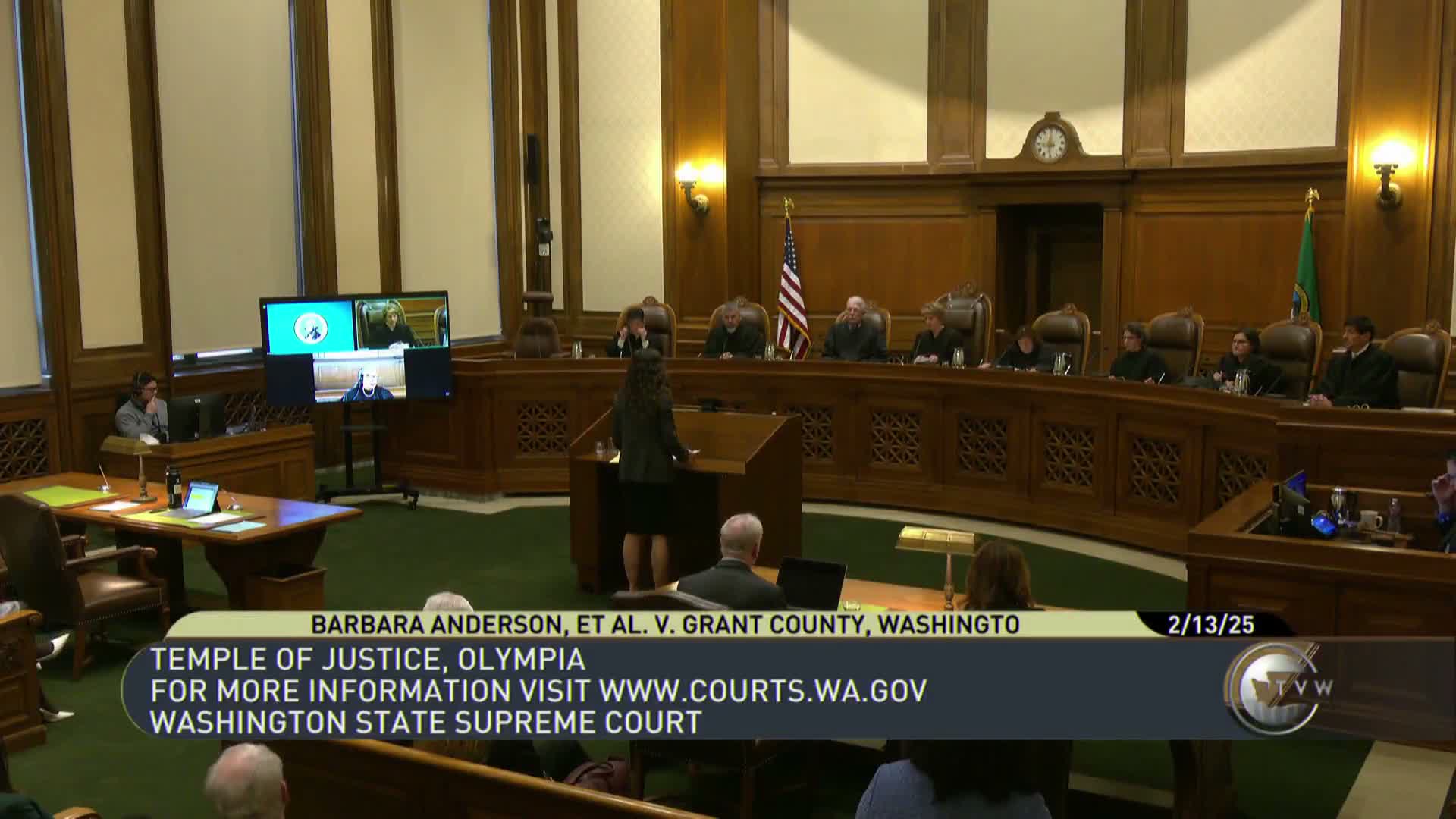
At oral argument in Anderson v. Grant County, counsel debated whether Washington's felony-bar and intoxication statutory defenses can fully bar damages claims when harm occurs in jails, and whether jails may assert comparative fault or are effectively barred by their custodial duties.
The Washington State Supreme Court on Feb. 13 heard argument in Anderson v. Grant County over whether state statutes that bar recovery for injuries connected to felonious conduct or intoxication apply when the conduct and injury occur inside jails — and whether a jail can ever assert comparative fault against an incarcerated person.
Petitioner counsel Shelby Lemel of Masters Law Group told the court that two statutory questions are at issue: "the statutory defenses and their application in a carceral context" and whether a jail or prison can assert comparative fault given the special relationship between custodial institutions and people they incarcerate. Lemel argued the legislature's adoption of the felony-bar statute and RCW 9.94 (which defines certain felonies in a carceral context) reflected a policy judgment and that those statutes operate as complete defenses when their elements are met.
"When the injured party committed a felony and that felony is a proximate cause of their injury, then they may not recover damages," Lemel told the justices, stressing that the statutes are grounded in legislative compromise.
Plaintiffs' counsel Jim Dixon said the case facts show procedures at the Grant County jail were not followed and that failure to follow those procedures — including a reasonable-suspicion strip search that he said was warranted — allowed contraband into the facility. "In our case, we would establish that there were procedures in place that were not followed," Dixon said, arguing that adherence to policy could have prevented the decedent from obtaining the drugs that led to his death.
An amicus appearing in support of the plaintiffs, Valerie McComie of the Washington State Association for Justice Foundation, urged the court to read the statutes against the backdrop of long-established common-law duties a jail owes to its inmates. "What do we do if we grant a complete defense to jails for felony conduct or intoxicated conduct?" McComie asked, warning that a broad reading could "eviscerate" custodial duties recognized by this court in cases such as Gregoire.
The justices pressed both sides on key lines of authority and limits: several asked whether Gregoire, Hendrickson and Christiansen should be read as creating bright-line rules that foreclose comparative fault, or instead as fact-specific applications of special-relationship principles. Counsel debated whether the legislature intended to displace common-law duties and whether such displacement would produce absurd results in custodial settings where staff observe or could intervene in an inmate's distress.
At oral argument counsel and amicus repeatedly emphasized that the dispute before the court is narrow on the two statutory defenses but that unresolved questions — including comparative fault's availability and whether an amendment applies retroactively or only to policing in the field — remain for the court to decide or, if ambiguous, for the legislature to address.
The court submitted the case and recessed for 10 minutes. No decision was announced at the hearing.
The court will later issue a written opinion resolving the statutory questions and any attendant questions about comparative fault and the interplay between statutory defenses and the jail's custodial duties.