Get Full Government Meeting Transcripts, Videos, & Alerts Forever!
Get email alerts on the Statutory Interpretation topic
No spam. Unsubscribe anytime.
Washington Supreme Court hears argument over whether "job applicant" includes anyone who clicks "apply"
Summary
At oral argument in Branson v. Washington Fine Wines & Spirits, LLC, advocates and justices debated whether Washington's pay-transparency law allows any person who submits an application (including through third-party sites) to sue, or only "bona fide" job seekers; counsel disagreed about legislative intent, L&I guidance, and litigation risks.
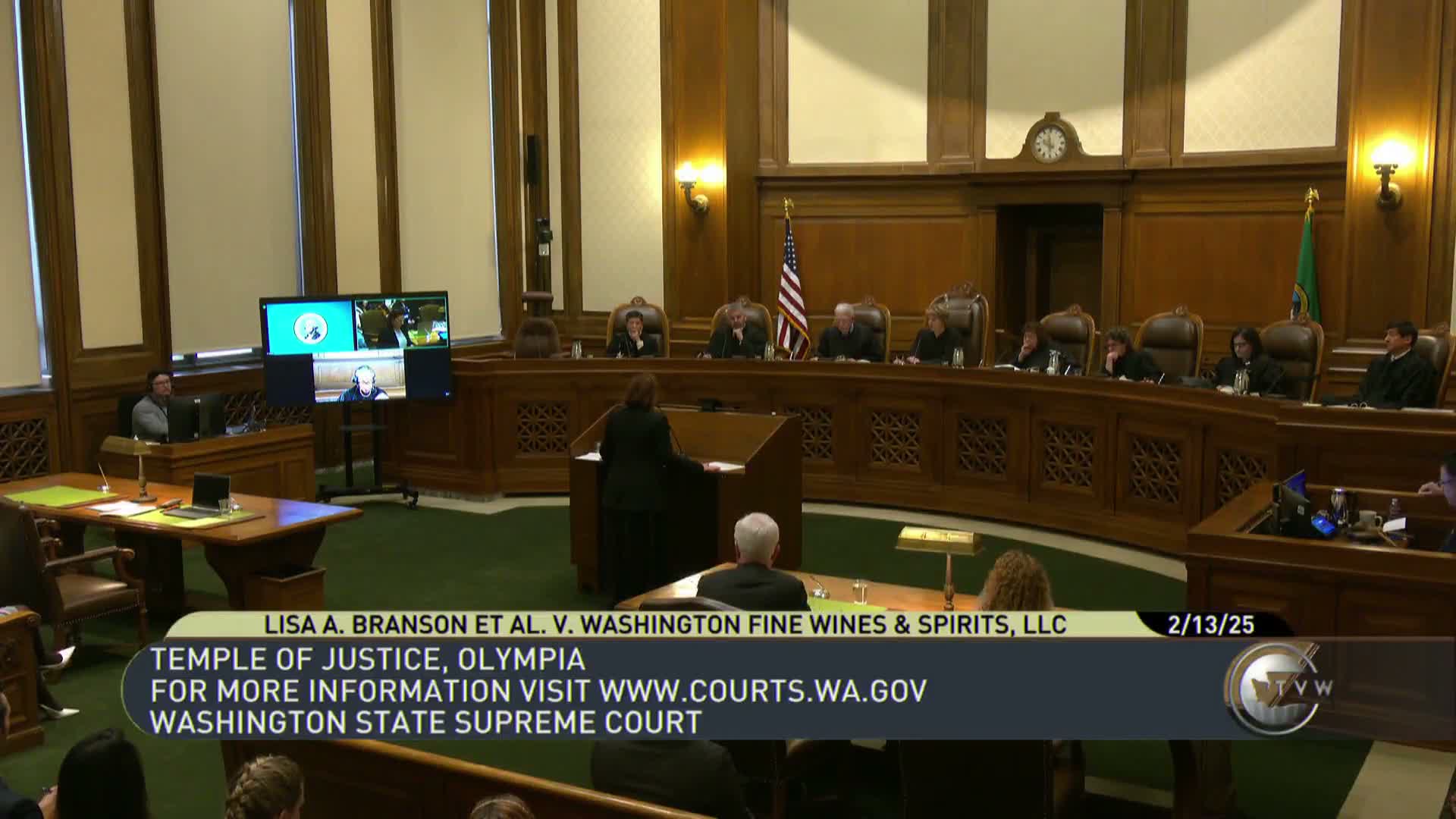
The Washington Supreme Court heard oral argument in Branson v. Washington Fine Wines and Spirits, LLC on whether the state's amended pay-transparency law allows a private suit by any person who submits an application to a posted job or only by a bona fide job seeker.
Sydney Tribe, representing appellants Lisa Branson and Sherry Burke, told the court the statute's plain language uses the term "job applicant" without qualification and that the legislature could have included words such as "bona fide" or "qualified" if it intended to limit the protected class. "The point of this law is wage transparency," Tribe said, urging the court to confirm that a person who submits an application to a job posting is a job applicant entitled to the statute's private remedies.
Justices tested the practical consequences of that plain-language reading with hypotheticals. One justice asked whether a 10-year-old or an 18-year-old who applied for an advanced specialty position would qualify as a job applicant. Tribe acknowledged potential practical limits on remedies (for example, capacity and standing issues) but maintained the statutory text does not import an intent or qualification requirement.
William Murphy, counsel for Washington Fine Wines and Spirits, argued the statute should be read to protect job seekers who are actually seeking employment. Murphy told the court that the record and industry groups show a wave of class actions he described as opportunistic: "There are over 300 class actions that have been filed in the courts of this state," he said, adding many were brought by a small set of repeat plaintiffs.
Murphy urged the court to adopt a definition tied to good-faith intent to obtain an offer, citing Labor & Industries (L&I) interpretive materials and proposed rulemaking that he said supports a bona fide-applicant approach. He warned that requiring individual intent-based inquiries would be necessary to determine class composition and could invite burdensome, individualized discovery.
The bench also raised concerns about national job-posting platforms that publish uniform wage ranges or national starting wages that may not reflect local minimums. Justices probed whether the pay-transparency law's posting requirement (a solicitation "intended to recruit job applicants for a specific available position," as Murphy read the provision) implies a location- or position-specific focus that would exclude generalized platform listings.
Tribe responded by analogizing the statute to the Public Records Act, where a requester's subjective intent does not defeat a statutory remedy. She also noted the legislature considered, but did not enact, an amendment to add the term "bona fide," and argued that omission counsels in favor of the broader plain-language reading.
Both sides framed part of the dispute around enforcement mechanics: Tribe said private rights of action and broad standing help enforce wage-transparency obligations the state cannot easily police alone; Murphy said the court should guard against what he described as systematic gaming of the statute by litigants who click applications on third-party sites to trigger statutory remedies.
The arguments closed with Tribe asking the court to answer the certified question that "job applicant" includes a person who applies for a job posting. The case was submitted and the court adjourned.
What happens next: The court will issue a written answer to the certified question, which will clarify whether Washington's pay-transparency law requires a showing of bona fide intent or whether the plain language is determinative.