Get Full Government Meeting Transcripts, Videos, & Alerts Forever!
Get email alerts on the Appellate Procedure Victim Privacy topic
No spam. Unsubscribe anytime.
Washington Supreme Court hears argument over whether victims can intervene on appeal to shield medical records
Summary
The Washington Supreme Court heard argument in State v. Lester Thompson Jr. over whether a decedent's estate may intervene as a party on direct appeal to protect a victim's medical records. Defense counsel said party intervention turns the estate into a second prosecutor; intervener and state counsel argued victims need a direct remedy under Criminal Rule 4.8 and appellate procedure.
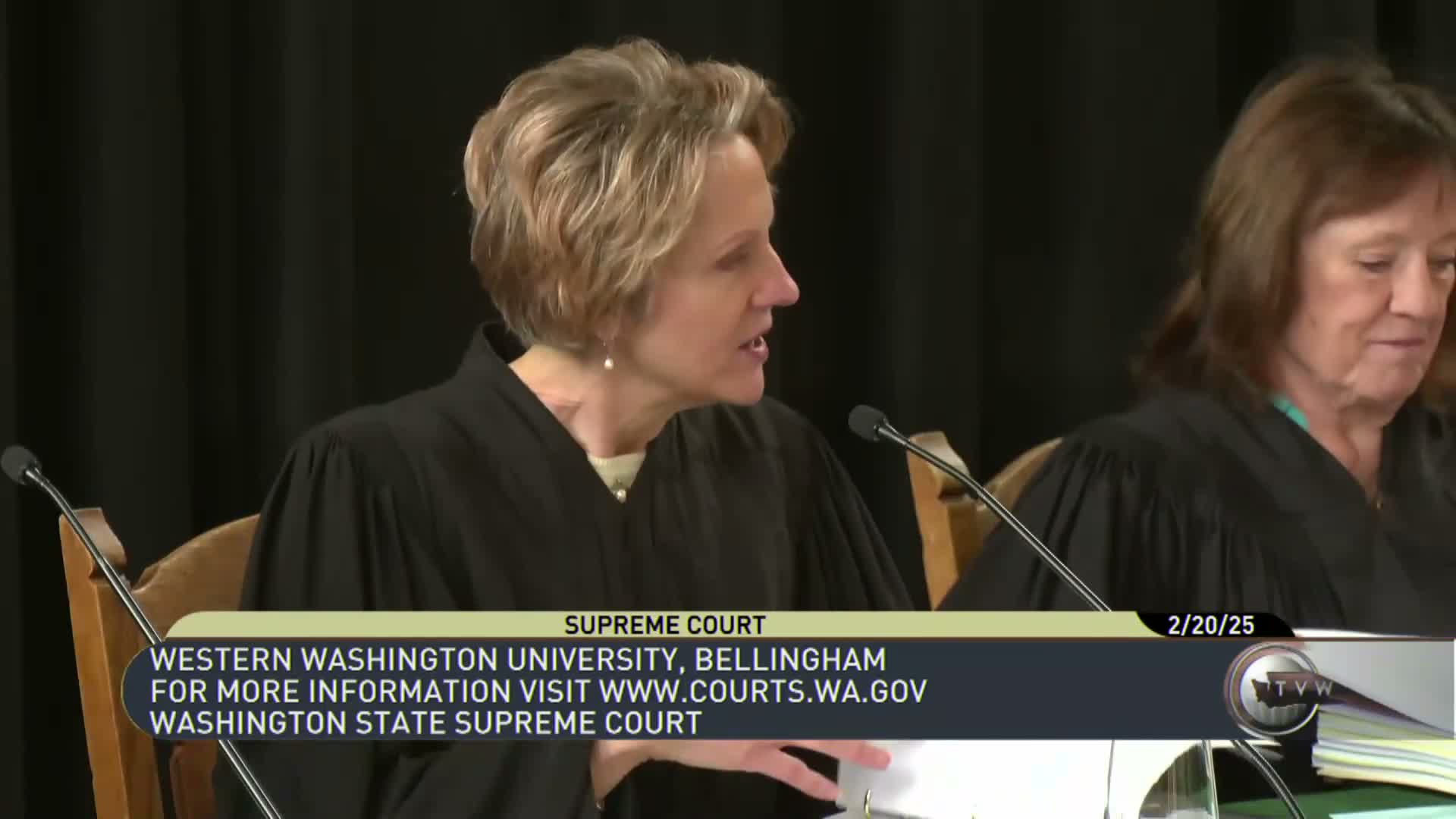
The Washington State Supreme Court convened at Western Washington University on a traveling court sitting to hear argument in State of Washington v. Lester Thompson Jr., a dispute over whether the decedent's estate may intervene as a party on direct criminal appeal to defend the privacy of medical records.
The question before the court was procedural but potentially consequential: does allowing a nonparty who sought and obtained a trial-court protective order to intervene on appeal turn that nonparty into a party defending the conviction, and if so, what remedies and limits are appropriate? The court heard 15-minute principal arguments followed by questioning from multiple justices and a brief rebuttal before the case was submitted.
Defense attorney Christopher Buffroni, appearing for Thompson, told the court that the Court of Appeals erred in permitting the estate to intervene as a party on direct appeal and that doing so improperly lets the estate act as a second prosecutor. "The court of appeals erred in allowing the decedent's estate to intervene as a party in Mr. Thompson's criminal appeal," Buffroni said, arguing the proper vehicle for a nonparty seeking to protect privacy interests would have been pretrial objections, a limited trial-court appearance, or discretionary review before the direct appeal began. He warned that on direct appeal an estate defending a trial-court protective order necessarily "is defending the conviction," a role he said is constitutionally committed to the prosecution.
Counsel and several justices explored alternatives. Justices asked whether the estate could have sought discovery protection through motions to quash subpoenas, discretionary review, in-camera review, or protective orders on remand. Buffroni acknowledged some remedies exist before and after trial but argued those options may not provide an immediate appellate remedy once a direct appeal is underway.
Elizabeth Flavin, counsel for Jerry Gates (the intervener), urged the court to affirm the Court of Appeals' approach as a limited and appropriate way to protect the privacy interests at stake. Flavin cited appellate procedure(RAP 1.2) and the court's ability to interpret rules liberally so cases are decided on the merits, saying the intervener sought participation narrowly "regarding the protection of her daughter's medical records." She told the court that victims have constitutionally recognized rights and that Criminal Rule 4.8 gives victims prior notice and an opportunity to seek protective orders when records are subpoenaed.
State counsel Ann Summers acknowledged the prosecution does not represent victims and supported mechanisms that allow victims to protect privacy without forcing them into full prosecutorial roles. "In a criminal prosecution, the state does not represent the victim," Summers said, and she explained that Rule 4.8 was designed to give victims notice and a route to seek protective relief without requiring an entirely separate action.
Justices probed whether allowing victims appellate participation on privacy motions would expand into broader appellate intervention or create conflicts with defendants' rights. Flavin said she sought only to be heard on the limited privacy issue, while Buffroni cautioned that defending a trial-court ruling on appeal can entangle the intervener in the merits and the defendant's right to a complete defense. Discussion referenced state and federal case law (including Yakama Herald Republic and other precedents) as the bench tested the doctrinal boundaries for intervention, discretionary review, and collateral remedies.
After a short rebuttal from defense counsel reiterating federal analogues and potential remedies for nonparties, the court submitted the case. The court offered no immediate ruling from the bench and recessed for 10 minutes.
The court's upcoming decision will determine how Washington appellate practice balances victim privacy protections under Criminal Rule 4.8 with the traditional prosecutorial role and the defendant's appellate rights.