Get Full Government Meeting Transcripts, Videos, & Alerts Forever!
Get email alerts on the Statutory Interpretation topic
No spam. Unsubscribe anytime.
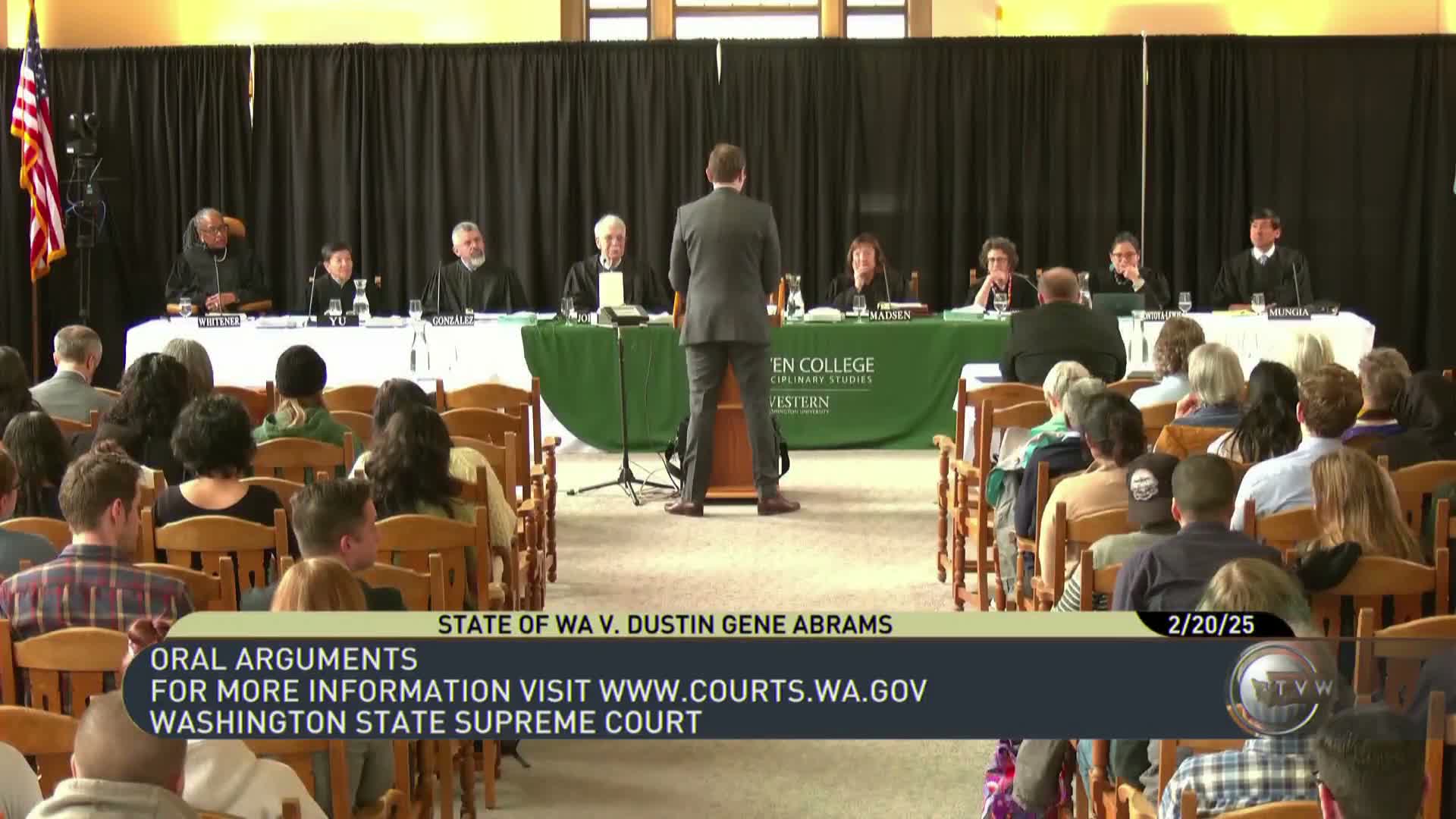
Washington Supreme Court hears argument over vacatur for defendant still in custody
Summary
In State v. Dustin Jean Abrams, the court considered whether a person who remains imprisoned on a separate conviction may seek vacatur of earlier convictions under the statute discussed as section 6 40 of the SRA; defense counsel urged remand for the trial court’s discretion, while the State said the waiting period reflects rehabilitation in the community and counsels against vacatur for those still in custody.
The Washington State Supreme Court on a traveling oral-argument session at Western Washington University heard opposing views on whether a person still imprisoned for another crime may move to vacate earlier convictions under the statute cited in argument as section 6 40 of the SRA.
Christopher Petrone, counsel for Dustin Abrams, told the court that the statute permits a person to file a motion to vacate once the statutory waiting period runs for the offense sought to be vacated and that the Court of Appeals erred by substituting its own discretion for the trial court’s. “The statute allows a person to move to vacate a conviction when the required amount of time has passed after they finish their sentence on that conviction, even if they remain in prison on other convictions,” Petrone said, urging the court to reverse the Court of Appeals and remand so the trial court can exercise its discretion.
Petrone acknowledged that a movant bears the burden of establishing eligibility criteria under the statute and the court’s precedent in Hawkins requires trial courts to consider relevant facts, including evidence of rehabilitation, but he said producing rehabilitation evidence is not a statutory prerequisite to having the trial court exercise discretion.
Kevin McCray, arguing for the State, countered that the statute’s waiting periods are aimed at reentry and public-safety considerations and that vacatur makes the most sense when an applicant has shown rehabilitation while in the community. “Here, Mr. Abrams is not reentering the community and won’t for quite some time,” McCray said, arguing that allowing vacatur for someone who has never been out in the community would “defeat the purpose” of criminal records and background checks.
The justices pushed on textual questions and policy consequences. One justice said the phrase “release from total or partial confinement” reads like physical release into the community and asked counsel to explain why the phrase should be read otherwise. Petrone replied that consideration of the Sentencing Reform Act’s overall structure and a separate “washout” provision supports reading the timing provision to focus on release from confinement for the offense at issue rather than requiring a period living in the community.
Bench exchanges addressed whether the clock runs from the sentencing date, release from confinement, or release from community custody (the statute’s three alternatives), and whether a person’s confinement in non-state custody or a “not guilty” confinement episode should count. Counsel debated whether establishing the statutory criteria creates a presumption in favor of vacatur or merely triggers the trial court’s discretionary inquiry; Petrone said meeting the criteria permits the court to exercise discretion, but does not compel vacatur, while the State argued the petitioner must show rehabilitation by a preponderance.
Counsel and several justices also discussed practical consequences inside prisons — for example, whether vacated convictions would affect programming or housing classifications — and whether the Department of Corrections would have to treat a vacated conviction as nonexistent for those internal decisions. Petrone said vacatur removes the conviction from criminal history and prohibits law enforcement from reporting it, although prosecution could still allege the underlying conduct if relevant to a subsequent offense.
After rebuttal the court submitted the case. As part of its traveling-court outreach, the bench then took questions from students and community members about appellate practice, how to prepare for oral argument, and the path to higher review; justices advised careful preparation, concise briefing, and listening closely to the court’s questions. The court adjourned after the outreach session.
The court did not announce a decision; the case was submitted for ruling.