Get Full Government Meeting Transcripts, Videos, & Alerts Forever!
Get email alerts on the Statute Of Limitations topic
No spam. Unsubscribe anytime.
Washington Supreme Court hears argument over whether Copper Creek controls Love v. West Coast Servicing
Summary
The court heard competing arguments over whether the Court of Appeals failed to follow this court’s Copper Creek precedent in applying the statute of limitations to an installment note and whether relief is available under Civil Rule 60(b)(11). Counsel debated finality, fairness and the practical consequences for foreclosure and quiet-title claims.
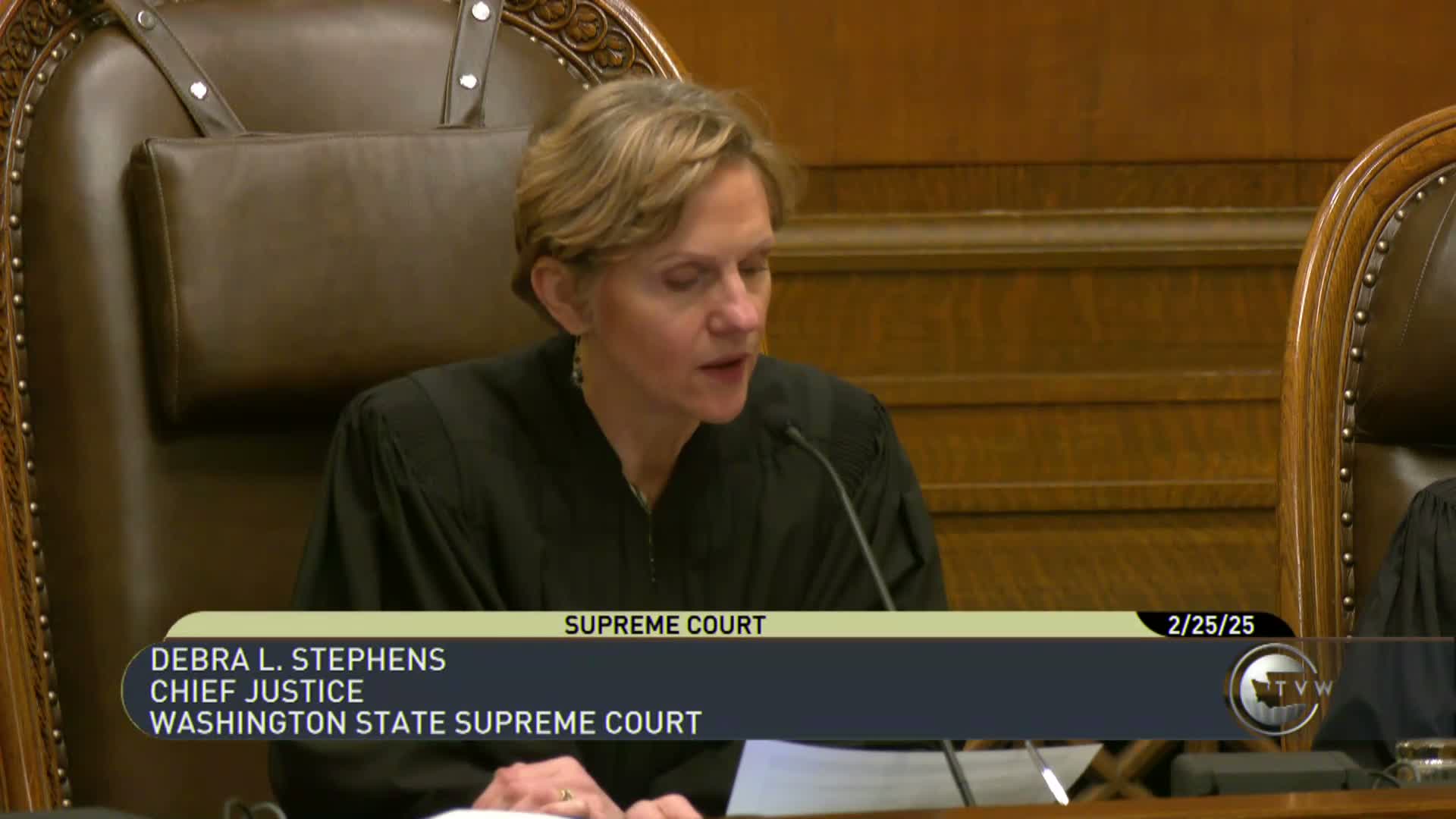
The Washington Supreme Court heard argument Tuesday in Prince Eric Love v. West Coast Servicing Inc., a dispute about whether the Court of Appeals properly applied this court’s Copper Creek decision to the statute of limitations on an installment note and whether relief may be granted under Civil Rule 60(b)(11).
Joe McIntosh, counsel for West Coast Servicing, told the court the core question is not merely whether a trial court complied with CR 60 but whether the Court of Appeals followed this court’s direction to "follow Copper Creek," a statute-of-limitations decision. McIntosh said the procedural history — multiple Court of Appeals opinions (Love 1, Love 2, Love 3) and this court’s remand instruction — makes the case uniquely appropriate for corrective direction, not simple Rule 60 review. "You need to follow the statute of limitations," McIntosh told the bench, arguing that if the Court of Appeals applies Copper Creek the outcome at the superior court would differ.
Kevin Hohalter, counsel for Prince Eric Love, framed the matter as a clash between finality and correctness. "This case is about the competing values of finality and correctness," he said, urging the court that longstanding precedent limits Rule 60(b)(11) relief where the underlying problem is an error of law rather than an extraordinary, extraneous circumstance. Hohalter argued that allowing Rule 60(b)(11) to reopen error-of-law judgments would undermine finality and invite repeated challenges after ordinary appeals have run their course.
The justices pressed both sides on the precise vehicle for review. Several asked whether the appeal effectively rests on the trial court’s CR 60(b)(11) motion that was denied at the trial level and then appealed to the Court of Appeals, and whether the Supreme Court’s earlier instruction to "reconsider in light of Copper Creek" should be read as an instruction to apply a change in law or simply to revisit the earlier result. McIntosh urged that the remand instruction contemplated application of Copper Creek’s statute-of-limitations framework; opposing counsel and several justices said the Court of Appeals had characterized Love 1 as an error of law, not a change in law.
Counsel discussed concrete accrual questions tied to an installment contract at issue in the case: McIntosh described the note as a 20-year installment agreement with installments running from February 2005 through 2025 and said each installment carries a six-year limitations period for enforcement because it is a written contract. He argued that foreclosure initiated in 2018 could reach back six years (to 2013) to enforce installments within the limitations window and that some installments therefore remained timely and secured by a lien. McIntosh also maintained a bankruptcy discharge does not alter the state statute-of-limitations accrual for secured remedies.
Hohalter warned that reversing finality would revive foreclosure and additional costly litigation and described the policy reasons courts typically give finality greater weight absent extraordinary circumstances extraneous to the litigation (for example, an intervening change in federal law followed by congressional action). He also urged the court to reject a broad reading of CR 60(b)(11) that would permit reopening judgments because of an error of law alone.
Hohalter asked the court to award attorney fees if Love prevails, citing the deed-of-trust language that allows recovery of "reasonable fees and costs" when a lender proceeds to foreclosure and referencing RCW 4.84.330 as creating reciprocal fee rights under state law.
At argument’s end the justices thanked counsel and took the case under submission; no decision was announced from the bench. The court recessed for a 10-minute break.
Next steps: the Supreme Court will issue an opinion at a later date resolving whether the Court of Appeals must be instructed to apply Copper Creek’s statute-of-limitations analysis and whether CR 60(b)(11) provides a basis for the relief West Coast seeks.