Get Full Government Meeting Transcripts, Videos, & Alerts Forever!
Get email alerts on the Pseudonymity Disclosure topic
No spam. Unsubscribe anytime.
Washington Supreme Court weighs unsealing disclosure document in Doe pseudonymity dispute
Summary
The court heard arguments over whether a trial court properly sealed a disclosure document that preserves plaintiffs' pseudonymity in a case involving records about level 1 *** offenders. Counsel debated abuse-of-discretion review, redaction alternatives and whether a sealed disclosure list should be required.
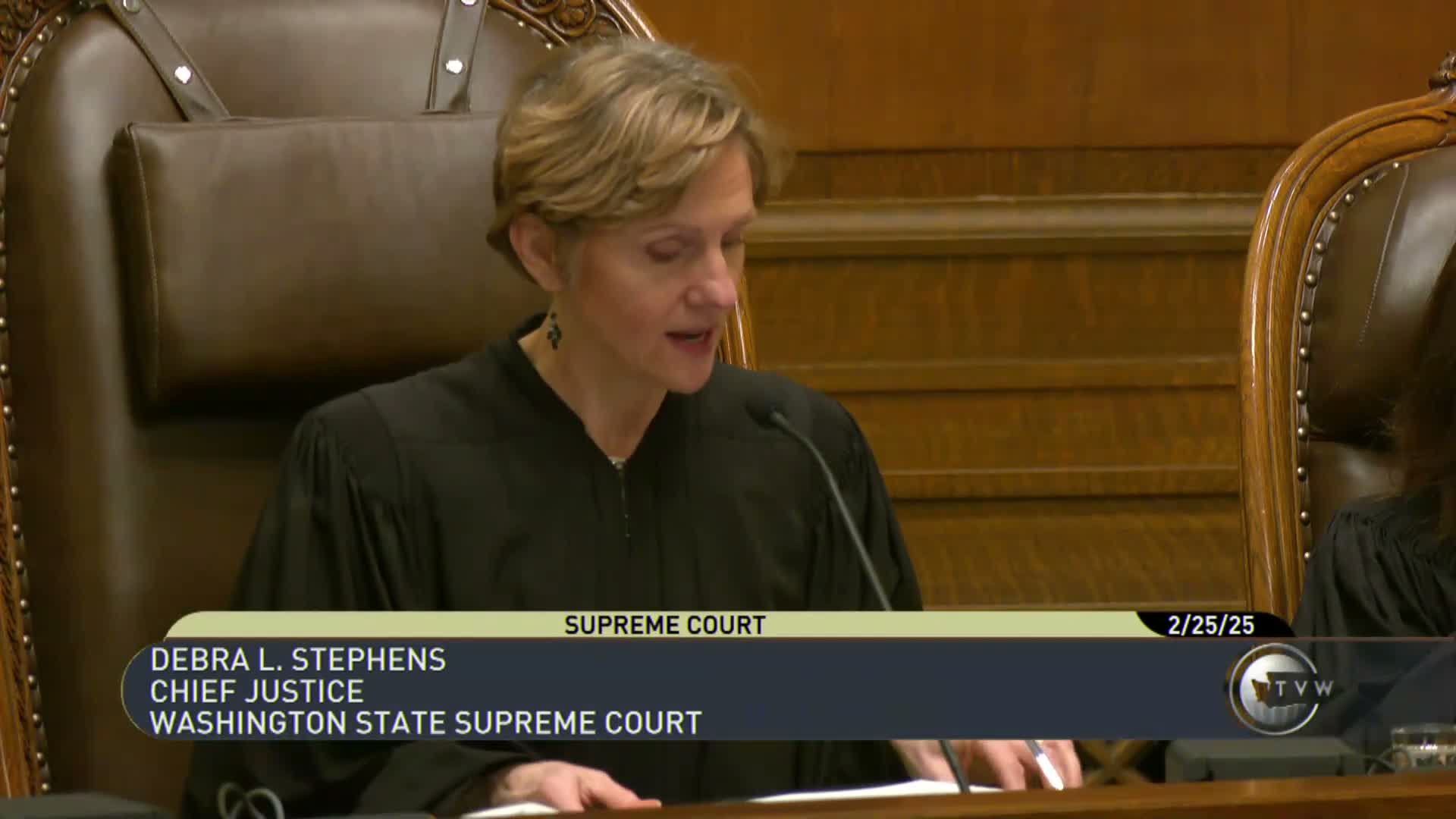
The Washington State Supreme Court on Feb. 25 heard argument over whether a lower court properly sealed a disclosure document that keeps the plaintiffs identified only by pseudonyms in a decade-old suit seeking release of records about level 1 *** offenders.
LaRonde Baker, an attorney with the ACLU of Washington, told the court that Division I of the Court of Appeals erred by failing to apply the abuse-of-discretion standard to the trial court's decision to seal the disclosure document, and that unsealing would defeat the plaintiffs' ability to proceed pseudonymously. "Pseudonymity can't be maintained if this disclosure document that has the identities of the Does is actually released and unsealed," Baker argued, saying the trial court held full Ishikawa hearings and found factual support for sealing.
The dispute centers on whether the court should review the trial court's factual findings for substantial evidence under an abuse-of-discretion standard or instead defer to the Court of Appeals' analysis. Several justices pressed counsel on that precise question, asking whether the panel should "go back to what the trial court did and say, did they do it right or not?" Counsel urged the court to review both the trial court's findings and Division I's application of the standard so that the appellate review remains deferential to trial-level factfinding.
Donna Zink, appearing pro se, urged transparency and broader public access. "Our constitution is that the public has a right to know who's using your courts," Zink said, arguing that unsealing the disclosure document or restoring names to the case captions would keep the record open. She proposed a rule requiring a disclosure document when courts permit pseudonym filings so that identities could be available to the court or unsealed if circumstances change.
Karen Horowitz, counsel for the Thurston County respondents, defended the trial court's 12/23/2022 order to seal the disclosure document and urged the Supreme Court to review that order for abuse of discretion. "The trial court did not abuse its discretion when it granted the plaintiff's motion to seal the record at issue," Horowitz said, adding that the court considered redaction and found the document largely consists of identities that could not be meaningfully redacted to preserve public information.
Justices also asked whether intervening case law — including recent decisions distinguishing public acts from private matters — affects the analysis. Counsel for the petitioners said those cases differ because here the plaintiffs provided detailed, often sensitive personal information under a grant of pseudonymity and that identifying them now could retraumatize victims and chill future access to courts for marginalized litigants.
In rebuttal Baker reiterated that an unsealed disclosure document would become part of the searchable court record and said the result could "do extreme harm to the doctrine of pseudonymity," deterring litigants with sensitive claims from seeking relief. The court noted a recusal — Justice Mangea is not participating — and that Judge Linda Lee of the Court of Appeals is sitting pro tem. The case was submitted and the court adjourned.
The Supreme Court did not announce a decision at the argument; the case is submitted for resolution.