Get Full Government Meeting Transcripts, Videos, & Alerts Forever!
Get email alerts on the Ap Programs topic
No spam. Unsubscribe anytime.
Dr. Ricky Papandri outlines Huntington High School’s AP program, offerings and benefits
Summary
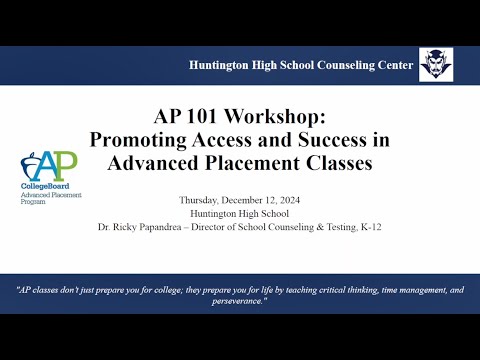
At an AP 101 workshop, Dr. Ricky Papandri, director of school counseling and testing for the Huntington Union Free School District, summarized AP course offerings, explained AP Capstone pathways and cited research on AP students’ higher college graduation and GPA outcomes. He also reviewed breakout sessions and resources for families.
Dr. Ricky Papandri, director of school counseling and testing for the Huntington Union Free School District, opened an AP 101 workshop at Huntington High School with an overview of Advanced Placement courses, how AP exams translate to college credit and the district’s local AP offerings.
Papandri said AP courses “are challenging with content that better prepare students for the rigors of college” and noted that most AP classes end with an exam while AP Research culminates in a research paper. He urged families to consult the College Board AP credit policy search to see how specific colleges award credit: “Some colleges just require 3 on the exam. Some may require 4,” he said, and “in certain cases, such as the Ivy League schools, may require a 5.”
The presentation foregrounded research linking AP participation with stronger postsecondary outcomes. Papandri cited a College Board figure that 65% of AP students graduate within four years compared with 39% of non‑AP students and said AP students tend to have higher first‑year college GPAs (he cited an average of 3.3 for AP students versus 2.9 for non‑AP students). He also referenced retention research indicating AP students are more likely to persist after their first year of college.
Papandri described nonacademic benefits as well, saying AP classes build critical thinking, problem solving and time‑management skills, strengthen college applications and can increase eligibility for merit‑based awards. He addressed several common misconceptions, telling families that AP is not limited to students who always earn top grades but is intended for students who are academically prepared and motivated. He acknowledged AP courses are challenging but emphasized supports such as peer study groups and teacher guidance.
On local offerings, Papandri said Huntington High School currently provides 30 AP courses across five academic departments, giving examples that ranged from AP African American Studies, AP World and AP US History to AP Biology, AP Calculus, AP Computer Science, AP Seminar/Research and AP Environmental Science. He outlined AP Capstone certification: a 3 or higher on AP Seminar and AP Research earns a Capstone Seminar and Research Certificate; combining those scores with at least four other AP courses (3+ each) can yield the AP Capstone Diploma.
Papandri also summarized recent local recognitions and participation numbers: roughly 127 AP Scholars last year (including 60 AP Scholar Award recipients, 24 with honors and 37 with distinction), three students earned AP Capstone Diplomas and three earned Seminar & Research Certificates. He said 403 students took AP courses last year and 876 AP exams were administered.
Practical information for families closed the session: handouts and online resources (including College Board materials and the BigFuture planning site) were made available, a QR code linked to the evening’s schedule, and attendees were invited to join three brief breakout sessions led by AP teachers and current students to learn more about individual courses. Papandri gave directions from the auditorium to the breakout rooms and dismissed the audience for the first session.
The workshop presentation and resource links were made available online; Papandri encouraged families interested in AP to speak with classroom teachers or school counselors about readiness and course recommendations.