Get Full Government Meeting Transcripts, Videos, & Alerts Forever!
Get email alerts on the Online Safety topic
No spam. Unsubscribe anytime.
Grand Island workshop: Secret Service, students and superintendent urge parents to tighten device settings and talk with kids
Summary
Superintendent Brian Graham and U.S. Secret Service analysts outlined recent local cases of online enticement and offered concrete steps—owning devices, using parental controls, checking 'My Eyes Only' and hidden apps—to help parents protect children; students described how limits improved school interactions.
Grand Island Central School District Superintendent Brian Graham opened a parent workshop in the school auditorium and online, saying the session’s focus was "keeping kids safe" after three local incidents involving students prompted the district to host outside investigators and student panelists.
The event featured two U.S. Secret Service speakers—Danielle Kingston, an investigative analyst with the Buffalo field office, and Tom Barilari, a network intrusion forensic analyst—who described recent cases of sextortion, grooming and missing-student investigations and gave step-by-step advice for parents. "But what I'm getting at is we don't know what our children are doing online," Kingston told the audience, urging parents to maintain open lines of communication and periodic device checks.
Why it matters: Speakers said the consequences of unmonitored online activity can be severe, ranging from financial fraud to extortion and sexual exploitation. Graham opened with an account of a middle-school student who left home with an adult she had not met; law enforcement tracked and recovered the student in Pennsylvania within 24 hours, he said, and he credited the multiagency response as a prompt for tonight’s workshop.
Practical steps and tech advice: Barilari emphasized parental control and auditing practices: "We own the devices," he said, recommending that families set shared passwords, review browser histories and check app permissions. Panelists recommended keeping children on mainstream platforms when practical (Snapchat, Instagram, iMessage) because major companies typically have law-enforcement contacts and can assist with preservation or legal requests; they warned that encrypted or foreign platforms (WhatsApp, Signal and some overseas services) can complicate evidence collection.
Speakers demonstrated common concealment methods to watch for—duplicate or disguised apps (for example, a second calculator icon that hides messaging), hidden notes with passwords, 'My Eyes Only' folders inside apps, and secondary calendar entries—and said these are frequent indicators that further review is needed. Barilari described how, under lawful process, forensic extraction of devices and cooperation with takedown services can help remove sexual images from servers; he cited resources such as cybertipline.org and TakeItDown services that investigators use to request removals.
Student perspectives: Two student panelists, Marissa (a senior) and Caden Sharkey, described how parental limits affected their behavior. Marissa said the district’s cellphone ban has increased in-person interactions: "We're connected through, like, Snapchat," she said, but added that limits at school have improved socializing. Caden said he got his first phone in sixth grade to ensure he could contact parents from after-school activities.
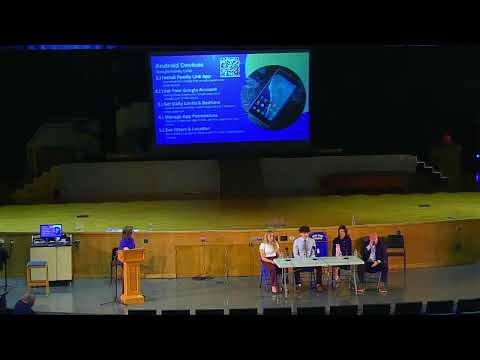
How to act: Panelists recommended steps parents can take immediately—review and enable parental controls (Apple and Android guides were provided in handouts and via QR codes), limit app downloads using approval workflows, turn off location sharing in apps, block unknown contacts, and periodically audit devices (including notes and hidden-photo folders). They also urged parents to be the trusted adult who listens calmly if a child reports concerning contact, and to involve law enforcement if grooming or criminal conduct is suspected.
Resources and closing: The district distributed handouts with parental-control instructions and QR codes to step-by-step guides; the moderator said the slides and handouts will be uploaded to the district website along with the recorded video. The session closed after audience Q&A and did not include any formal motions or actions by the district.