Get Full Government Meeting Transcripts, Videos, & Alerts Forever!
Get email alerts on the Flood Mitigation topic
No spam. Unsubscribe anytime.
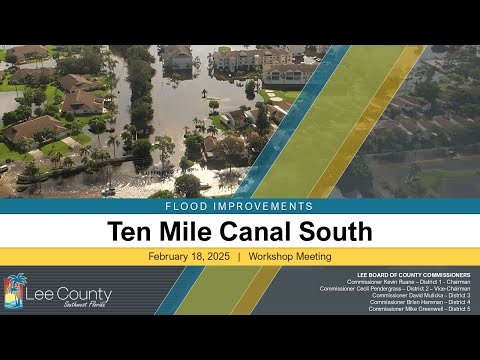
Lee County staff recommend vegetation removal and channel cut to reduce flooding on 10 Mile Canal south segment
Summary
County staff presented a phased plan that would first remove vegetation and cut a narrow channel to reduce rainfall‑driven flooding on the 10 Mile Canal; the near‑term package is estimated at about $5.5 million while a full program could reach roughly $23 million, and staff will pursue FEMA Hazard Mitigation Grant Program funding with local matching funds.
Lee County staff on Feb. 18 recommended a phased approach to reduce rainfall‑driven flooding along the 10 Mile Canal’s south segment, urging the board to pursue vegetation removal and a targeted channel cut as near‑term steps while pursuing federal grant funding for larger work.
Roland, the presentation lead, said engineering and bathymetric studies and modeling of the Hurricane Irma (INVEST 92L) rainfall event show a peak flow on 10 Mile Canal of about 2,300 cubic feet per second. "We recommend starting with vegetation removal and the channel cut," Roland said, adding that the two measures together could lower water surface elevation by roughly 0.9 feet in the most affected reaches.
The county’s recommended initial package — vegetation removal plus a channel cut in a narrow reach near Hidden Harbor — is estimated at about $5,500,000, Roland said. He described a wider program that would also include reconstructing berms and replacing some private boat ramps or docks as costing about $23,000,000 in total. "With all alternatives in place, it's about a $23,000,000 endeavor," Roland said.
Why it matters: the 10 Mile Canal watershed drains about 70 square miles of Lee County and includes industrial, commercial and residential areas that have experienced repeat high‑water events. Staff said the proposed work would address rainfall‑driven flooding but would not prevent damage from storm surge or extreme tidal events.
Staff and technical findings Roland said Johnson Engineering completed topographic, geotechnical and bathymetric surveys and ran models based on Irma‑era rainfall. The analysis found that removing in‑channel vegetation provides modest benefits (about 0.3 feet in upper reaches), buying down water levels in everyday and heavy rainfall events, while removing or converting obstructive private docks and creating off‑channel basins provided larger modeled benefits but would be complex and costly.
Dredging (making the channel deeper) was evaluated and rejected as an effective stand‑alone strategy because the canal outfalls into a relatively shallow tidal creek (Mulock Creek): "If you dredge deeper, you're really limited because you have to stay off property lines," Roland said, and deeper excavation could create a local "bathtub" effect with minimal added conveyance.
Costs, permitting and timing Staff presented a phased funding approach. Roland said vegetation removal could likely be implemented quickly, potentially within months using existing county contractors, and would likely need little permitting. The channel cut will require state and federal permits; Roland estimated permitting could take more than a year for that element.
Lehi, who spoke on funding mechanics, said the county has an application pending for HMGP funds but has not received an award. He explained FEMA’s Hazard Mitigation Grant Program typically funds about 75% of an approved project, leaving the county with an estimated 25% match; staff cited Community Development Block Grant Disaster Recovery (CDBG‑DR) funds as one potential match source. Lehi estimated environmental reviews for federal funding would take roughly 90–120 days once initiated.
Board concerns and policy questions Commissioners pressed staff on practical and equity questions. Vice Chairman Cecil Pendergrass and others raised concerns that allowing newer development to be elevated could push more runoff into the canal and "drown" older neighbors downslope; Pendergrass asked what the county could do policy‑wise to protect existing residents.
One commissioner asked how many private docks would be implicated by a replacement program; Roland estimated about 60 properties in the narrow reach would be most restrictive. Commissioners noted replacing or paying for private docks raises riparian‑rights, property‑acquisition and maintenance questions and agreed these issues justified excluding large‑scale dock replacement from the initial recommendation.
Next steps Staff recommended the board pursue the vegetation‑removal and channel‑cut combination as the first phase, explore berm reconstruction where feasible, and continue pursuing HMGP and CDBG‑DR funding for larger elements. Staff committed to return additional permitting, cost, and funding‑path details for the board’s strategic planning discussion. The presentation closed with staff agreeing to provide more detailed timelines and permit‑status options to make elements as "shovel ready" as possible.
(Reporting: Presentation and direct quotes are from county staff and consultants; no formal motion or vote was taken at this workshop.)