Get Full Government Meeting Transcripts, Videos, & Alerts Forever!
Get email alerts on the School Budget topic
No spam. Unsubscribe anytime.
West Milford board previews preliminary budget with 4.48% levy increase; residents warn of deep program and staffing cuts
Summary
The West Milford Township Public School District presented a preliminary budget that would raise the local school tax levy by roughly 4.48% and rely on one-time stabilization aid to offset state-aid losses; parents and residents urged the board to reconsider proposed cuts affecting special education, electives and staff positions.
The West Milford Township Public School District on the latest meeting night presented a preliminary budget that would increase the districts local tax levy by about 4.48% and raise the general fund roughly 2.5 percent as administrators warned of multi-year state-aid reductions.
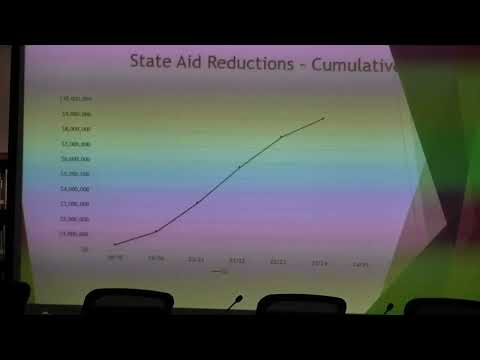
District presenters said the loss of state aid is continuing under the phased implementation of the state funding formula known in the transcript as "S2," with "the cumulative state reduction is over 9,000,000 now" and expectations it could exceed $10 million within the next year. Administrators said they applied for supplemental stabilization aid; the district received roughly $788,000 that officials described as one-time money and recommended using it for one-time capital or equipment purchases rather than ongoing personnel costs.
Why it matters: board members and residents framed the budget as a turning point for the districts finances. With state aid shrinking and costs for health insurance, transportation and energy rising, officials said the district faces few flexible revenue options and must balance reductions across schools and programs.
Administrators described curricular priorities included in the preliminary plan: expanding dual-enrollment options and career-oriented courses such as an aviation course and EMT training, replenishing elementary science kits and support for robotics and 3-D printing. They also said the district is moving intervention and referral plans into the student information system so intervention plans are available "in real time."
Multiple residents urged the board to reconsider personnel reductions. One student addressed the board about cuts to the Italian program and warned that "every cut is an opportunity taken away from the students," urging the board to preserve courses and teachers. A resident who identified themself as Dr. Merskoff said, "This reactive approach must stop now," and urged the district to pursue grant-writing or hire outside grant-writing help so recurring programs are not whittled away by annual shortfalls.
At the second public-comment block, Christina Duffy, who identified her address for the record, said the workforce-reduction proposal listed 22 positions and asserted that "a little under one-third of those positions, a total of seven, work with our kids with learning differences." Duffy urged the board to reconsider eliminating a special-education teacher at a school expected to receive a large influx of students after redistricting, warning that the cuts could make resource and special-education access "less accessible." Another resident, Catherine White, asked how many of the employees listed for possible reduction were tenured and urged the district to ensure tenured teachers are offered their jobs back if openings recur.
Board members debated how to balance cuts and preserve classroom programs. Several trustees noted that the district has sustained enrollment declines for years and pointed to prior policy choices (including earlier 0% tax increases) and the Highlands Acts effects on local growth. Administrators said they had tried to spread reductions across categories, and cautioned that the $788,000 supplemental aid is a one-time bucket that should not be used to support continuing salaries.
Formal actions and next steps: the board moved into executive session for negotiations and then for personnel matters. After returning, trustees approved hiring an educational consultant, Kathleen Hallowa, to conduct the superintendent search for $10,000 pursuant to the consultant proposal.
What remains unresolved: the transcript records the budget presentation, extensive public comment and several procedural votes but does not show a final board adoption of a full 202425 budget ordinance in the public minutes included here; administrators described the preliminary levy and the cuts being considered and noted personnel items will be finalized in subsequent personnel actions. The district indicated the supplemental stabilization aid can be earmarked or added to reserves if not used.
The board adjourned after completing the evenings business; the superintendent-search consultant contract was approved and the board planned further personnel work in a personnel committee and follow-up meetings.