Get Full Government Meeting Transcripts, Videos, & Alerts Forever!
Get email alerts on the School Finance topic
No spam. Unsubscribe anytime.
Pickerington Local weighs 8- vs. 9.21-mill operating levies as district presses pause on staffing
Summary
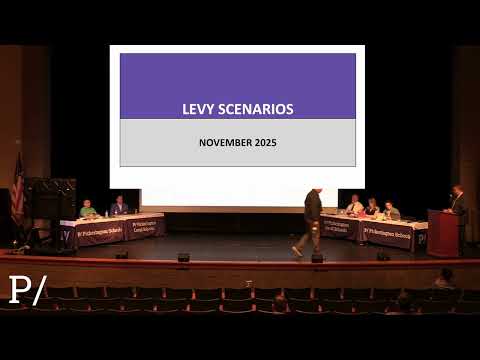
Interim Superintendent Scott Hunt and district finance staff presented levy scenarios and a staffing 'press pause' at a May 12 work session. Board members debated an 8-mill ask (to meet policy carryover) versus a 9.21-mill continuing levy to cover projected staffing needs and agreed to bring both resolutions to the next meeting.
Interim Superintendent Dr. Scott Hunt told the Pickerington Local Board of Education during a May 12 work session that the district must identify new revenue to avoid deep staffing and program cuts and to meet the board’s 45-day cash-on-hand policy.
"Eighty percent of our budget is in human resources and people," Hunt said, warning that a $5 million shortfall would equate to roughly 50 certificated positions under the district’s cost assumptions. He outlined a set of possible cuts if voters do not approve new operating revenue, including eliminating optional course offerings, reducing transportation service to state minimums, raising activity fees and trimming school-resource-officer allocations.
John, the district finance presenter, gave the board multiple levy scenarios and cash-day projections. He said a successful continuing 9.21-mill levy placed on the November ballot would begin generating material revenue in 2026 and could move the district toward the 45-day cash goal by 2029. He contrasted that with an income-tax alternative, explaining an earned/traditional income tax would take "about 18 months" to ramp and would generate far less near-term revenue: "With an income tax at a quarter percent, you're collecting about $350,000 in that same fiscal year time period," he said, compared with roughly $7 million collected in FY26 from a 7-mill operating levy.
Board members debated electability and strategy. One member urged a realistic, passable ask and recommended clear campaign promises tied to specific outcomes (for example, earlier literacy or all-day kindergarten). Another board member argued the need for a higher millage—"I don't think we should ask for anything less than 9.2"—to fully meet staffing projections that were developed before the press-pause adjustments.
The board discussed a district staffing review that used class-size assumptions of 26 students in K–6 and 28 in grades 7–12; Hunt said district staff will monitor enrollments weekly through June and adjust FTE allocations as needed. He also listed the limited FY26 hires planned under the press-pause approach: one K–12 teacher, one nurse and one special-education coordinator in addition to previously posted special-education intervention positions.
Members compared neighboring districts’ recent levy outcomes (for example, Hilliard’s 6.9 mills) and noted upcoming property reappraisals and new-construction growth will affect future revenue capacity. Board members and administrators agreed administration will prepare two draft resolutions of necessity for the board’s next meeting—one at 8 mills and one at 9.21 mills—so the board can choose a final millage and finalize language and homeowner impact examples.
The meeting concluded with a motion to move into executive session under ORC 121.22(G)(1); a roll call was started and several members answered in the affirmative on the record. The chair said the board did not anticipate further action that evening.
The board is scheduled to consider those draft resolutions at its next board meeting; administrators said they will also provide homeowner-cost examples and more detailed messaging options before that vote.