Get Full Government Meeting Transcripts, Videos, & Alerts Forever!
Get email alerts on the Community Engagement topic
No spam. Unsubscribe anytime.
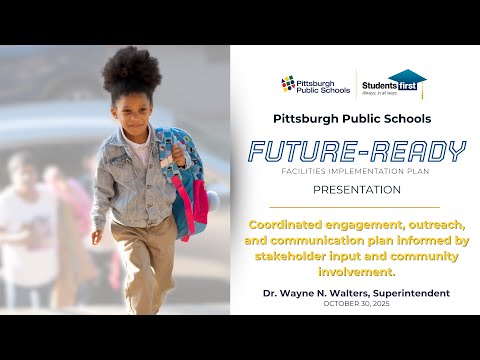
Pittsburgh Public Schools outlines community engagement plan for Future Ready facilities
Summary
A district presenter described a multi-channel outreach and engagement plan for the Future Ready Facilities transition, highlighting parent and student ambassadors, listening sessions, translation and childcare supports (contingent on budget constraints), and a public 'Students First' dashboard for tracking progress.
A presenter for Pittsburgh Public Schools outlined a comprehensive community engagement plan for the district's Future Ready Facilities transition, emphasizing outreach across digital channels, in-person listening sessions and ambassador programs to include families, students and staff.
The presenter said the effort is “grounded in authentic stakeholder input and community partnership,” and described four core communications strategies: short explainer videos, infographics and visual guides, social-media bite-sized posts and a regularly updated FAQ on the district website.
The plan centers two engagement formats: districtwide community conversations to gather broad feedback and smaller school-based listening sessions for more personal dialogue. The presenter said both district and school leaders will attend sessions to ensure accountability and that families will break into small groups to raise concerns and ideas. Feedback will be summarized using a “what we heard / what we are doing” approach and distilled into quarterly engagement reports.
Programs to amplify local voices include a parent ambassador program—parents who will share timely information, help dispel rumors and bring community feedback back to district leaders—and co-design teams made up of parent ambassadors, school and district leaders and community partners to guide transition planning. The presenter also said student input will be supported through student envoys, the superintendent's student advisory council, student board members and a Future Ready student ambassador program.
To help families feel prepared, the district will hold “Welcome to Your Future Ready School” kickoff nights and orientations featuring ambassadors, tours and resource tables. The presenter said the district will also promote each school's unique brand, programs and culture and will publicize milestones and events through media and social platforms to build community pride.
The district plans a community sponsorship and school adoption process to connect local businesses and organizations with individual schools for sustained support; the transcript indicated sponsors would be identified by the start of the next school year, but the speaker did not specify which year. The presenter said community hubs will provide continuous services and welcoming environments to help schools adapt during the transition.
On outreach channels, the presenter listed five primary tools to reach families in multiple languages: scripted talking points and translated text messages; Blackboard Connect and translated phone messages; mailings and multilingual flyers; district digital platforms (the PPS website, the myPPS app, Peachjar and Constant Contact); and social media short videos, graphics and interactive explainers.
The presenter said every staff member will serve as a trusted messenger using message maps and scripts and will take part in scenario training to prepare for empathetic, informed conversations. To centralize information, the district will maintain a dedicated Future Ready transition page as a hub for school-specific timelines and FAQs. The presenter said the district will embed two-way feedback loops—surveys, listening sessions and a parent hotline—and track progress publicly on a Students First dashboard.
The presenter noted that translation services, childcare and refreshments are planned to reduce participation barriers but that those supports are contingent on a budget impasse referenced in the transcript; the speaker did not specify which budget or the timetable for resolving it.
Next steps identified in the presentation include launching the ambassador programs and listening sessions, publishing the dedicated transition webpage and producing quarterly engagement reports to track themes and district responses. The presenter did not announce formal votes, timelines or binding decisions during the remarks.