Get Full Government Meeting Transcripts, Videos, & Alerts Forever!
Get email alerts on the Operating Levy topic
No spam. Unsubscribe anytime.
Byron superintendent outlines $800-per-pupil operating levy ask to cover rising costs and protect programs
Summary
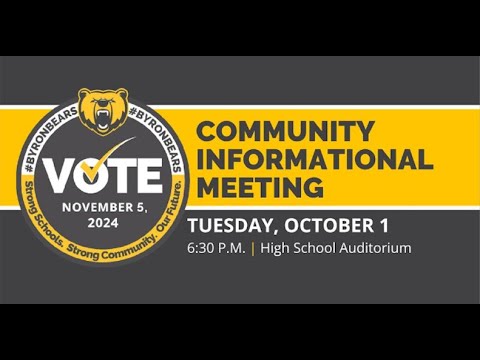
Superintendent Dr. Mike Newbeck told a public meeting Byron will ask voters on Nov. 5 to approve an $800-per-pupil operating referendum (10 years, inflation adjustments) expected to generate about $1.9 million a year to cover operating costs, following depleted one-time funds and rising insurance and mandate costs.
Dr. Mike Newbeck, superintendent, told residents at an information session that Byron will ask voters on Nov. 5 to approve an $800-per-pupil operating referendum, with inflation adjustments and a 10-year maximum term, that the district projects will generate roughly $1.9 million annually for day-to-day operations.
Newbeck said the district faces a widening gap between what state funding would be if it had kept pace with inflation and current per-pupil aid. “If it was kept up with inflation, [per pupil] would be $8,637; presently we get $7,281,” he said, adding that the difference over the past 20 years would total about $3.4 million. He also said Byron ranks among the lowest-funded districts per pupil in the state.
Why the levy now: Newbeck pointed to several drivers for the request, including the expiration of COVID-era (ESSER) and other one-time funds, sharply higher insurance premiums and other inflationary costs, and the need to remain regionally competitive on staff pay. “Last year, [insurance premiums] were 28 percent. This year was 29 percent,” he said, warning those and other mandates will continue to increase costs.
What the levy would pay for: Newbeck described the operating levy as general-education revenue that can be used for salaries, technology, utilities, transportation and other recurring operating expenses. He said the levy is not a bond and cannot be used for capital projects; bond proceeds remain restricted by state statute to building and facility uses.
Enrollment, open enrollment and revenue context: Newbeck said current enrollment projections show flat or declining counts over the next decade unless housing growth resumes. He added that open-enrolled students make up about 22 percent of Byron’s K–12 population and generate roughly 18.5 percent of district revenue—“around $5,000,000 a year,” he said—which helps sustain course offerings and smaller class sizes.
Cuts and other steps already taken: The superintendent said the district implemented about $1.5 million in reductions coming into this year, including staff reductions and department budget trims, and has used one-time fund balance and ESSER dollars (about $414,000) that are no longer available. He said the district is strengthening internal controls—adding signatories, revising spending protocols, contracting monthly reconciliations with Region 5, and forming a quarterly budget committee—to improve transparency and fiscal oversight.
If the levy fails: Newbeck warned that without additional revenue the district will need to make further reductions that could increase class sizes, reduce support services such as paraprofessionals and mental-health supports, and eliminate some course offerings and extracurricular programs that the district now provides.
Next steps and timings: Newbeck said the levy question is written as a per-pupil amount on the Nov. 5 ballot and, if passed, would provide funds for the 2025–26 school year. He reminded residents that operating levies may only be brought to voters in November, and noted a truth-in-taxation session is scheduled for Dec. 16; the district’s next public meeting on this material was set for Oct. 14.
Audience questions at the session included how the state determines the pupil count (the district uses the Oct. 1 count), where residents can find assessed valuations (county property-record websites; the district will post guidance), whether bond projects were complete (projects are substantially complete with a punch list and about $300,000 in preliminary remaining funds), and the district’s ongoing efforts to seek different insurance bids and plan contract negotiations.
The district did not take any formal action at the session; it presented information and answered residents’ questions.