Get Full Government Meeting Transcripts, Videos, & Alerts Forever!
Get email alerts on the Zoning Text Amendment topic
No spam. Unsubscribe anytime.
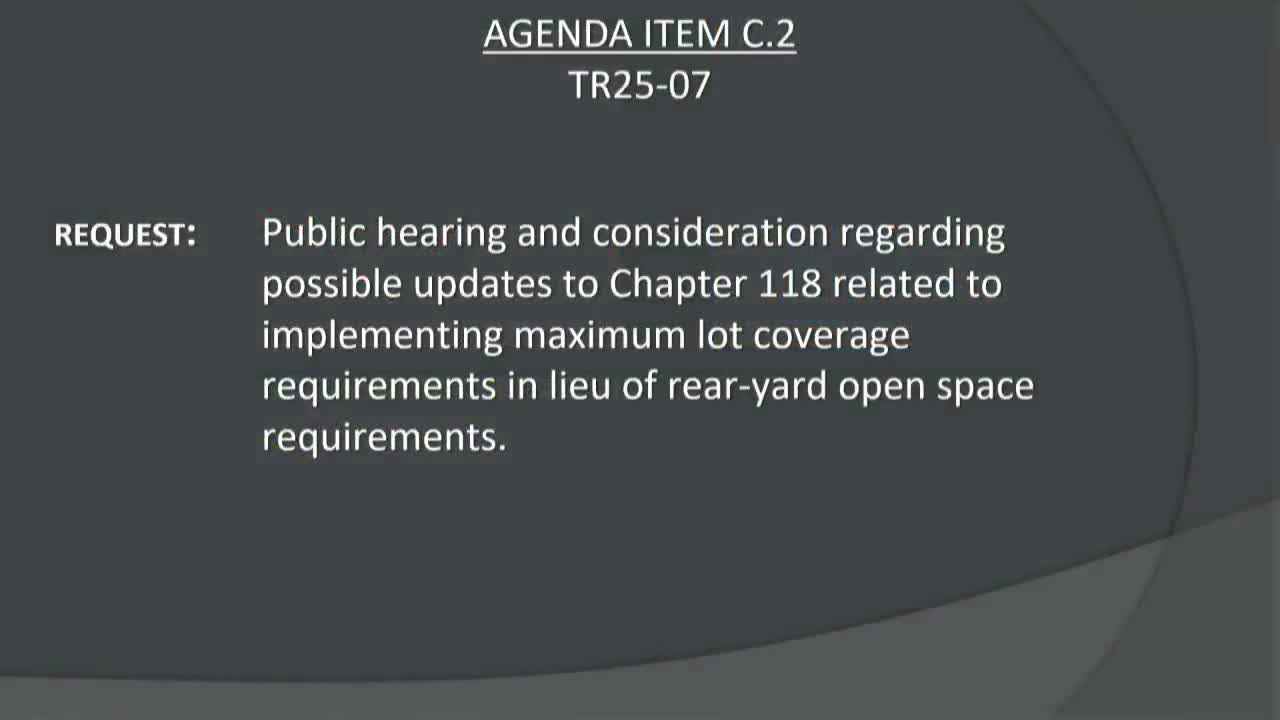
Commission opens public hearing on rear-yard rule, votes to continue while staff refines hybrid credit approach
Summary
Staff proposed a hybrid text amendment to Chapter 118 that would retain a 20% rear-yard open-space requirement but allow 'excess yard area' in front/side yards to be credited so rear-yard open space could be reduced to 10%; the commission continued the public hearing to Jan. 15, 2026 for further drafting and builder outreach.
The Planning & Zoning Commission opened a public hearing on a proposed text amendment to Chapter 118 addressing rear-yard open-space requirements and voted to continue the hearing to Jan. 15, 2026 so staff can draft ordinance language and meet with home builders.
Corey, the city planner, told the commission staff had researched several options — replacing the rear-yard requirement with a maximum lot-coverage percentage, exempting longstanding homeowners, or broadening the definition to any usable open space — and recommended a hybrid approach. Under staff’s proposal, the city would retain the 20% rear-yard open-space requirement in districts where it applies but permit credit for “excess yard area” (front or side yard area beyond required setbacks) so that a site could reduce its rear-yard requirement to as low as 10% if offset elsewhere on the lot.
Corey said the change is intended to address two recurring problems: long-time homeowners who want modest additions without a variance and builders working infill lots whose designs are constrained by the 20% rear-yard rule. “We would allow them to reduce that rear yard open space down to 10%,” Corey said when describing the credit mechanism, and staff emphasized the change would not automatically apply to districts that do not currently have rear-yard requirements.
Commissioner Justin Welborn said he favored the hybrid approach because it preserves the existing rule while allowing flexibility for unique lot configurations; Commissioner Amy seconded a motion to continue the public hearing to Jan. 15 to give staff time to draft formal ordinance language and consult builders. The motion carried.
Staff also noted accessory structures will remain exempt from rear-yard open-space calculations under the current code and that accessory-structure regulation (walls, heights, prefab ADUs) will be a separate future review topic.
The commission will revisit TR25-07 at its Jan. 15 PNC meeting with a draft ordinance and a summary of builder feedback.