Get Full Government Meeting Transcripts, Videos, & Alerts Forever!
Get email alerts on the Transportation topic
No spam. Unsubscribe anytime.
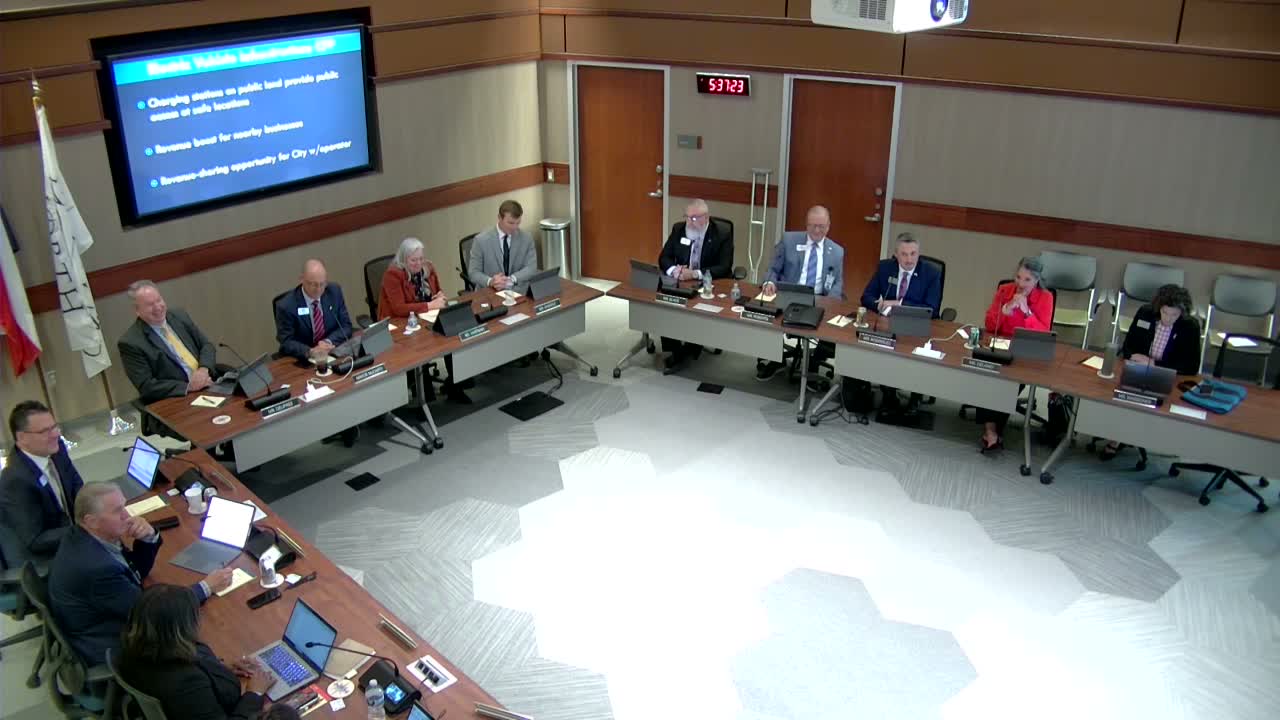
North Richland Hills staff brief council on NCTCOG EV charging grant; council OKs applying
Summary
City staff recommended applying for a North Central Texas Council of Governments grant to fund EV charging stations at several city sites. The COG would fund ~80% of infrastructure, vendors 20%; the grant covers installation and five years of partial operations. Council gave direction to apply and to return with procurement and operational details.
Staff asked the council whether the city should apply for an NCTCOG call for projects to install electric‑vehicle charging infrastructure on city‑owned property.
Corey (speaker 9) described candidate sites: a retail site near I‑820 (near Babes), a downtown City Hall location adjacent to the police department, a Boulevard 26 site near the community college, and a site in Iron Horse (Bridal Adoption Rescue Center area) that would fill a charging‑station void. Staff proposed Level 2 and Level 3 (DC fast) chargers depending on site, with a minimum of four chargers per site; the Babes site might accommodate 4+2 or 2+2 configurations.
Staff explained that the COG would fund approximately 80% of the infrastructure costs, vendors would contribute about 20%, and the COG would reimburse the city for its cash outlays (monthly reimbursement is possible so a full upfront local cash outlay is not required). The grant also includes funding for five years of partial operations, which lowers vendor operating costs in the award period. A procurement RFP would be run by the COG; participating cities would be involved in vendor scoring.
Council members raised questions about demand for public chargers (many EV owners charge at home), enforcement of EV parking spaces (ticketing non‑EVs), and the city’s potential long‑term ownership and operation after five years. Staff said many vendor models include penalties for overstaying and that the city would own the stations after the initial five‑year operations period and could choose new operating arrangements or discontinue service at that point.
Council’s consensus was to apply for the program and then return to council with site details, procurement terms and proposed operational agreements for approval before construction contracts are executed.