Get Full Government Meeting Transcripts, Videos, & Alerts Forever!
Get email alerts on the Short Term Rentals topic
No spam. Unsubscribe anytime.
North Richland Hills council adopts short-term rental rules, excludes Town Center and sets occupancy cap
Summary
After an extended public hearing with divided testimony, the North Richland Hills City Council approved a consolidated short-term rental zoning ordinance and Chapter 18 operating rules, grandfathered existing operators who register and meet tax requirements, set a $450 annual permit and revised maximum occupancy to two people per bedroom plus two (maximum 14).
The North Richland Hills City Council on Oct. 13 approved a consolidated zoning ordinance and operational regulations for short-term rentals, carving out the city's Town Center district and imposing new registration, inspection and tax-compliance requirements.
Staff presented three zoning options and a companion operations code change that together add a short-term-rental use to the city's zoning code, identify where short-term rentals are permitted, and create an annual permitting process. Council voted 7-0 to adopt the consolidated zoning ordinance (39-22b) excluding the Town Center districts and, separately, approved Chapter 18 regulations (ordinance 39-25) with amendments that set a 30-day delayed effective date.
Why it matters: The package aims to balance neighborhood protections with allowing existing hosts to continue operating. Staff said the rules are designed to limit party rentals, ensure payment of the city's hotel-occupancy tax, create a local point of contact for properties owned out of state or abroad, and give code enforcement clearer tools to suspend or revoke permits.
Key provisions adopted
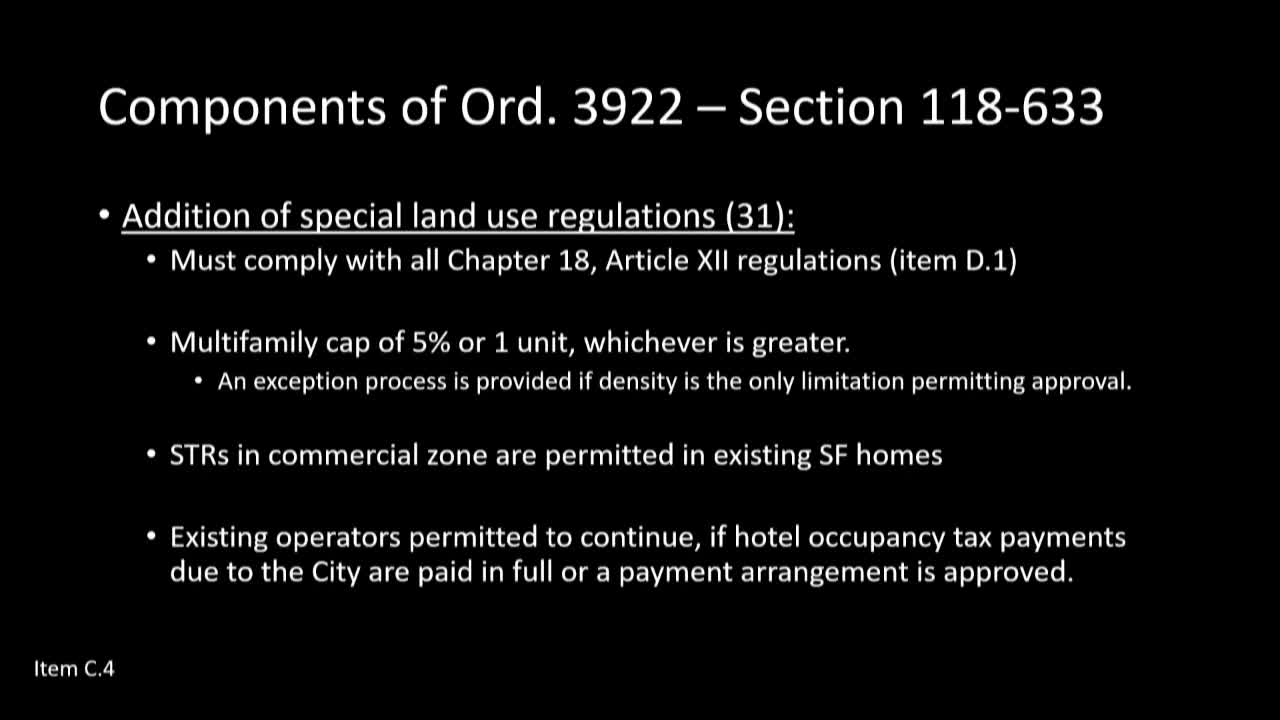
- Zoning and continuation: Council approved a consolidated ordinance (39-22b) that adds a short-term-rental use to permitted zones; existing operators may continue if they register during the initial window and either pay outstanding hotel-occupancy taxes or enter an approved payment arrangement. Council excluded the Town Center district from being open to new short-term rental zoning.
- Annual registration, inspections and fees: Operators must register annually (registration window Dec. 1'Jan. 31), submit a floor plan and parking plan, provide proof of sufficient hotel-occupancy-tax payments (or an approved arrangement), and pass an initial inspection; the council set the annual permit fee at $450 and a $100 reinspection fee after the first reinspection.
- Local point of contact and enforcement: Properties with nonlocal owners must designate a local contact who can respond within 60 minutes to city requests. Staff may inspect properties based on complaints, and may conduct up to one quarterly inspection at its discretion. Permits can be suspended for immediate safety hazards or revoked for serial violations (draft clarified as three separate incidents within 12 months or five or more violations within 24 months).
- Occupancy, parking and minimum stay: Council amended staff's draft occupancy rule to "two persons per bedroom plus two additional persons, not to exceed 14 persons total." Parking must be accommodated on-site or immediately adjacent (driveway, garage or curb adjacent to the property) and short-term rentals must comply with all city noise and health-and-safety codes. The ordinance includes a minimum stay provision (the draft included a two-night minimum, which staff had noted was modeled on recent local practice).
Public reaction and council debate
The hearing drew more than two dozen speakers who split roughly between neighbors worried about noise, parking and the character of residential areas and hosts who described short-term rentals as vital supplemental income. Joel Brown told council "the Texas tax code defines STRs as hotels" and urged stricter enforcement and on-site management for out-of-area owners; Stacy Luke, speaking on behalf of an operator, warned that the proposed occupancy formula could run afoul of federal and state housing standards and asked for a flexible, evidence-based approach. Several hosts described STR income as a lifeline: "Airbnb became more than just a platform, became a lifeline," Carly Wilcox said, recounting how hosting helped her during medical hardship.
Staff framed the regulations as both protective and pragmatic, saying many operators already maintain two-night minimum stays and that the software and permit window will give the city time to implement an online registration and payment portal before the rules take effect.
What comes next
The ordinances take effect 30 days after adoption to allow staff time to finish software implementation, notify existing operators and finalize procedural materials (sign templates, inspection checklists and payment forms). Existing operators who wish to continue must register in the indicated window and either pay outstanding hotel-occupancy taxes or secure an approved payment plan.