Get Full Government Meeting Transcripts, Videos, & Alerts Forever!
Get email alerts on the Park Fees topic
No spam. Unsubscribe anytime.
Parks committee adopts 2026 shelter and field rental prices, adds lighting and prep fees
Summary
The Parks and Recreation Committee adopted updated shelter and field rental rates for the 2026 season, including a proposed hourly structure, four‑hour blocks and added charges for field lighting and prep when staff attendance is required. The schedule will be reevaluated after the season.
The Parks and Recreation Committee voted Feb. 23 to adopt an updated set of shelter and field rental fees for the 2026 season, keeping most shelter prices steady while adding a clarified rate structure for field rentals and a separate charge for field lighting and prep work.
Staff presented benchmarking from nearby communities and a breakdown of local categories — resident/nonresident, nonprofit/for‑profit and security deposits — and compared amenities such as restrooms, water and field availability. “Our current rates are … family group resident 60, family group nonresident 85,” staff noted, and the committee discussed whether parks with fewer amenities (for example, Yellow Banks, which lacks permanent restrooms) should be charged a lower shelter fee.
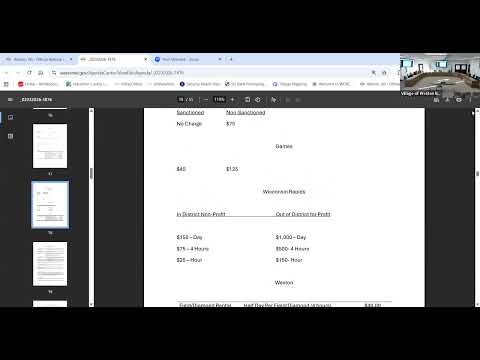
On field rentals, the committee favored a block‑based approach: a $25 hourly baseline with recommended blocks of $100 for a four‑hour window and $200 for a full day as starting points for in‑district nonprofit users, with higher charges for out‑of‑district and for‑profit events. Committee members also agreed to add a distinct lighting fee when staff must travel to turn lights on and off; staff estimated the energy cost at about $6 for four hours but said labor costs (staff time, travel) require a separate charge and an hourly staffing rate of roughly $80 was cited during the discussion.
The committee discussed distinguishing turf fields (which typically require less in‑game prep) from dirt infields (which can require bases and more labor), and agreed to account for prep time in the fee schedule rather than extending a single flat price for all fields.
After hearing that most user groups are resident family groups and that Mack Miller and Kennedy parks are the most popular rentals, the committee moved to adopt the recommended 2026 fee schedule and agreed to review actual revenues and utilization at season’s end. The motion passed by voice vote.
The committee directed staff to finalize the schedule for the board and to return with post‑season data that could prompt adjustments.