Get AI Briefings, Transcripts & Alerts on Local & National Government Meetings — Forever.
Monroe County commissioners say financing could allow a new jail but debate size, site and services
Loading...
Summary
Commissioners reviewed a county council resolution and financial analysis that show a potential maximum bond capacity near $170 million, then debated trade-offs including single-story design, colocation with other justice services, and investing in treatment programming to reduce recidivism.
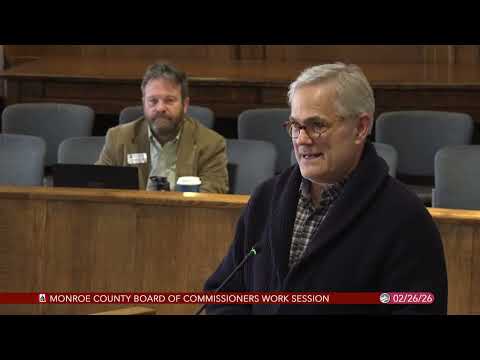
Commissioners at the Monroe County Board of Commissioners work session on Feb. 26 said the county has a path to finance a replacement jail but disagreed over size, location and how much to invest in treatment and colocation.
The conversation began after staff summarized a county council resolution and an accompanying Gerritos financial report that—according to staff—indicate a theoretical maximum financing capacity of about $170,000,000 using a mix of bond proceeds and unappropriated local income tax (LIT) balances. Commissioner Thomas and staff said that figure would be a maximum, not an assumed target, and that final cost depends on site, design and programmatic choices.
Commissioner Madera urged caution about building to the lowest cost. She said the county should invest up front in durable, treatment-oriented facilities so the jail is “safe, functional, and legally compliant for the next 40 to 50 years,” and to avoid repeated retrofits that raise long-term costs. Madera argued that a modern facility should include space for medical and mental-health treatment, reentry planning and education programs aimed at reducing recidivism.
Commissioner Thomas said the council report, the Gerritos numbers and current LIT balances make it feasible to proceed sooner than previously expected. Thomas stressed a single-story design where possible and emphasized that site selection should avoid floodplains and overly constrained parcels that force expensive workarounds. Thomas also acknowledged outstanding questions for bond counsel and other advisors before final decisions.
Staff and commissioners discussed funding details the report shows: a cited unappropriated balance in one economic development fund of about $23,000,475.66; a bond anticipation note balance of $5,721,462 set aside for the project; and a jail-LIT balance noted at about $7,108,463. Staff also clarified there is roughly $35,000,000 in cash across funds but that payments would be invoiced over project milestones rather than removed in a lump sum.
Several commissioners and staff said timing matters: whether to rely on current revenue streams and issue bonds now or wait for later property-tax and LIT changes. Questions for bond counsel included whether future LIT receipts can be pledged and how that affects debt service and the county’s willingness to reserve portions of LIT for other priorities.
Commissioner Jones agreed with Madera’s emphasis on programming and constitutional care. Commissioners discussed options for colocation with other justice system functions, noting judges, the prosecutor and the sheriff have expressed that colocation is desirable but that colocation could increase upfront costs.
No formal action was taken at the work session. Commissioners said staff will continue research and expect to bring an ordinance or refined proposal to the March 12 meeting with additional answers from bond counsel and more precise cost estimates tied to candidate sites.
"We need to make a decision on where we're going to go, and we need to be firm in that and get things going," one commissioner said, while another cautioned against choosing the cheapest option if it sacrifices long-term performance. The board adjourned and scheduled the next meeting for March 12 at 10 a.m.