Ellettsville and Richland Township officials outline proposed fire territory, budget and tax impacts
Loading...
Summary
At a second public hearing on a proposed Ellettsville–Richland fire protection territory, the town and township’s presenters outlined a projected 2027 operating budget of about $3.8 million, an equipment‑replacement fund and estimated tax impacts (about $16/month for an average Richland homeowner).
At a joint meeting of the Ellettsville Town Council and the Richland Township Advisory Board, local officials held the second of the four required hearings on a proposed fire protection territory that would consolidate fire services and establish a dedicated property‑tax levy beginning in 2027.
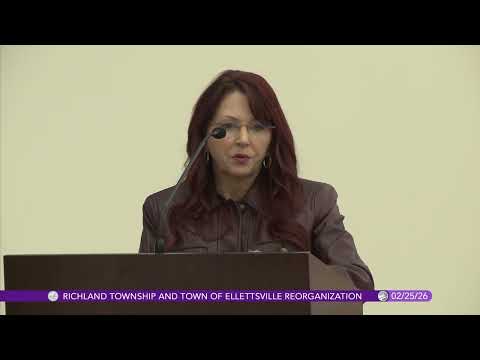
The hearing featured a department overview by Fire Chief Kevin Patton and a detailed financial presentation by Paige Sansone of Baker Tilly. “We’ve got a total of 17 full time firefighters that includes the administration staff and then we’re supplemented by a few volunteers,” Patton said, describing two stations that serve the area and a run volume increase of about 102% over five years. Patton said roughly 70% of the department’s calls are medical in nature.
Sansone framed the proposal as a statutorily authorized tool for producing sustainable, dedicated revenue. “A fire territory is something that is statutorily allowed,” she said, and she described the timeline for final action: a public hearing on March 11 and a public meeting on March 25 when each legislative body would vote on whether to create the territory. If approved, Ellettsville would be designated the provider unit, levy property taxes, collect revenues and pay bills on behalf of the territory beginning in 2027.
Sansone presented budget and levy estimates for 2027: an operating budget of about $3.8 million, plus an equipment replacement fund (maximum 3.33¢) projected to generate roughly $506,000, for combined budgets near $4.3 million. Revenue sources would be primarily property tax (about $4.1 million) supplemented by vehicle excise tax (about $207,000), producing an estimated available total of roughly $4.17 million and an initial levy calculated at about 0.2744 per $100 of assessed value.
The presentation included examples of homeowner impact. Using an average home value of $293,500, Sansone estimated an average Richland Township homeowner would pay about $16 more per month (roughly $193 per year). She said some Ellettsville properties are already at local tax caps and would see no increase. For a $300,000 residential rental in Richland Township, she estimated about a $32 monthly increase (about $390 per year).
Sansone noted capital needs and funding sources: portable radios (about $6,000 each), a planned aerial truck with an estimated cost of $2.3 million (funded by West Side TIFs in the presentation), and a roughly 50‑year‑old station on Curry Pike. She also said an outstanding balance on an existing aerial ladder truck—about $1.8 million—will remain the town’s responsibility until it matures on 08/01/2029 and will not be transferred into the territory.
Officials also reviewed how the territory would affect overlapping taxing units and local revenue distribution. Sansone estimated redistribution of local income tax shares—projecting about $275,000 more for Richland Township and $291,000 more for Ellettsville in certified shares for local income tax—and explained state tax‑cap classifications (1% homestead, 2% residential rental, 3% commercial) and how they limit increases for certain property classes.
During public questions, a trustee asked whether the territory would remain if a separate reorganization plan becomes law. Chief Patton replied the public would not see a change in service but the separate governmental territory would be absorbed into the consolidation: “The way what the public is gonna see will stay the same… the territory will basically go away, and it will be part of the consolidation.” Presenters reiterated that if the reorganization plan fails, the fire territory would be the mechanism that sets property‑tax levies; if the reorganization passes, its plan would govern taxes.
The meeting closed with no public speakers claiming the podium. The next scheduled steps are the March 11 public hearing and the March 25 public meeting when both legislative bodies are expected to vote on whether to create the fire territory.