Get Full Government Meeting Transcripts, Videos, & Alerts Forever!
Get email alerts on the Historic Preservation topic
No spam. Unsubscribe anytime.
Commission debates delisting rules and incentives for preserving Rockville’s historic properties
Summary
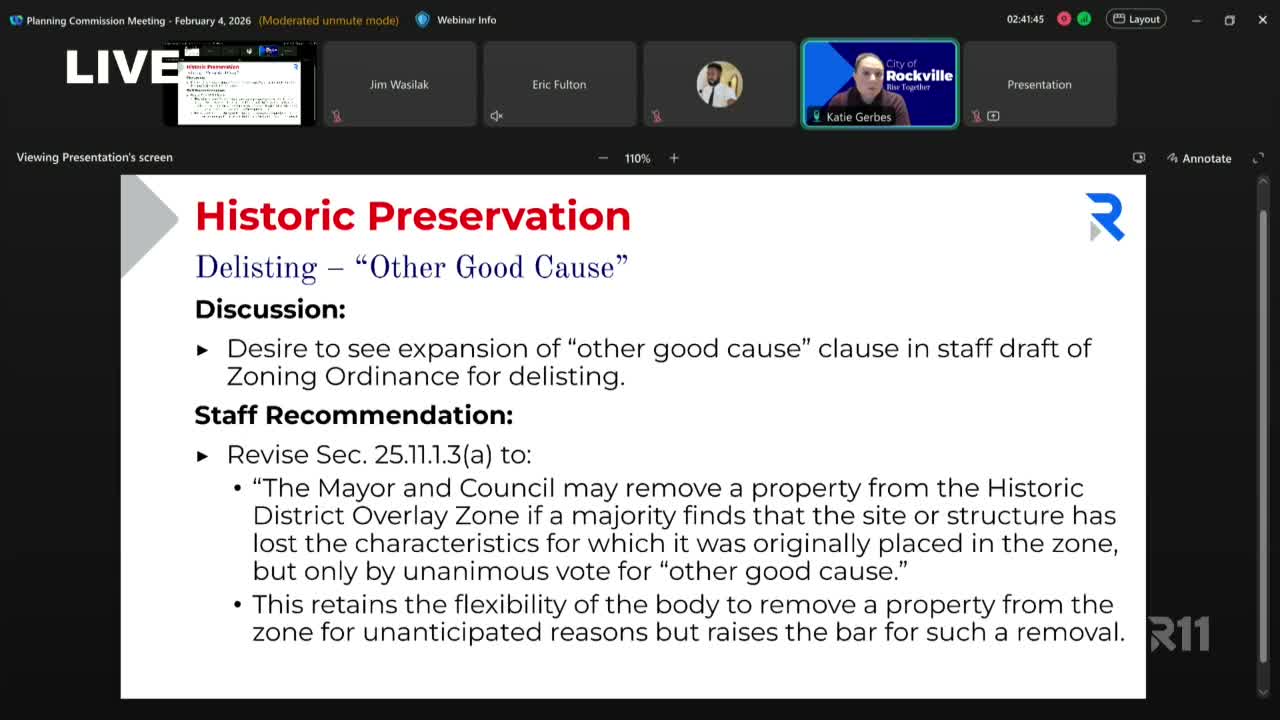
Planning commissioners and staff discussed changes to delisting procedures that would allow removal from the historic-district overlay by majority vote if a site has lost qualifying characteristics, but require a unanimous Mayor and Council vote for 'other good cause.' The commission also urged staff to study incentives—such as allowing additional dwelling units or tax credits—to preserve historic properties.
Rockville planning staff proposed and the commission discussed revisions to the historic-preservation provisions of the zoning rewrite on Feb. 4, focusing on how properties could be removed from the historic-district overlay and whether the city should promote preservation through incentives.
Katie Gerbis (staff) presented a redraft of section 25-11-13(a) that would allow the Mayor and Council to remove a property from the historic-district overlay if a majority finds the site has lost the characteristics that originally justified designation, but require a unanimous vote for "other good cause." Staff said the change aims to allow correction of a register that includes properties that may no longer meet designation criteria, while protecting designations from routine or ad hoc removal.
Commissioners split on specifics. Some said delisting should mirror the high bar currently required for designation against owner wishes; others favored the staff approach (majority for lost-characteristics; unanimous for other causes) to permit administrative cleanup of the register. Commissioners also asked staff to clarify how delisting would interact with penalties for owners who inflict self-harm to their properties to force delisting; staff said existing municipal code provisions and enforcement tools should be sufficient to deter and penalize such behavior, and that damage alone would not automatically trigger delisting.
The commission also spent significant time on incentives to preserve large single-family historic homes, including allowing additional dwelling units within existing historic footprints or pursuing tax-credit programs. Multiple commissioners urged staff to research practical mechanisms—zoning allowances, overlay-zone permissions, or budgetary tax-credit incentives—and to return with options the Mayor and Council could consider.
What’s next: The commission supported staff’s proposed two-tier delisting approach with clarifying language to be included in the memo to Mayor and Council, and directed staff to research feasible incentive mechanisms (zoning text changes and budgetary incentives such as tax credits) to preserve historic properties.