Get Full Government Meeting Transcripts, Videos, & Alerts Forever!
Get email alerts on the Zoning Ordinance Language topic
No spam. Unsubscribe anytime.
Rockville staff to tighten plain-language zoning text, improve notice practices and update the development-review manual
Summary
Commissioners endorsed staff plans to remove subjective wording from the draft zoning ordinance where inappropriate, retain necessary aesthetic standards for federally-regulated small-cell installations, and to modernize notice practices and the development-review manual for better transparency and efficiency.
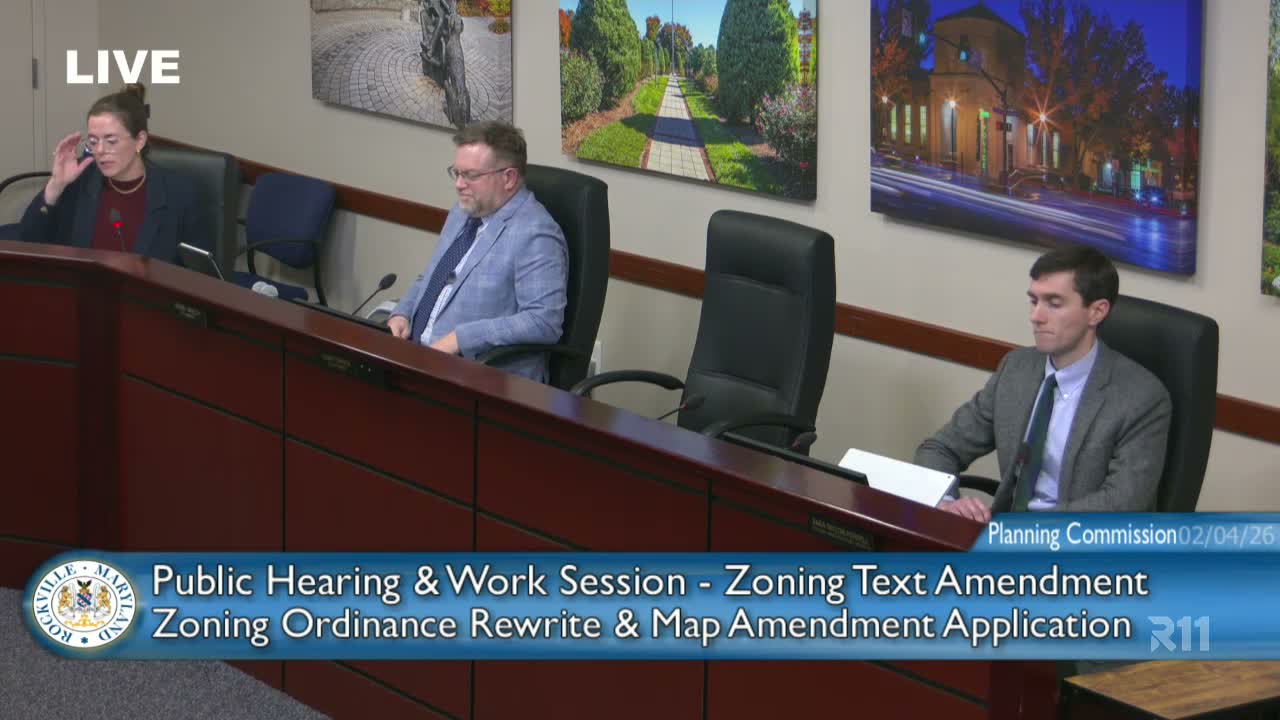
City staff told the Planning Commission Feb. 4 that the zoning-ordinance rewrite aims to increase clarity and objectivity by reducing subjective words and restructuring purpose statements, while preserving necessary language where law permits it.
Holly Simmons and colleagues described a plain-language review that will remove vague terms like "aesthetics" or "high quality" in regulatory sections but retain relevant aesthetic standards in federally governed areas such as small-cell wireless siting. Staff said purpose statements will remain aspirational where appropriate and that the final plain-language edits will be captured in a staff memo accompanying the recommendation to Mayor and Council.
John Foreman explained notice requirements in the draft: mailed radius notices remain at the current distances directed by the Mayor and Council; application signs, parties-of-record notices, and project-level electronic notices will continue. Staff also previewed FAST 2 communications improvements—clearer on-site signage, a centralized project calendar on the city website, the monthly Development Watch newsletter, and expanded online posting of Level 1 site-plan decisions for transparency.
The commission supported staff’s approach and asked staff to include precise language and a summary of outstanding issues in the memo to Mayor and Council. Commissioners also asked whether translated notices and the development manual can be surfaced via the city website; staff agreed to research translation options and to formalize where the manual will be hosted and maintained.
What’s next: Staff will complete the plain-language review, prepare a recommendation memo referencing the language changes and notice practice updates, and implement phase-1 manual changes before launching a phase-2 manual revision to align with the final code.