
Rockville staff outline major landlord‑tenant code changes including relocation assistance, fee caps and background‑check limits
Get AI-powered insights, summaries, and transcripts
Subscribe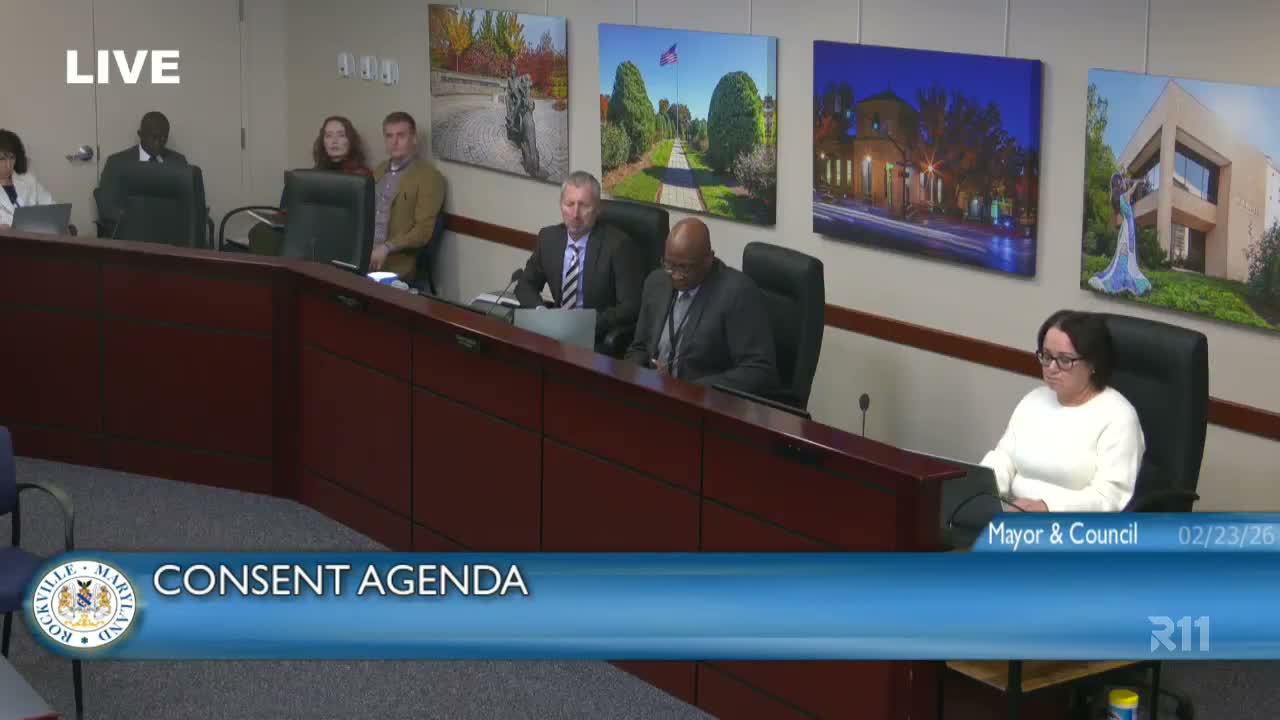
Summary
City staff presented a package of proposed updates to Rockville’s landlord‑tenant code: background‑check restrictions aligned with Montgomery County’s Housing Justice Act, temporary and permanent relocation assistance, restrictions and transparency for fees, a requirement to offer two‑year lease terms, and higher penalties; staff will draft ordinance language for May 18, 2026.
City staff on Feb. 23 presented a comprehensive set of proposed updates to Rockville’s landlord‑tenant code designed to strengthen tenant protections while outlining guardrails for landlords.
Jane Lyons Raider, the city’s housing programs manager in the Department of Housing and Community Development (DHCD), and Trevor Stevens, the city’s housing and landlord‑tenant specialist, asked the Mayor and Council for guidance on recommended items that include background‑check restrictions, relocation assistance, fee limitations and transparency, a requirement that landlords offer a two‑year lease term, and increased municipal penalties for Chapter 18 violations.
Why it matters: the proposals would change how landlords screen tenants, respond when units are rendered uninhabitable, and how routine fees and fines are governed — all areas that advocates and property managers say affect housing stability and investment.
Staff described the background‑check framework as largely modeled on the Montgomery County Housing Justice Act’s Ban‑the‑Box approach: an initial prescreening/conditional offer phase that prohibits questions about criminal history, followed by a secondary review with written notice and a seven‑day response window if a check is initiated. Jane Lyons Raider said the county’s model also excludes certain violent and extreme felonies from the protections and staff recommended following those exclusions.
On eviction history, staff proposed prohibiting landlords from asking about eviction history on rental applications while still allowing landlords to consult court records or review credit and income at later stages. Stevens told the council that “we're recommending alignment with Montgomery County’s Housing Justice Act, including the Ban the Box initiative,” and that the city would confirm exclusions and compliance in the draft ordinance.
Relocation assistance: staff proposed two related programs. Temporary relocation assistance would be required when the city determines a rental unit cannot be occupied and the landlord is at fault; for short displacements (30 days or less) the landlord would provide hotel or alternate comparable housing, per diem payments and basic expenses, while displacements of 31 days or more would add moving and storage costs. Permanent relocation assistance would apply in broader circumstances — for example where a rental license is suspended or revoked, a unit is uninhabitable and cannot be made habitable, unpermitted units that cannot be permitted, or when redevelopment/demolition forces lower‑income households (≤50% AMI) to move.
Stevens offered a numerical example to show how the permanent relocation assistance could add up: for a $2,000 apartment the modeled payment could be about $9,782, reflecting security deposit refunds plus a cash equivalent of three months’ median market rent and actual moving expenses.
Council members pressed staff on how “fault” would be determined, whether per diem payments should equal or exceed tenants’ existing rent, and how to ensure comparable housing is available within the city so children’s school stability is not disrupted. Jane Lyons Raider said fault determinations may sometimes require legal or adjudicative steps but that the code would be drafted to include clear protocols and guardrails.
Fees and leases: staff proposed a mix of fee restrictions and transparency measures to limit so‑called “junk fees.” The recommendation would prescribe allowable fee types (application fees, late payments, pet fees, lost‑key fees, secure storage, parking, etc.), cap application fees (the state cap of $25 was cited) and require that some fees reflect the landlord’s actual cost plus a modest allowance. Staff also proposed requiring landlords to offer a two‑year lease term as an option (tenants not required to accept) with reasonable‑cause exceptions available to landlords.
Penalties and enforcement: staff recommended increasing the maximum municipal infraction penalties under Chapter 18 from a historical $100 to a range up to $5,000, noting Maryland’s October 2025 change that expanded municipal infraction ceilings. Staff said enforcement would be shared between the Code Enforcement Division (CBDS) and DHCD Housing Programs and that fee revenue would flow to the city’s general fund as part of the normal budget process.
Public input and perspectives: several residents urged stronger tenant protections, including rent stabilization. Jamie (a resident who spoke at the public forum) told the council: “You’re not concerned about renters… Your actions are motivated by protecting your vested interests,” a sharp critique echoed by other speakers who said tenants repeatedly ask the city for rent stabilization and clearer fee protections. By contrast, Terrence Sailor, an on‑site property manager who said he works for Comstock, asked the city to balance protections with operational realities and cited a Department of Justice settlement that has already restricted some RealPage pricing practices.
Next steps: staff said they will draft ordinance language and return the full code packet for review, with a goal of presenting a draft for consideration on May 18, 2026. Council members asked staff to include comparative language from Montgomery County and any relevant state bills, to provide equity and economic‑impact analyses, and to detail enforcement capacity and fee schedules when the draft returns.
The Mayor and Council did not take final votes on the code revisions at the Feb. 23 work session; staff will bring the formal draft and supporting analysis back for council review and possible adoption.