Get Full Government Meeting Transcripts, Videos, & Alerts Forever!
Get email alerts on the Water Infrastructure topic
No spam. Unsubscribe anytime.
Pflugerville reviews water and wastewater master plans as treatment-plant expansion proceeds
Summary
City staff presented updates to Pflugerville's five-year water and wastewater master plans, explaining 2019 treatment violations, membrane upgrades to counter zebra mussels, funding tied to state programs and timelines for a water-treatment expansion and secondary raw-water line slated for completion next year.
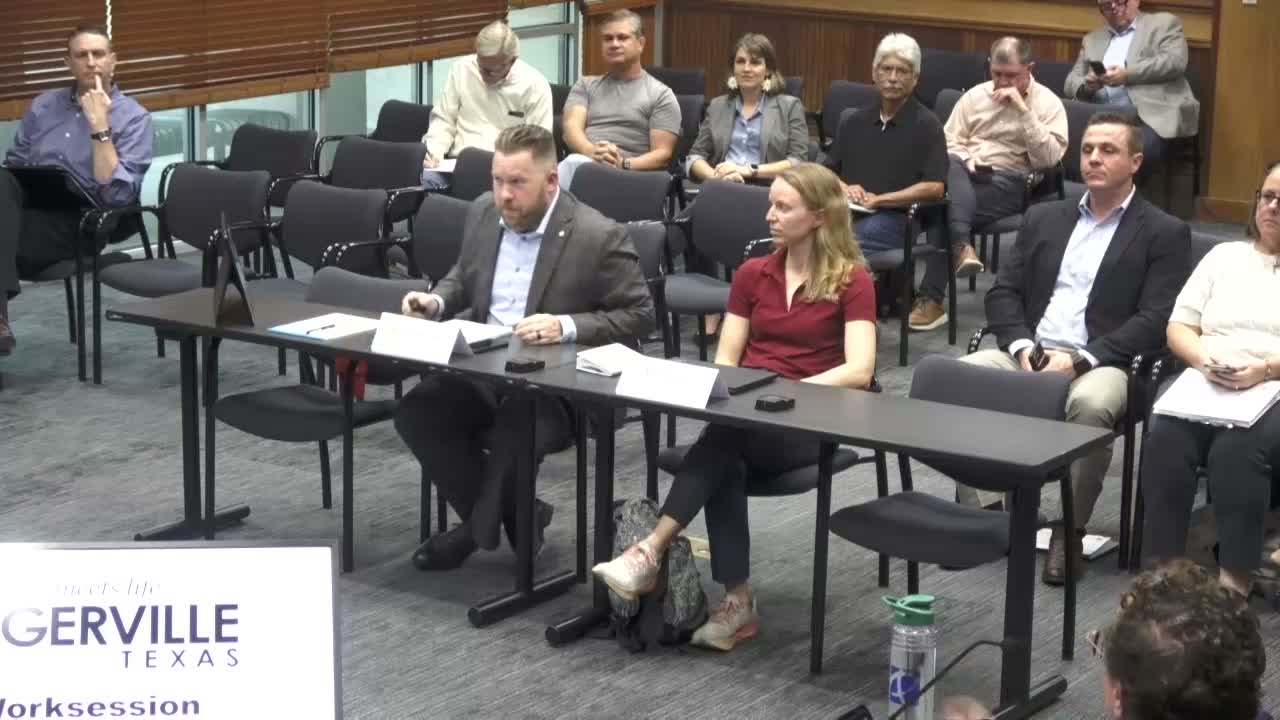
Pflugerville city staff told the council at a Nov. 25 work session that the city is moving forward with major water and wastewater upgrades, including an expansion of the water treatment plant and construction of a secondary Colorado River raw-water line.
Brandon (presenter), who led the briefing, said the water master plan frames the utility’s priorities across 5-, 10- and build-out planning horizons and that recent capital work is intended both to address long-standing compliance issues and to increase capacity. “In 2019, it was 74 total,” Brandon said of the treatment-related violations the Texas Commission on Environmental Quality documented, a series of incidents that prompted a special performance evaluation and led staff to pursue both short-term fixes and longer-term plant upgrades.
Brandon explained the city previously operated as the retail operator for some areas served wholesale by Manville Water Supply Corporation; a 2017 change that brought those retail customers under the city’s CCN (Certificate of Convenience and Necessity) produced a visible jump in connection counts. He said some earlier counting of retail-only connections in places such as Blackhawk contributed to apparent anomalies in the historical connection data.
The presentation outlined technical changes at the treatment plant. Staff described replacing and upgrading membrane elements damaged by shellfish such as zebra mussels and adding a pretreatment basin to remove particles and reduce total organic carbon (TOC) levels before water reaches membranes and disinfection contact basins. “The pretreatment basin allows those kinds of things to not actually get to the membranes themselves,” Brandon said, describing enhanced coagulation and other pretreatment measures intended to reduce disinfection byproducts and equipment damage.
Brandon said the city used a TCEQ-approved Supplemental Environmental Project (SEP) as part of addressing violations, which funded asbestos and lead remediation at a house near Becker Farm Road as a community-benefit project instead of direct fines. He said including the violations in project funding information helped secure better funding treatment through Texas Water Development Board programs.
On the question of direct potable reuse (DPR), Brandon told councilors that DPR remains a future option but carries permitting and operational complexity. He estimated a best-case permitting window of roughly three to five years and said the city will weigh DPR against raw-water costs from the Lower Colorado River Authority (LCRA) and other ROI factors before proceeding.
On wastewater, staff said the central wastewater treatment plant’s prior permit (about 5.3 million gallons per day) was effectively expanded by recent construction and is permitted at 7.25 million gallons per day as of 2024. Brandon emphasized that wastewater planning uses a rolling 12-month average and that state rules require cities to begin design for an expansion when flows hit 75% of permitted capacity.
Councilors asked technical questions about growth projections, timing of capital work and options for interim projects such as force-main upgrades; staff responded that while projection differences can shift timing, the 2019 compliance issues and capacity constraints justified near-term expansion. Staff said both the water treatment expansion and the secondary Colorado River raw-water line remain on schedule for completion the next calendar year.
No formal actions or votes were taken at the session. The council offered thanks to Brandon for his service; he said this was his last council meeting.