Get Full Government Meeting Transcripts, Videos, & Alerts Forever!
Get email alerts on the Udc Update topic
No spam. Unsubscribe anytime.
Pflugerville advisory committee begins UDC update, prioritizing housing diversity, mixed use and better trail connectivity
Summary
Consultants from Friese & Nichols outlined a three-phase rewrite of Pflugerville's Unified Development Code, emphasizing middle housing, mixed-use corridors, parking and landscaping reforms; committee members urged incentives, faster interim actions and stronger trail and ADA design.
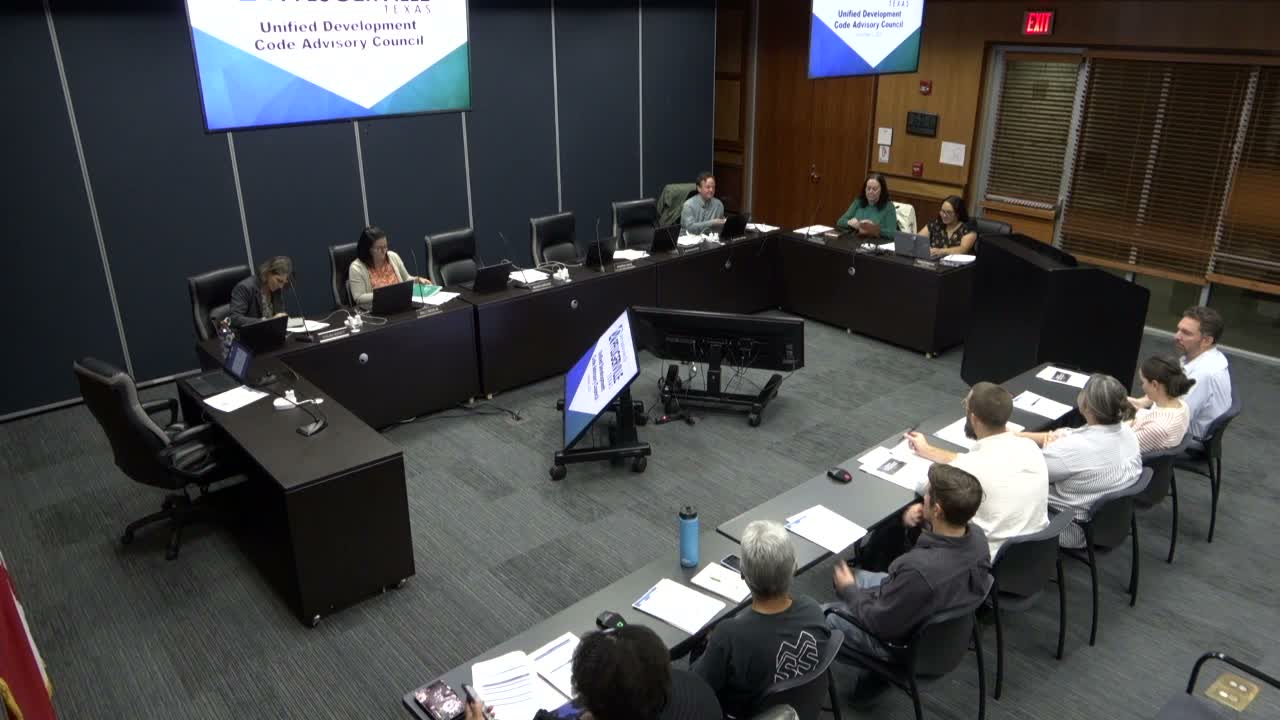
Pflugerville's advisory committee met with consultants from Friese & Nichols on March 2 to begin work updating the city's Unified Development Code (UDC). Chance Sparks, a principal at Friese & Nichols leading the project, described a three-phase process that will draft the code in modules, run targeted public engagement and move into a public-adoption phase with joint workshops and posted drafts.
Sparks told the committee the firm is drafting the UDC and the city's engineering criteria manual at the same time to avoid technical conflicts between standards. "If you're doing a development code and engineering manual at the same time, I will praise that every single opportunity I get in a public setting," Sparks said, calling the coordination "somewhat rare." He said the consultants will prioritize housing diversity ("middle housing"), mixed-use development, parking ratios, landscaping suited to changed growing-zone conditions and overall code usability.
Committee members responded with a range of recommendations. The Chair urged the team to create pathways to homeownership for younger residents and to disincentivize "build-to-rent" projects that do not lead to ownership, while also asking for fast-track approval options to signal market intent sooner. "We should send the market signals of what we're intending to change sooner than when it's ready," the Chair said, arguing that interim steps could encourage desirable projects now.
Other members recommended allowing manufactured and modular homes, smaller lot sizes and accessory dwelling units to improve affordability; reducing overly large landscaping requirements in some commercial zones; and rethinking minimum parking standards that developers find burdensome. Several members pressed for stronger trail connectivity and for trails to function as mobility corridors linked to businesses and downtown rather than mere recreational assets.
Accessibility also drew attention. A committee member contrasted bare ADA compliance with what they called "disability-affirming" design, urging code changes that make sidewalks, curb cuts and bike lanes genuinely usable for people with disabilities rather than only meeting minimum legal checks.
Members discussed incentives to offset high development costs, including potential fee discounts in exchange for parkland or trail connections. Committee members also asked the consultants and staff to produce more approachable, visual guidance or a "playbook" showing what acceptable development looks like in different zones to reduce back-and-forth during review.
Sparks said the next public milestone is a joint workshop with the city council on November 25 and that the consultants will identify places where a discrete, fast amendment could be triaged to staff to achieve early wins. No formal votes or motions occurred at the meeting. The committee closed after members thanked the consultants and were encouraged to send follow-up ideas to city staff.