Get Full Government Meeting Transcripts, Videos, & Alerts Forever!
Get email alerts on the Downtown Study topic
No spam. Unsubscribe anytime.
Consultants outline phased plan to 'energize' Pflugerville's historic downtown
Summary
Consultants presented a downtown study to Pflugerville city officials recommending near-, mid- and long-term actions — including an RFI for city-owned properties, streetscape and wayfinding investments, and a 10-year break-even benchmark for tenant negotiations — and staff said the plan will go to council on Oct. 28.
Consultants presented a phased strategy to 'energize' the historic core of Pflugerville, recommending immediate placemaking and accessibility work, a two- to six-year period of targeted tenanting or sales, and a six- to ten-year horizon for larger redevelopment.
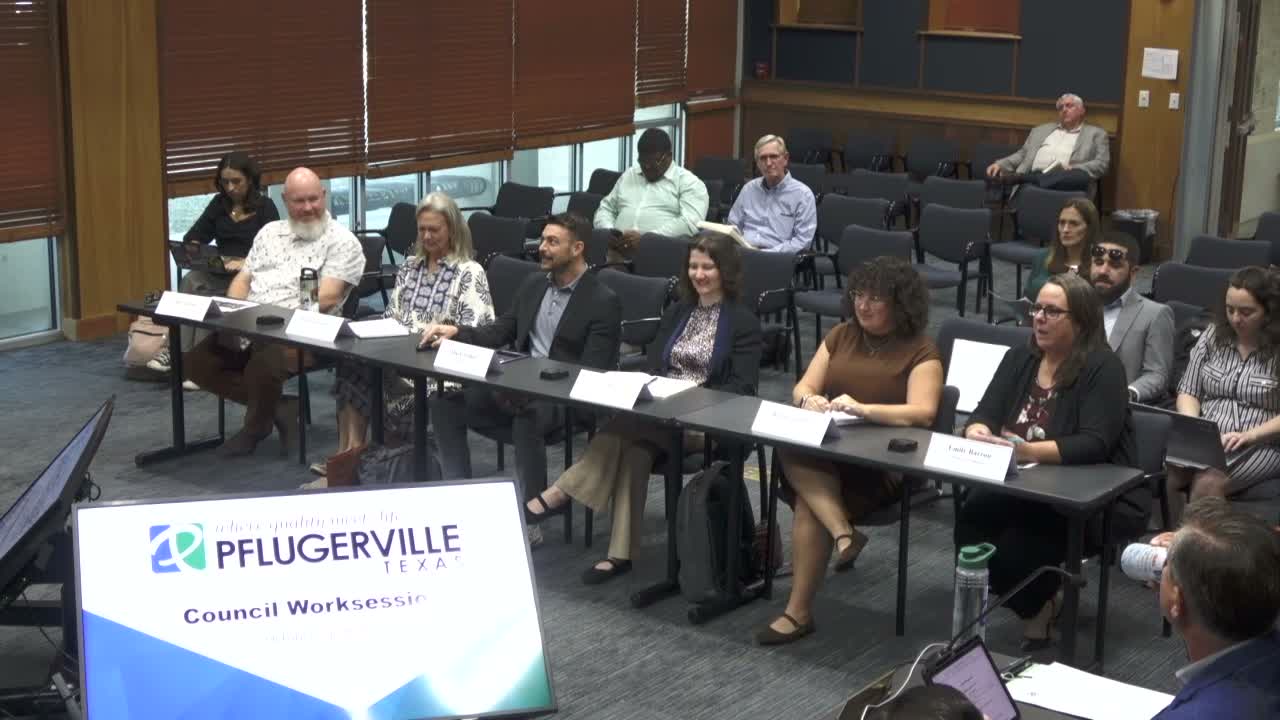
At a city work session, Mark Gilbert, a consultant on the project team, summarized the market analysis and said, “current rental rates for commercial uses do not support new construction” on several downtown parcels, so the team recommends adaptive reuse and incremental investments that build demand over time.
The study team — which the transcript names as Hyatt Brown, Jen Boston, Mark Gilbert, Molly Alexander and Dale Austin — framed its recommendations around three themes: leverage existing plans and assets, respond to current market forces and use incremental interventions to attract later investment. “We are offering today actionable recommendations with an incremental approach,” consultant Jen Boston said.
Key near-term recommendations include issuing a request for information (RFI) to gauge developer interest in city-owned spaces, prioritizing sidewalk, crosswalk and wayfinding improvements at Main & Railroad and Main & Pecan, expanding placemaking (public art, signage and events), and exploring activation of the 100 West Main surface parking lot as an outdoor plaza.
On city properties, the consultants listed City Hall at 100 East Main, the 100 West Main building (planning and development services) and 105 East Pecan as strategic assets. The team also presented 10- and 20-year break-even benchmarks intended to guide lease negotiations and tenant-improvement offers; they recommended the 10-year benchmark as a starting point for negotiations.
Councilmembers asked whether the city should act as landlord or sell properties. “I’m not a fan of the city being a landlord,” a council member objected during the discussion; consultants replied that an RFI can be used to solicit broad input and that government procurement allows the city to weigh factors beyond the highest bid, such as long-term fit for downtown.
The study also addressed retail strategy and youth-oriented businesses. Molly Alexander, who led the retail assessment, recommended clustering food, entertainment and personal services and said staff had solicited youth-advisory input: suggestions ranged from roller skating to thrift and entertainment venues. The consultants suggested connecting downtown to community anchors such as the Monarch recreation center and the library.
Funding questions centered on the hotel occupancy tax and PCDC (4B) economic-development dollars. Staff said the hotel tax currently funds public art and said 4B funds could be explored to support streetscape enhancements or small-business incentives; staff also indicated issuing an RFI would have minimal direct cost beyond public notices.
City staff closed by asking for feedback and said they will bring the downtown study and recommendations to the City Council for consideration and possible adoption at the Oct. 28 meeting. No formal vote or motion occurred at the work session.
The council recessed for a short break and deferred a later agenda item to after the regular session.