Lifetime Citizen Portal Access — AI Briefings, Alerts & Unlimited Follows
Pflugerville staff present $2.3 billion, five‑year CIP; council hears plan to drop $30 million debt issuance in FY26
Loading...
Summary
City staff walked council through a $2.3 billion five‑year Capital Improvement Plan, detailed transportation and drainage projects tied to the 2020 bond, and said updated programming removes a planned $30 million debt issuance for next year.
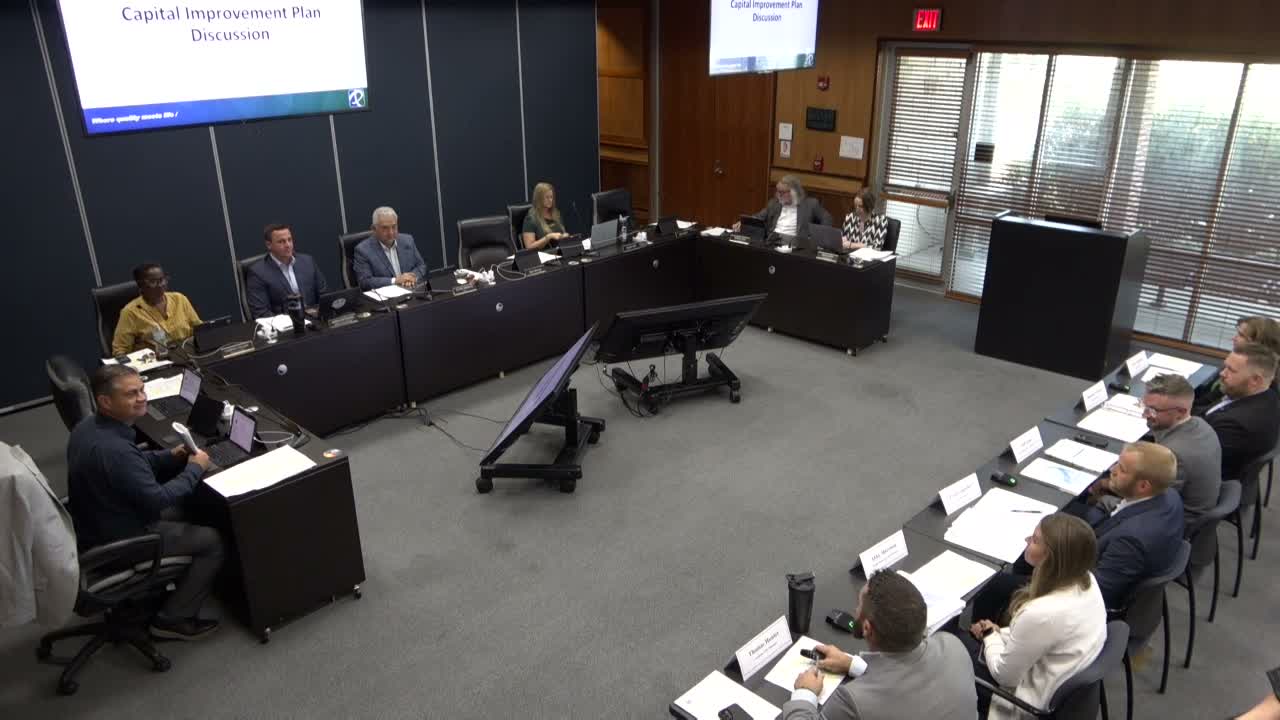
City staff on Tuesday presented the proposed five‑year Capital Improvement Plan (CIP) for Pflugerville, describing roughly $2.3 billion in programmed capital projects and a process that treats the CIP as a living, changeable document.
The presentation opened with an overview of the CIP’s scale and cadence, with the presenter noting the plan is refined annually and typically spans five years. “The capital improvement plan…typically spanning over a 5 year term,” the Presenter said, describing how master plans, service requests and development trends feed the program.
Staff highlighted the 2020 bond program as a major component of the five‑year plan but said many bond projects only became fundable in 2021 and were not fully designed or right‑of‑way ready when the bond passed. The Presenter said that distinction — whether a project is in design versus in construction — affects when funds are spent and when projects can be bid.
Transportation projects were singled out as a major element of the CIP. Staff summarized programmed roadway, intersection and signal projects, including ongoing signal retiming and the staging for Melber Lane, Kelly Lane phases and Piccadilly Drive work. For several projects staff gave anticipated bid or construction windows spanning 2026–2027. On the 685 corridor and frontage‑road work, staff said consultants have been selected and are scoping design, with targeted bid dates in 2027 for relief‑route projects.
Drainage funding emerged as a recurring question for council members. Staff explained the city currently has no dedicated drainage utility fee programmed for FY26 and that regional drainage projects had been left to the CIP and grants when the drainage utility idea was previously declined by council. “When the drainage utility was brought forward, there were a lot of pros and cons… the idea behind the drainage CIP right now is simply that we’re not planning to fund any of those projects,” the Presenter said, adding that staff will bring projects back to council if grant funding is secured.
Council members pressed staff on whether the drainage utility fee should be reconsidered; staff said it could be brought back for discussion and emphasized grant pursuit as the near‑term funding strategy. Staff also flagged that some CIP line‑items show future debt indicators (pink boxes) and recent changes (yellow highlights) to reflect program refinements.
On the budget side, a council member noted a planned $30 million debt issuance for the general‑fund CIP in FY26 and asked whether revisions could reduce that borrowing. A council member (speaker 10) thanked staff after they reported the figure had been removed from the FY26 plan: “I really appreciate you making that happen, and I really appreciate the ability to, remove $30,000,000 in debt issuance from this year budget.” Staff confirmed some debt will still be needed for the Public Works Complex, but overall the revisions reduce near‑term issuance and move certain construction costs into later years.
Why it matters: the CIP allocates scarce capital across transportation, parks, facilities and utilities while balancing grants, impact fees and debt. Council’s requests during the presentation — for pavement condition maps, clearer historical vs. projected spend lines, and updates reconciling the CIP to the budget book — are likely to shape final budget documents and the timing of bonding decisions.
Next steps: staff committed to providing requested backup (a list of streets included in the pavement program, PCI maps and detailed program lists), to bring grant‑dependent drainage projects back if funding arrives, and to return engineering and design agreements for several water, wastewater and road projects for council consideration later in the year.