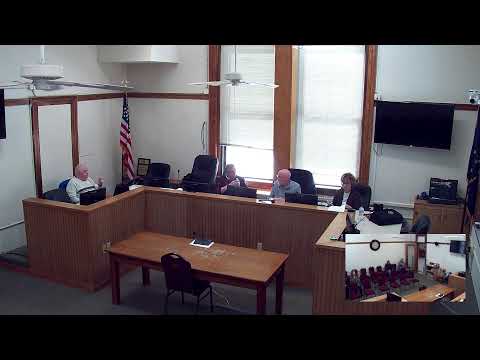
Owen County election board disqualifies one candidate for missing financial disclosure, orders audits for others
Loading...
Summary
At a Feb. 25, 2026 continuation of candidate‑challenge hearings, the Owen County Election Board disqualified Dustin White for failing to submit a required CAN‑12 disclosure, kept multiple other challenged candidates on the primary ballot, and ordered follow‑up audits and hearings for campaign finance reports.
The Owen County Election Board on Feb. 25, 2026 upheld a challenge that disqualified Dustin “Dusty” White from the May primary ballot because he did not submit the required CAN‑12 financial disclosure with his CAN‑2 candidacy form, while denying removal challenges for several other candidates and ordering separate audits into campaign finance filings.
Chairman Tony Volker opened the continuation of a hearing that began the previous day by summarizing legal guidance and procedural limits. “He did not submit a CAN‑12 with the CAN‑2,” Volker said, and that omission, he told fellow board members, “disqualifies him from the primary ballot.” Board counsel Richard Lorenz had earlier described the testimony and filings as pointing to “systemic” problems with how candidates complete forms and advised the board that some technical errors can be remedied through separate proceedings.
Why it matters: The board’s rulings determine who may appear on the county’s primary ballot and whether campaign finance reporting errors result in later civil penalties. The board said errors that affect only campaign finance reports (CFA forms) generally require separate hearings and potential fines, while missing mandatory CAN‑12 disclosures are disqualifying under state law.
Key outcomes and votes at a glance: Volker moved to uphold the challenge against Dustin White and disqualify him from the primary ballot for failing to include a CAN‑12; the board approved the motion and Volker said the candidate retains remedies, including a party caucus (the party has until July 3 to fill an open ballot position) or running as an independent. The board similarly found Walter Newman and William Fulk ineligible for the GOP primary ballot because they failed to meet the statutory requirement of voting in the prior two primaries. By contrast, the board denied challenges and allowed Sandra Calvert, Sam Hobbs, Amy Meyer, Laurie Warner, Norman Warner and Nicholas Pisenica to remain on the ballot, though several were slated for follow‑up CFA audits or hearings.
On campaign finance issues, members stressed a distinction between defective (fixable) and delinquent (potentially penalized) filings. For example, the board concluded Sam Hobbs had signed his CAN‑2 under oath but that several CFA filings appeared defective or incomplete; the board denied removal for now and ordered that Hobbs be included in an audit and a future hearing that could determine civil penalties. The board took a similar approach with Amy Meyer, noting her CAN‑2 was signed under oath but that CFA‑related irregularities raised in testimony warrant inclusion in the audit process.
Several votes were decided after board discussion of record stamps, clerk signatures and candidate testimony. In the case of Sandra Calvert, the board found a missing name entry on a portion of the CAN‑2 was a harmless error because the candidate had sworn under oath and the clerk’s file stamps showed intent to file. Clerk Diane Stutzman repeatedly warned that missing signatures or unchecked boxes are concerning and said clerks and candidates need to do more to avoid these problems.
Board counsel Richard Lorenz said the evidence presented showed many of the challenges were technically correct but that the board must apply the law to determine whether the deficiency is disqualifying, fixable or requires a separate enforcement action. He told members he had prepared a consolidated findings document for signatures; the board recessed, confirmed the printed order matched the recorded votes, and signed the findings.
What’s next: The board ordered staff to notify affected candidates, to publish notices about forthcoming CFA audit hearings for those candidates with alleged finance deficiencies, and to pursue training and process improvements aimed at reducing form errors. Volker and other members said they would work with local party leaders and the clerk’s office to improve candidate guidance.
Representative quotes:
• Tony Volker, chairman: “He did not submit a CAN‑12 with the CAN‑2 … For that reason, in my estimation … that disqualifies him from the primary ballot.”
• Richard Lorenz, board counsel: “Some of these challenges are technically correct … the question becomes then, what is the remedy that is evolved?”
• Frank Coffin, board member: “Error is not fraud. Error is error. Sometimes it can be fixed.”
• Diane Stutzman, county clerk: “The candidates really need to educate themselves on what they need to do. There are booklets out there.”
The board recessed to allow members to review and sign the consolidated findings document, and it directed the clerk’s office to distribute copies of the final orders to candidates and to schedule the follow‑up CFA audit hearings.