Get Full Government Meeting Transcripts, Videos, & Alerts Forever!
Get email alerts on the Property Insurance Study topic
No spam. Unsubscribe anytime.
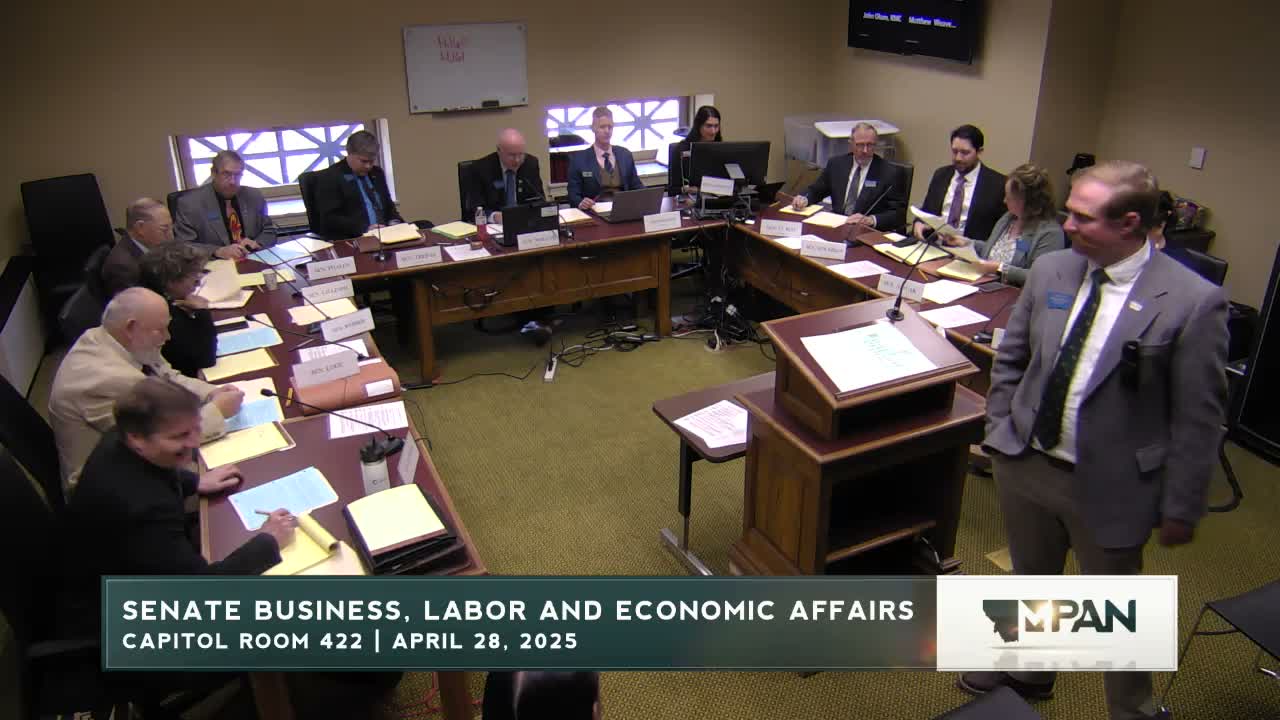
Committee approves study of property insurance amid steep premium increases and wildfire concerns
Summary
The Senate Business and Labor Committee concurred on HJR61 to form an interim study of Montana’s property insurance market, prompted by testimony citing a roughly 44% premium increase, tightened reinsurance markets and insurers pulling back from high‑wildfire areas.
Representative Josh Seckinger opened on House Joint Resolution 61, which would launch an interim study into Montana’s property insurance market and the causes of rising premiums.
Seckinger described what he called “escrow creep” and said homeowners’ premiums have increased roughly 44% over five years while coverage has shrunk in high‑wildfire areas; he said HJR61 is bipartisan and supported by the insurance commissioner’s office.
A series of industry and consumer witnesses backed the study. Frank Cote, representing the commissioner of securities and insurance, urged the legislature to avoid rushed fixes and to use the interim period to gather expert input. John Iverson of the Independent Insurance Agents of Montana called the market “hardening” and said Montana should study what can be done locally.
Bruce Spencer of the National Association of Mutual Insurance Carriers described reinsurance tightening and higher reinsurance costs — a national trend that he said raises premiums even where local fire risk is low. “That is making insurers who write property casualty insurance in Montana raise their premiums because they can’t get the insurance they need,” Spencer said, adding that reinsurance market pressures can cause carriers to limit risk or stop writing in certain areas.
Industry representatives (APCIA) and consumer advocates (Consumer Federation of America) told the committee Montana lacks up‑to‑date, granular market data; Michael DeLong (Consumer Federation) said available datasets are limited and often aggregated, and he urged an independent study to analyze drivers, coverage gaps and possible remedies.
Patrick Kawaki said tribal homeowners in forested areas face particular access and affordability challenges, urging the study to account for tribal data and rural access issues.
Senators pressed witnesses on whether insurers track losses regionally, how wildfire mitigation and home construction materials affect rates, and whether the commissioner’s office reviews carrier charters or rate filings. Frank Cote said the office reviews rate filings and loss ratios and can require carriers to change rates that are inadequate, excessive or unfairly discriminatory, but that available public data are often aggregated at the state level rather than by region.
Seckinger closed by stressing that while the study may find limits to what the state can do (for example, reinsurers operate globally), policymakers need better information to determine possible responses.
In executive action the committee moved to concur on HJR61; the motion passed and the resolution will be carried to the floor.