Get Full Government Meeting Transcripts, Videos, & Alerts Forever!
Get email alerts on the Prescriptive Authority topic
No spam. Unsubscribe anytime.
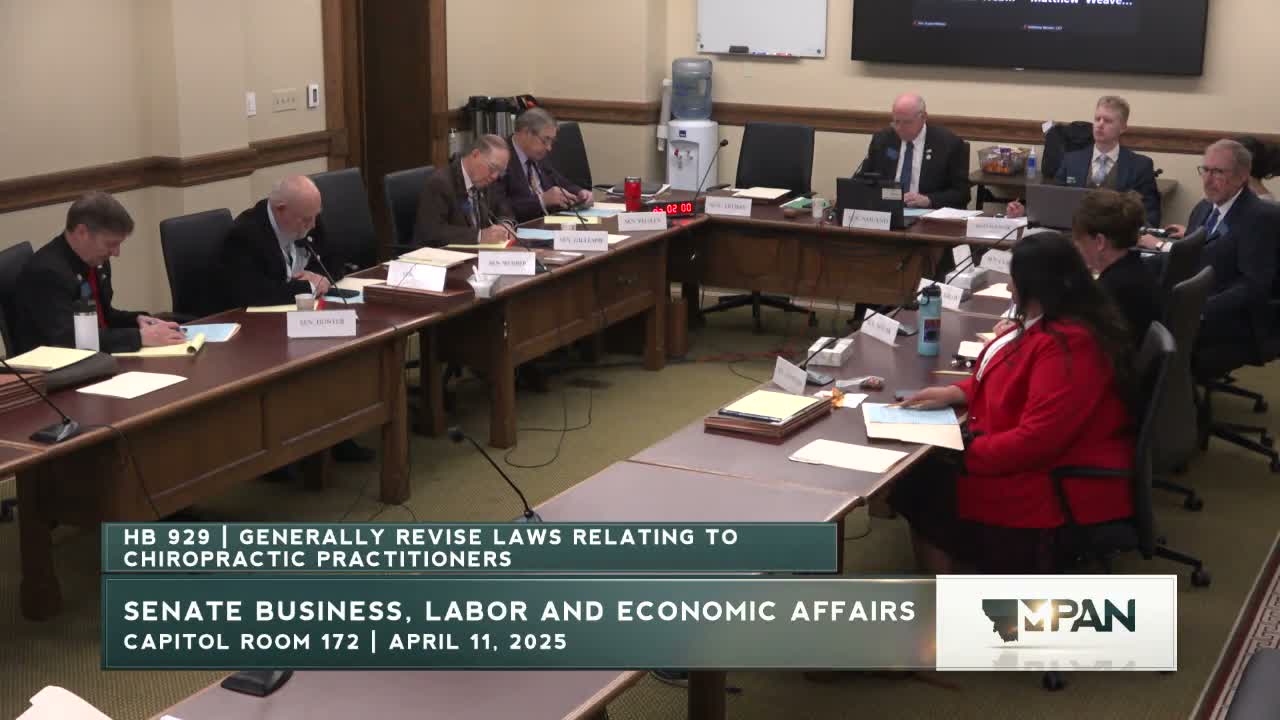
Heated testimony in Montana hearing over bill to give chiropractors limited prescriptive authority
Summary
Representative Greg Oblander's House Bill 929 would create an optional endorsement for chiropractors to prescribe a narrow formulary of noncontrolled, non‑scheduled drugs for musculoskeletal conditions. Proponents argued it would improve rural access and reduce delays; a large group of chiropractors, malpractice insurers and the Montana Medical Association opposed the bill over training, oversight and malpractice concerns. The committee did not take a final vote.
Representative Greg Oblander opened House Bill 929 by asking the Senate Business, Labor and Economic Affairs Committee to authorize a voluntary license endorsement giving chiropractors limited prescriptive authority for noncontrolled, non‑scheduled medicines for musculoskeletal conditions.
"This is a choice," Oblander said. "Nobody has to do anything of whether to apply for an endorsement to prescribe, and it is an option that will be left to each individual." He said the endorsement would be coupled with board rulemaking to set education, clinical training and oversight.
Proponents said the change would shorten waits and keep care local. Dr. Ryan Oblander, vice president of the Montana Chiropractic Association, told senators that limited prescribing would be used in fewer than 5% of visits and help avoid delays that can increase opioid prescriptions. "Expanding our prescription rights isn't about us," he said. "It's about them." Several proponents described rural access problems and urged strict education and monitoring requirements.
Opponents were numerous and emphatic. Austin Davis, a Montana chiropractor testifying in opposition, said the bill "poses significant risks to patient safety, professional standards, and the accessibility of care across the state," arguing that the measure would "blur important lines of medical responsibility." Multiple practitioners said they had not been consulted and that passage could raise malpractice premiums and force some small rural practices to close.
The Montana Medical Association's CEO, Jean Branscum, told the committee the MMA opposed the bill on patient safety grounds and criticized the lack of explicit physician or pharmacist oversight in the draft language.
Malpractice and insurance concerns were highlighted by witnesses with industry experience. Dr. Stu Hoffman, president of a malpractice carrier, testified in opposition and said his company's policy would not cover drugs prescribed within chiropractic practice: "Our insurance policy will not cover drugs within the chiropractic practice. Period."
Department of Labor and Industry officials described the rulemaking and fiscal implications. Commissioner Sarah Swanson said the board of chiropractors would lead rulemaking with departmental oversight and that initial rulemaking and IT implementation costs were estimated in the fiscal notes; she described a robust rulemaking process with opportunity for interested parties to participate.
Committee members questioned how many education hours would be required, how oversight would be structured and whether the board composition should change; those specifics were left to rulemaking if the bill advances.
Representative Oblander closed by asking for a "do pass." The committee concluded the hearing without taking a final vote during the session.