Get Full Government Meeting Transcripts, Videos, & Alerts Forever!
Get email alerts on the Water Management topic
No spam. Unsubscribe anytime.
Hunters Lake residents urge action as dense vegetation and low water limit navigation
Summary
Dozens of Hunters Lake residents told commissioners the lake’s vegetation and low water are constraining recreation and wildlife; staff cited recent assessments (FWC site work, DEP LVI score of 54) and proposed options including mechanical maintenance, grass carp, targeted dredging and grant seeking. The board directed staff to bring forward proposals and public engagement plans.
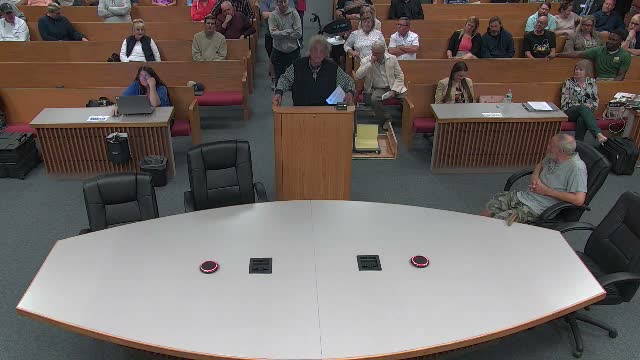
A large group of Hunters Lake residents pressed Hernando County commissioners on Nov. 18 about the lake’s condition, saying dense aquatic vegetation and chronically low water levels have made navigation, fishing and wildlife habitat difficult.
Residents described shoreline and channel blockage, lost recreational access and reduced water depth. "It used to be a lake; now it’s completely covered with weeds," Douglas Burns, who has lived on Hunters Lake for 16 years, told the board. Several speakers asked for regular maintenance, dredging of navigation channels and a long‑term funding plan.
County Natural Resources Manager Carla Berman summarized multi‑agency assessments and early results. "The LVI from the Department of Environmental Protection came back at a 54," she told commissioners, referring to the Lake Vegetation Index that DEP uses to evaluate plant communities and habitat. Berman said DEP flagged Hunters Lake as an "atypical lake" in the region with strong aquatic plant communities and overall good water clarity in littoral shelf areas; she noted that management interventions would likely be maintenance‑level actions, not ecological restoration.
The Florida Fish and Wildlife Conservation Commission (FWC) performed field surveys and identified native macrophytes and areas of navigation concern; county staff said FWC has performed targeted shredding work in portions of the lake as a habitat restoration project and the county followed to remove floating vegetation where feasible. Staff also said the county’s harvester is effective for floating invasive mats but is not a tussock harvester and requires sufficient water depth to operate.
Commissioners and staff discussed management options raised by residents and experts: permitting and possibly stocking grass carp (FWC permits required and species considerations apply), targeted mechanical removal in channels, maintenance dredging to improve access, and grant applications to FWC and DEP for funding. Several commissioners suggested exploring a local maintenance assessment tool such as an MSBU or fee for properties that directly benefit from recurrent lake maintenance.
The board directed county staff to continue coordination with state agencies, produce a plan for potential maintenance and funding options, and schedule public outreach (workshops or port‑authority meetings) to gather resident input and present technical findings.
Residents asked the board to accelerate action and return with a scheduled plan and funding options. Staff said more detailed water‑quality data and a DEP water‑quality report are pending and will inform which measures are recommended.